
Where Is Our Salary? The Silent Cry of Contract Teachers
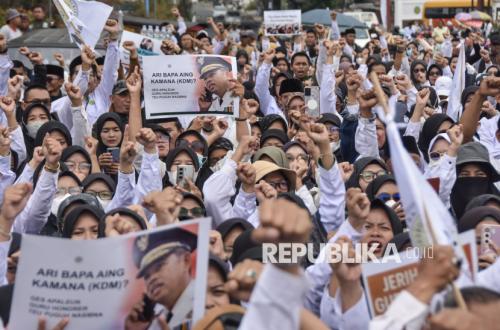
In the modest corners of teachers’ rooms, on cracked school grounds, and on the streets of the capital during repeated demonstrations, one question keeps being raised: where is our salary? This question is not a complaint, nor merely a demand, but a reflection of a long-standing failure in how this nation values those who safeguard Indonesia’s future every day.
When a contract teacher is paid just three hundred thousand rupiah a month after fifteen years of service, we are not talking about an administrative staffing issue. We are talking about the conscience of the state.
Data shows that around half of all teachers in Indonesia hold non-civil servant status, with the majority living below the regional minimum wage. Some of them even have to take side jobs as online motorbike drivers, shopkeepers, or street vendors after teaching hours. This irony becomes even more bitter when we realise that the quality of Indonesia’s children is entrusted to their hands, and the nation’s aspirations are taught from their mouths every morning.
Unfulfilled Promises
Every government begins its term with promises to improve teachers’ fortunes. Incentive assistance, professional allowances, mass appointments, and the PPPK recruitment programme are touted as solutions. However, in practice, these promises often stall at the administrative stage.
Many teachers who have passed selections must wait years to receive their appointment letters. Many more who already hold PPPK status still have not received their full monthly income due to local budget transfer issues.
Abraham Maslow’s hierarchy of needs theory reminds us that basic human needs must be met before a person can achieve self-actualisation. A teacher who is still worrying about the price of rice tomorrow morning cannot be fully present in the classroom.
They will still teach, but the best part of them is left at home, with unpaid electricity bills and their own children who also need school fees. We cannot demand educational excellence from someone who is not even given the decency to live.
This is where the most fundamental policy failure lies. So far, we have treated teachers’ welfare as an act of charity, not an investment. Allowances are given as if they were gifts, not rights. Appointments are made as if concessions, not obligations. Yet, in countries with excellent education systems, teaching is a respected profession on par with doctors and engineers, with incomes that reflect that respect.
The Cost of Neglect
Linda Darling-Hammond in The Flat World and Education shows that the quality of a country’s education system will never exceed the quality of its teachers. And the quality of teachers, in turn, will never exceed the quality of life provided to them. There is a direct link between teachers’ welfare and the future of their students, even if that link is often hard to see in the short term.
When a teacher is forced to teach half-heartedly because their energy is drained by a second job, the real loss is not felt that day. It will be felt five years later, when students who should grow critical instead grow apathetic. It will be felt ten years later, when school graduates lack competitiveness in the job market. It will be felt twenty years later, when a generation that was never taught wholeheartedly must lead this nation without sufficient depth.
We often calculate education budgets as fiscal burdens, when they are actually savings for civilisation. Every rupiah we do not pay to teachers today will cost us many times over in the future, in the form of lagging human resources quality, stagnant productivity, and innovations that never emerge. Neglecting teachers is not savings, but delaying losses.
Urgent Steps
Solutions to this problem require political courage, not just technocratic intelligence. First, the central and local governments need to agree on a uniform teacher salary scheme at least equivalent to the regional minimum wage, with transfer mechanisms that cannot be delayed by local bureaucracy.
Second, the appointment of PPPK candidates who have passed selections must be completed thoroughly, not piecemeal based on annual fiscal quotas.
Third, legal protections for contract teachers need to be strengthened so they are no longer in a weak bargaining position against foundations or school principals.
Fourth, and most fundamentally, we need to change our perspective. Teachers are not costs to be cut, but investments to be nurtured. The constitutionally mandated 20 per cent education budget will lose its meaning if the largest portion does not reach teachers’ hands, but is spent on more visible but less impactful programmes. Teachers’ welfare must be the top priority, not budget leftovers.
In the end, the question ‘where is our salary’ raised by teachers is not a small question. It is a question directed at the entire nation: do we truly value education, or are we just good at speechifying about it.
Every day that question goes unanswered, a classroom loses a little energy, a student loses a little hope, and Indonesia’s future is gradually eroded. Answering that question is not about budgetary capacity, but about commitment. And commitment, ultimately, is the true measure of a nation’s civilisation.