
When will humanoid robots go mainstream? Between 2 and 10 years, Chinese industry players say
When will humanoid robots go mainstream? Between 2 and 10 years, Chinese industry players say
During a panel discussion at the Boao Forum for Asia on Wednesday (Mar 25), experts also cited Singapore as a model for emerging artificial intelligence governance.
BOAO, Hainan: Imagine humanoid robots as commonplace as household appliances - chopping vegetables, folding laundry and mopping the floor without needing instructions.
Yet when this vision will become reality remains uncertain, with Chinese industry leaders at the Boao Forum for Asia saying on Wednesday (Mar 25) that a ChatGPT moment - a breakthrough to mass adoption - could take anywhere from two years to a decade.
In a panel on the development and breakthroughs of humanoid robotics, they also highlighted key challenges, including improving reliability and enabling robots to operate safely and seamlessly in complex, real-world environments.
When asked how long before a ChatGPT moment emerges, Wang Xiaogang, chairman of Daxiao Robotics and co-founder and executive director of SenseTime, a leading Chinese artificial intelligence (AI) firm specialising in facial and image-recognition technology, said it could come in as little as two years.
“We need to scale data to a much higher level, and with world models and simulation, we can accelerate that process,” he said, referring to systems that simulate and predict real-world environments rather than simply react to data.
Shao Hao, chief expert at Chinese smartphone maker Vivo’s robotics lab, was more cautious, saying a comparable breakthrough could take closer to a decade. He cited challenges in scaling the large, low-cost data needed to train humanoid robots for real-world tasks.
They and other panellists said progress is unlikely to follow a single breakthrough moment, but instead develop gradually across different industries.
The discussion at the Boao Forum for Asia comes as China ramps up support for “embodied intelligence”, AI that operates in the physical world through machines such as robots and drones.
During China’s recently concluded annual political meetings dubbed the Two Sessions, the term was identified as a future industry alongside areas such as quantum technology, brain-computer interfaces and 6G.
FROM SHOWCASE TO REAL-WORLD USE
Across the United States, Europe and China, companies and governments have been stepping up efforts to develop humanoid robots as part of the next wave of AI.
In China, humanoid robots have drawn public attention through high-profile appearances. They notably featured at this year’s Spring Festival Gala, showcasing acrobatics and kung fu.
While such demonstrations highlight progress, large-scale deployment remains some distance away, panellists said on Wednesday, noting that much of the technology is still being demonstrated in controlled environments.
“Many of these behaviours are not pre-defined, they are learned from humans and are becoming increasingly natural,” said Wang from Daxiao Robotics.
The panellists pointed to scaling as a major bottleneck, citing the difficulty of obtaining large amounts of affordable training data, meeting industrial-grade reliability standards and enabling robots to operate consistently across a wide range of real-world environments.
Shen Dou, the executive vice president of Baidu, a leading Chinese internet services and AI company, said the robots’ physical capabilities still need improvement.
“Currently, stability, durability and dexterity of the robot body still face relatively large challenges,” he said.
“There is still a long way to go before we reach an ‘iPhone moment’ for humanoid robots,” he added, referring to a breakthrough that brings the technology into widespread, everyday use.
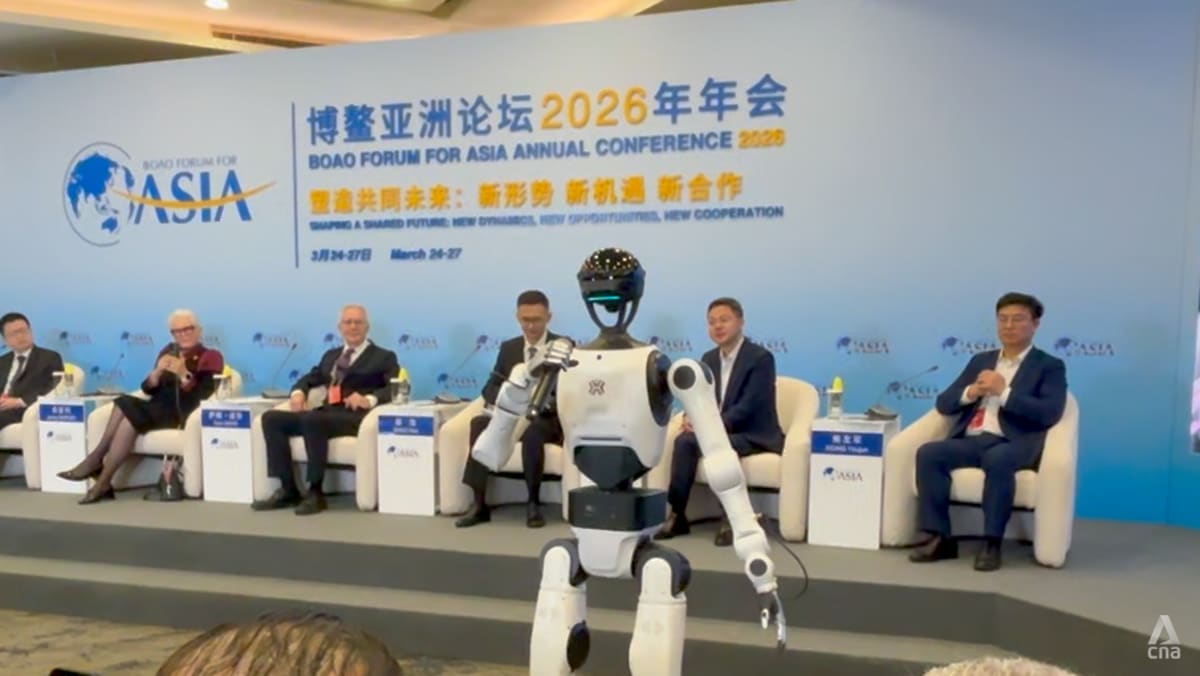
The issue of gaining public trust in the technology was also raised at the panel - with a humanoid robot taking charge.
A humanoid robot from the Beijing Humanoid Robot Innovation Centre posed a question to former New Zealand Prime Minister Jenny Shipley, who was one of the panel participants.
“Madam Shipley, I’d like to ask you one question … as a robot that genuinely wants to serve humanity, what should we do to earn the trust of ordinary people?” it asked.
In response, Shipley said trust would depend on reliability, clear boundaries and an understanding of human needs.
“I expect you as a robot to convince me that you are reliable, adaptable and responsible,” she said.
“I’m looking to you with confidence for functional support, but I want my humanity to be able to reserve the space in a respectful way.”
She added that robots should not overstep into areas such as emotional judgment.
“I don’t expect you to comfort me … I don’t think that is your responsibility,” she said.
WHO’S RESPONSIBLE?
Focus also fell on responsibility and governance.
Sam Daws, senior adviser at the Oxford Martin AI Governance Initiative, said policymakers must balance innovation with safeguards, including managing labour displacement, data use and safety risks.
He cited Singapore as one example of how governance frameworks are evolving.
“Singapore’s governance framework on agentic AI will be useful as we anticipate the effect of a million ‘lobsters’ beginning to interact in the world,” Daws said, referring to OpenClaw, the open-source AI agent that has taken China and much of the world by storm.
Singapore unveiled its Model AI Governance Framework for Agentic AI in January this year at the World Economic Forum in Davos, guiding organisations on deploying AI agents safely, with a focus on risk management, human oversight and accountability.
“We mustn’t forget that we also need to enable human flourishing as well as efficiency,” Daws said.
Speaking to CNA after the panel, Daws said Singapore has emerged as a “real leader” in AI governance, pointing to initiatives such as AI Verify and work on data centre sustainability.
He added that Singapore could play a broader role in shaping global rules through platforms such as the Digital Forum of Small States, a S