
When Water No Longer Has a Place
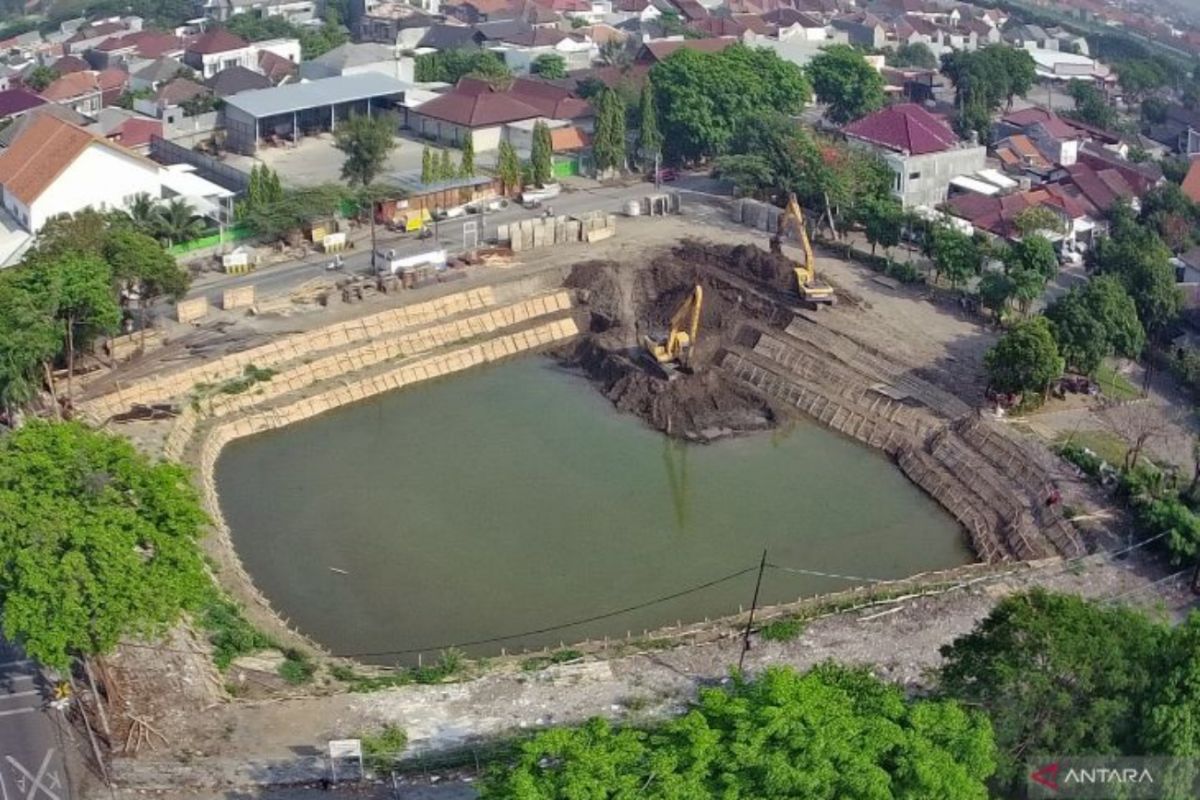
Bozem may not completely eliminate flooding. Extreme rain can still overwhelm the system’s capacity. But bozem gives Surabaya a chance to reduce damage, slow down water, and keep the city breathing when rain falls.
Surabaya (ANTARA) - Rain in the city of Surabaya always arrives with two faces. On one side, it serves as a soothing marker of the season after the hot coastal air.
However, on the other side, rain also brings recurring anxiety. Streets turn into rivers, vehicles are stalled, residents’ homes are submerged, and the city’s rhythm seems paralysed in just hours.
Surabaya is no stranger to flooding. As a low-lying city at the downstream of major rivers and directly facing the sea, Surabaya indeed lives under pressure from water from many directions.
When rain falls alongside high tides, the city’s drainage system operates under heavy pressure. The problem becomes even more complicated because the growth of residential areas and urban concretisation continues to narrow infiltration spaces.
Amid this situation, bozem or artificial water storage sites are slowly becoming one of the new “key words” in Surabaya’s flood management landscape.
It is not just a water-holding pond, but part of the city’s strategy to buy time when rain falls too heavily. Water is held temporarily, its flow slowed, then gradually channelled to primary rivers or the sea through pump and channel systems.
Recently, attention to bozem has strengthened again after the Surabaya City Government accelerated the construction of Bozem Tanjungsari. Surabaya’s Mayor, Eri Cahyadi, even targets the Simorejo Sari area to be flood-free by November 2026.
That project is no small endeavour. Its storage capacity reaches around 20,000 cubic metres of water, with a flow system connected to Diversi Gunungsari and Bozem Dupak.
Interestingly, bozem construction is no longer viewed as a supplementary project. It is beginning to be positioned as the heart of urban flood control strategy. Surabaya seems to be realising that a modern city cannot rely solely on narrow drainage channels racing to dispose of water to the sea as quickly as possible. The city also needs space to hold water.
That awareness is important. Because for years, many cities in Indonesia have been trapped in the old logic of enlarging channels without providing storage space.
As a result, water is merely moved faster from one point to another. Flooding disappears in one area but appears in another lower area. Bozem attempts to break that cycle.