
When the World is in Turmoil, Tokyo Becomes Jakarta's Buffer
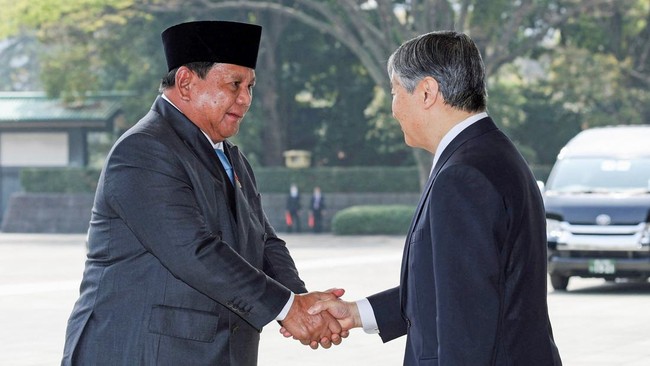
When the world is once again moving under the shadow of crisis, countries cannot merely strengthen their domestic foundations. They must also prepare anchors beyond their territorial borders.
It is in this context that President Prabowo Subianto’s visit to Japan at the invitation of Emperor Naruhito should be read not merely as diplomatic ceremony, but as a strategy to reinforce the national economic buffer amid the global storm.
Prabowo’s visit to Tokyo at the end of March 2026 took place at a highly pivotal moment. The world is facing escalating geopolitical tensions, disruptions to energy supply chains, and the renewed threat of global economic slowdown. In such situations, high-level diplomacy is no longer just the language of inter-state relations, but part of the national economic resilience strategy.
Symbolic Diplomacy, Strategic Interests
The direct invitation from the Japanese Emperor carries deep political and symbolic meaning. In international diplomatic protocol, an audience with a symbolic head of state like the Emperor is not merely a matter of courtesy, but an affirmation of recognition of Indonesia’s strategic position in the region.
Indonesia-Japan relations themselves have long historical roots. For over six decades, Japan has been one of Indonesia’s main partners in investment, trade, technology transfer, and development financing.
Most importantly, this visit produced tangible economic impacts. The Indonesia-Japan business forum accompanying the trip resulted in a number of business-to-business agreements with investment values reaching approximately US$22.6 billion. This figure is highly significant amid global pressures on international investment flows. The amount demonstrates that head-of-state diplomacy now serves as a concrete economic instrument, not merely a symbol of statehood.
Learning from the Tracks of Crises
The history of the global economy repeats in patterns that are almost similar. The 1973 oil crisis taught that geopolitical turmoil can directly strike the economic stability of countries with high dependence on imported energy. The 1997-1998 Asian crisis showed how quickly external pressures spread to exchange rates, the financial sector, and public purchasing power.
The global Covid-19 pandemic in 2020 reaffirmed that countries with strategic international networks recover faster than those going it alone. Today, the world faces a similar pattern.
Global tensions have increased risks of oil and gas price volatility, logistics disruptions, and fragmentation of international trade. Japan, as one of the world’s largest economies, needs certainty in energy and strategic mineral supplies. Indonesia, on the other hand, needs investment, technology transfer, and strengthening of the national downstreaming agenda. This is where the interests of both countries meet.
Historically, Prabowo’s step towards Japan reflects an anticipatory approach: building external anchors before global pressures penetrate deeper into the domestic economy.
Affirming Indonesia’s Position
This visit also affirms Indonesia’s position as a regional power that is increasingly taken into account. In a world architecture that is becoming more multipolar, Indonesia cannot merely be an observer. Free and active foreign policy must be translated into measured economic diplomacy that favours national interests. Amid threats of recession, energy volatility, and global uncertainty, the step to Tokyo is a message that Indonesia chooses to act earlier.
In the end, what distinguishes a sturdy nation from one that is shaken is not the size of the storm, but the acuity in reading the direction of history. And when the world is in turmoil, diplomacy becomes a nation’s first buffer.