
When Numbers Guide the City's Direction
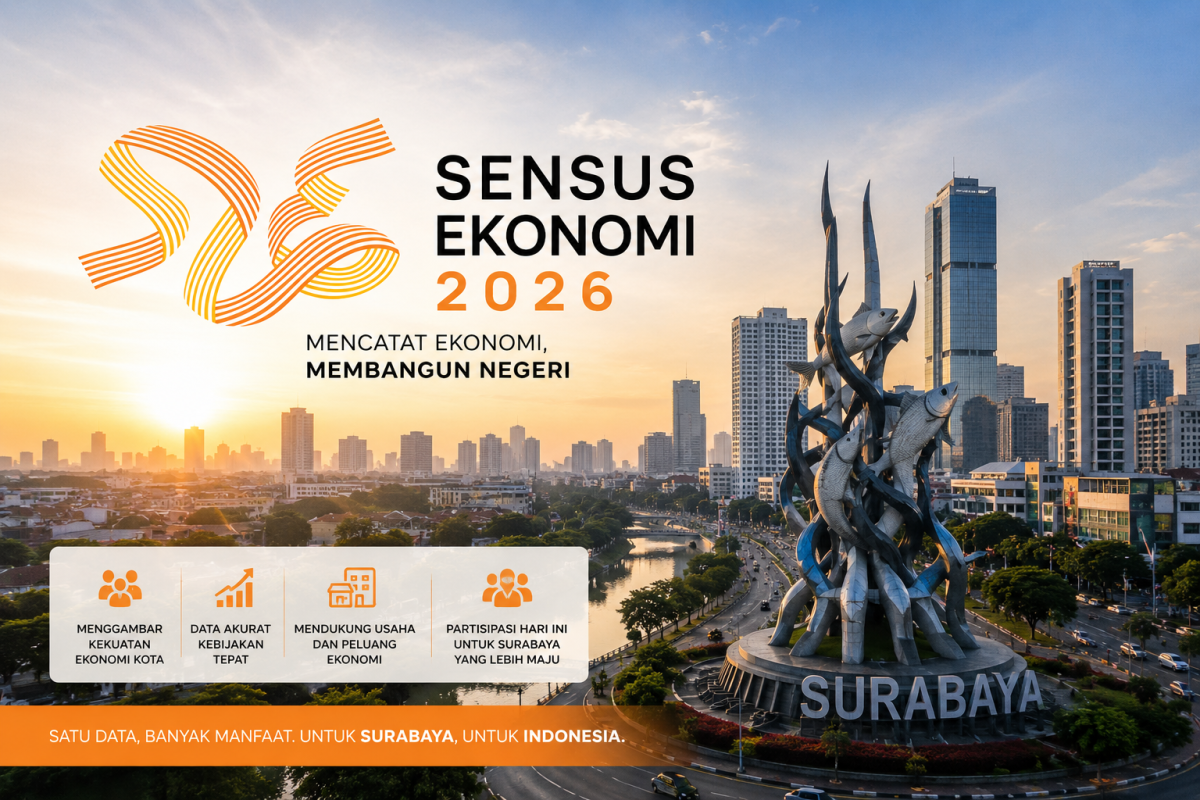
In a bustling corner of Surabaya’s trading district in East Java, which never truly quiets down, a small trader appears busy staring at his constantly lit mobile phone screen. Order notifications arrive in rapid succession, stock moves quickly in response to demand, while manual records in an old notebook are increasingly rarely touched. Customers who once came only from the nearby alley now reach beyond the city, even across regions, through digital screens. Amid this rapidly changing rhythm without pause, the Surabaya City Government (Pemkot) together with the Surabaya Central Statistics Agency (BPS) is preparing a major agenda that often goes unseen on the surface but truly determines the future direction of the economy: the 2026 Economic Census. Far from just a routine data collection activity, this census arrives at a time when Surabaya’s economic structure is in the midst of intense change. The digital economy is growing beyond old patterns, business models are shifting from physical to virtual, and the boundaries between formal and informal enterprises are becoming increasingly blurred. At this point, data is no longer merely an administrative record but a policy compass that determines a city’s steps amid ongoing changes. Dynamic Traces The 2026 Economic Census becomes an important momentum because it is held amid a major transformation in the urban economy. Surabaya, as one of the main economic centres in East Java, contributes around a quarter of the province’s economy. This means that every accuracy or error in data in this city will have a broad impact on the direction of regional development. The census implementation will run from 1 May to 31 July 2026, targeting around 415,000 non-agricultural business units. That number is not just an administrative figure but a representation of a highly diverse economic pulse, ranging from small traders in traditional markets, home-based industrial players, to large companies and rapidly growing digital startups. The deployment of around 1,900 field officers by BPS Surabaya demonstrates the scale of the task, which is no small feat. They will not only visit company offices but also homes that serve as business locations, digital workspaces without fixed addresses, and creative economy actors operating on online platforms. The main challenge is the change in economic behaviour itself. Many businesses now no longer take a physical form that is easy to identify. Food sellers can operate from home kitchens, graphic design services work across cities, and goods trading occurs entirely in digital spaces. In this context, the census does not just count but also reinterprets what is meant by “business”. This is where the 2026 Economic Census becomes crucial. It is not merely recording but an effort to reread the face of an increasingly fluid economy no longer bound by old boundaries. Business Structure Behind the census data lies a deeper question: how is Surabaya’s economic structure actually formed today, and where is it heading? Digital transformation is one of the strongest variables changing the business landscape. The city government and BPS Surabaya openly acknowledge that most digital business actors have not yet been fully reached by conventional data collection methods. This creates gaps in the data that can imply inaccuracies in policy. When data is incomplete, policies risk not addressing the root problems. For example, business assistance programmes may not hit the right targets, job training may not match needs, or economic interventions may not reach sectors that are actually growing rapidly. On the other hand, the approach used in the 2026 Economic Census attempts to address this by incorporating broader variables, such as business identification numbers, business characteristics, number of workers, and financial aspects like revenue and assets. However, beyond that, the biggest challenge remains the participation of the business actors themselves.