
When Chinese New Year Meets Ramadan: Harmony That Strengthens the Nation's Spirit
JAKARTA — Red lanterns sway gently in the sky above Makassar, as though embracing Ramadan arriving simultaneously with Lunar New Year celebrations. Beneath that light, prayers and laughter meet. Remarkably, amid a world often troubled by differences, Indonesia celebrates its diversity in a manner that is both warm and stirring.
On Saturday evening (28 February), the Jappa Jokka Cap Go Meh Festival in Makassar became a platform where the light of tolerance shone brightly. Under the theme “Harmony in Light”, this celebration is not merely a cultural agenda of the Chinese community, but rather a meeting space across faith, ethnicity, and tradition. Ramadan and Imlek running simultaneously seem to signal that differences in this nation are not meant to divide, but to be celebrated together.
Prominent Islamic preacher Das’ad Latif was present in the crowd. With his characteristic communicative and humorous style, he conveyed a simple yet profound message: respecting and loving one another is part of faith.
“We are here not merely to enjoy the festival, but as proof of our love for our brothers and sisters,” he said. He emphasised that this celebration is a manifestation of respect for those “born as ethnic Chinese by God Almighty.”
The sermon was more than mere religious teaching; it was a bridge of the soul. Muslims and the Chinese community sat side by side, smiled, and even exchanged small gifts and red envelopes distributed by the preacher to the audience. The large religious gathering that evening felt both solemn and joyful. Ramadan teaches self-restraint, Cap Go Meh teaches togetherness; both converge in a single breath of harmony.
Similar echoes resonated in Jakarta. At the peak of the Harmoni Imlek Nusantara event, Deputy Minister for Creative Economy Irene Umar cited cultural synthesis as the “source code” of Indonesia. “This is Indonesia. We want to demonstrate that Indonesia is the world’s most inclusive nation because we are Indonesia, Bhinneka Tunggal Ika, different, but still united,” she said.
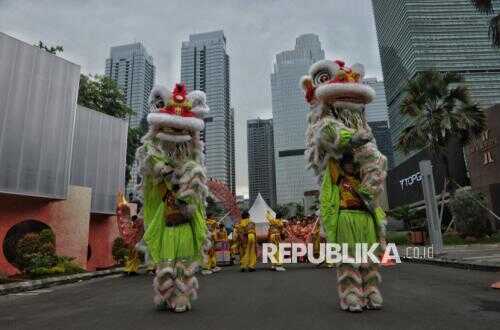
On that public stage, tai chi proceeded alongside martial arts, wing chun was presented alongside wushu. Lion dances performed beneath the sparkle of drone displays forming light symbols in the night sky. Interspersed with this, local product bazaars showcased the work of the nation’s people. Culture became not only identity but also an engine of economic growth, proving that tolerance can generate prosperity.
The Harmoni Imlek Nusantara celebrations took place across various cities—Palembang, Singkawang, Medan, Manado, Makassar, and Pontianak—binding the archipelago in a single unified celebration. In each city, lanterns bore witness that diversity is not merely a slogan but the pulse of life.
In Bogor, harmony took a different form. The Suryakencana area came alive once again with Cap Go Meh celebrations on 1–3 March 2026. The Cap Go Meh Festival organising committee chairman, Arifin Himawan, emphasised that all activities must provide tangible benefits for the people’s economy. The Pasar Malam Jadoel (Old Night Market) took place at dusk, whilst the main celebration occurred after evening prayers. A subtle arrangement—culture and worship proceeding side by side without negating each other.