
What Remains of the Grandeur of Kerta Palace
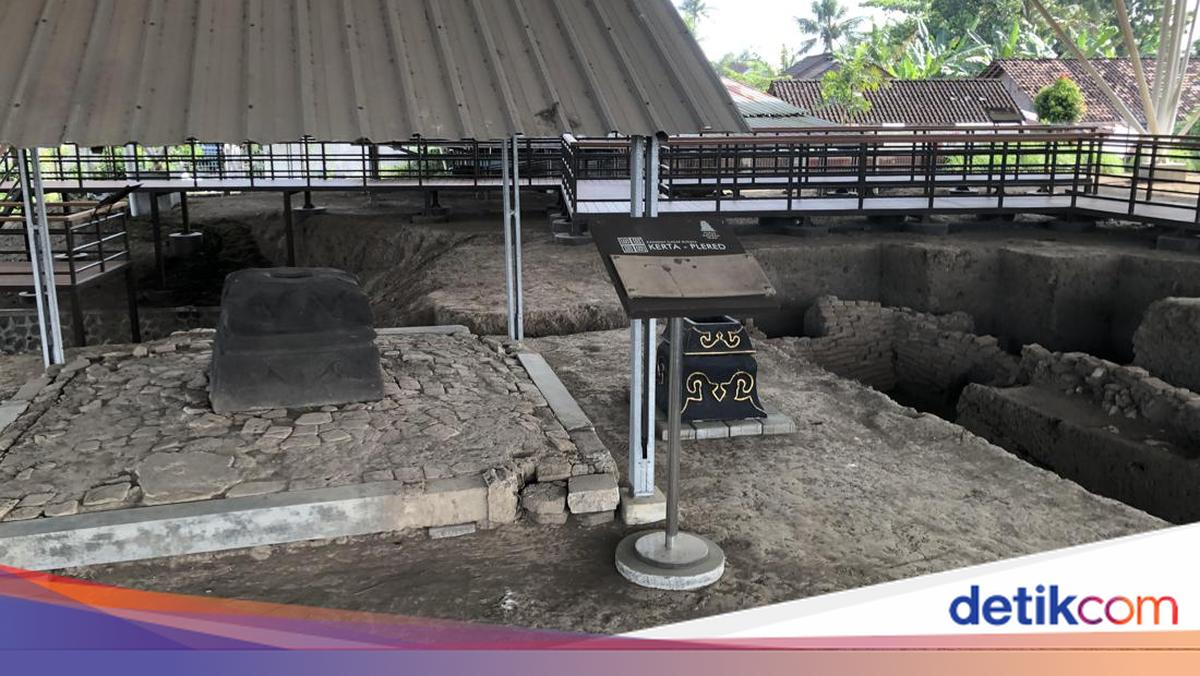
Kerta Palace was a royal palace of the Islamic Mataram kingdom dating from the era of Sultan Agung in the 17th century, now located within the hamlets of Kerto and Kanggotan in Pleret Village, Pleret District, Bantul. Fragments of its ruins can still be discovered at the Kerta Palace site in Pleret, Bantul.
Fahmi Prihantoro, an archaeologist and lecturer in archaeology at UGM (Universitas Gadjah Mada), stated that the ruins of what would become the Kerta Palace site were first discovered in 1889 by Dutch researcher G.P. Rouffaer. “G.P. Rouffaer created sketches depicting the existence of the Plered palace including Kerta,” Fahmi explained.
Observations at the Kerta site reveal a main excavation pit in the centre of the site with several smaller excavation pits surrounding it. The main pit is quite expansive, containing remnants of buildings constructed from large brick structures. Additionally, there are sizeable stones with material similar to temple stone, found in considerable quantities and varied shapes.
“The Centre for Archaeological Research conducted surveys and excavations in 1976 and 1978, discovering 3 foundation posts of Kerta Palace buildings,” Fahmi clarified. “They also discovered brick structures that formed part of the palace building’s structure. These foundation posts served as the base for the main support pillars of the principal building,” added the Head of UGM’s Department of Archaeology.
The Kerta site is also known as Lemah Dhuwur, believed to be the remains of the Sitiinggil of Kerta Palace. Sitiinggil, meaning elevated ground, refers to an artificially raised land area that constituted a component found in all palaces of the Islamic Mataram kingdom. This interpretation is supported by excavation findings revealing fragmented brick structures indicating embankments, steps, gates, and boundary walls, as well as stratigraphy showing elevated land surfaces.
“Previous research suggested the possibility that these findings were part of the Sitiinggil building of Kerta Palace, indicated by the discovery of exceptionally large foundation stones, even larger than those found in the current Yogyakarta Palace,” Fahmi explained. “Whilst the discovered ruins indicate parts of building structures, investigations as recently as 2025 have not yet revealed the actual form or layout of buildings from that era,” he added.
According to Fahmi, the ruins discovered so far are relatively comprehensive for a Sitiinggil palace structure. However, they represent only a small fraction of the complete Kerta Palace complex. “The ruins found thus far constitute only a small portion of the Kerta Palace complex, but as a Sitiinggil building site, the findings are substantial enough to assume the existence of a sitiinggil structure based on the discovery of support post foundations,” he explained.
Consequently, excavation of the Kerta site continues to this day. Fahmi noted that ruins of Kerta Palace likely extend beneath the homes of Pleret village residents. “Ongoing excavations aim to uncover further building sections. It is highly probable that Kerta Palace was quite extensive, with sections scattered across several areas surrounding the current Kerta Palace site,” he stated. “It remains quite possible that palace sections lie beneath the residential settlements, given that a palace typically contained several supporting buildings,” he concluded.