
What Did the Bakrie Group See to Be Willing to Take a Stake in BIPI Shares?
Shares of PT Astrindo Nusantara Infrastruktur Tbk (BIPI) have recorded a significant rally of 126.1% since the beginning of 2026. This attractive surge in share prices has drawn the attention of capital market players regarding the strategic manoeuvres of the energy company on the Indonesian stock exchange.
So, what are the main factors that the Bakrie Group saw, leading them to decide to take a stake in the company’s shares? The capital injection action by Bakrie Capital Indonesia worth Rp948 billion represents the initial step in integrating the national energy infrastructure supply chain.
This 6% minority ownership certainly does not provide absolute operational control. However, this portion serves as a strategic foundation to align the company’s business vision with the conglomerate’s grand plans for building an integrated green energy transition ecosystem in the future.
“Bakrie Capital Indonesia has decided to invest by purchasing BIPI shares at Rp248 on 24 February 2026, worth Rp948 billion (USD 56.35 million) or equivalent to a 6% share ownership portion,” wrote analysts from Samuel Sekuritas, Juan Harahap and Ahnaf Yassar, in their research cited on Wednesday, 25 March 2026.
Tactical Synergy of Shareholders
This strategic step is further strengthened by the presence of PT Indotambang Perkasa, which holds a 19.39% ownership stake. The business entity affiliated with Halim Jusuf also helps reinforce the company’s capital structure to smoothly execute all business expansion agendas without funding obstacles.
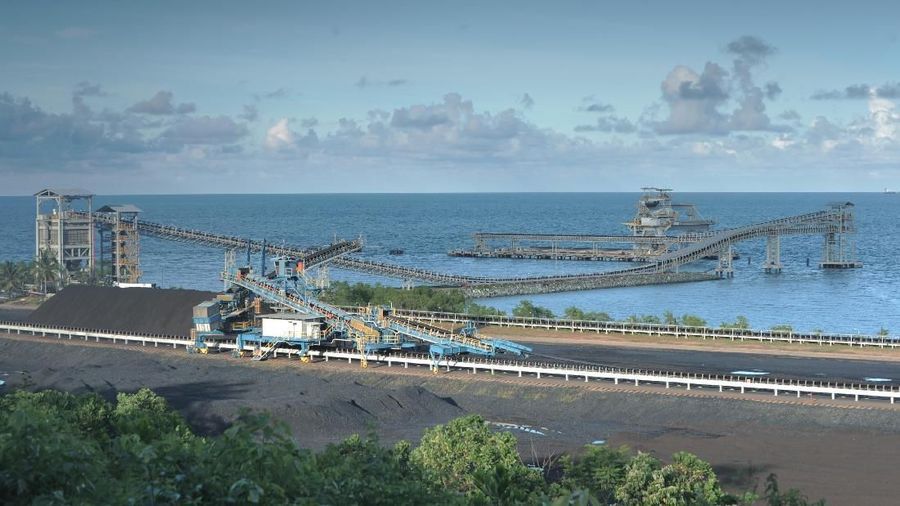
The consolidation of these two major business groups aims to secure various long-term sustainable logistics contracts. Through the availability of adequate port infrastructure and conveyor networks, BIPI is directed to become a facility providing main commodity flow services that mutually benefit affiliated companies.
The research report from Samuel Sekuritas analysts, Juan Harahap and Ahnaf Yassar, objectively dissects the potential of this corporate action. They assess that the entry of this new investment has the potential to trigger further fundraising agendas to accelerate the realisation of the issuer’s green infrastructure projects.
“Through the entry of a new prospective shareholder in BIPI, management positions itself to monetise its aggressive ‘transition’ phase from coal initiatives to clean energy. We see the upcoming capital injection announcement from BIPI as an upside risk potential (potential increase) as investment overhang issues in expansion initiatives fade,” it states.
Coal as a Transition Cash Engine
Company data shows that the coal sector dominates with 90% of revenue, while port leasing contributes 8.9%. This strategic synergy will optimise the high global commodity price cycle to achieve sustainable production volume targets, reaching up to 8 million tonnes in the future.
The rise in global energy prices due to geopolitical dynamics has a positive impact on the company’s financial liquidity. This sufficient operational cash flow will be allocated disciplinedly by management to fund the development of various green energy infrastructure portfolios going forward.
“Currently, BIPI remains dominant as a coal player benefiting from stronger energy prices amid the Iran war. We see a strong growth narrative based on volume, where management targets an annual production increase of around 1 million tonnes, to be accelerated to 8 million tonnes in the medium term,” it explains.
Aggressiveness in Natural Gas and Geothermal Expansion
Business expansion into the liquefied natural gas sector becomes the company’s focus plan. This plan starts with an initial capacity target of 2.5 mmscfd in the second half of 2026. This production capacity will then be increased to 20 mmscfd in 2027 to 2028.
The company is also preparing the construction of two large-scale liquefied natural gas facilities. The 50 mmscfd capacity plant will operate in Batam in 2029, followed by a similar facility in the Aceh region with a completion target in 2030 to 2031.
In addition to natural gas, the company is beginning to target active involvement in state infrastructure tender projects. Through a partnership scheme with Danantara, this issuer participates in the second-stage tender for the waste-to-energy processing project in the Yogyakarta region with a total capacity target of 1,500 tonnes.
Capturing Opportunities in the AI Era
The increasing national electricity needs to support data centre computing creates certainty of promising market prospects. The consolidation of the Bakrie Group and Danatama is expected to smooth the execution of the 150 MW geothermal power plant in Ponorogo, targeted to produce in 2031.
“Management argues that the push for renewable energy in the medium term will be supported by technological developments and capacity limitations, especially as additional electricity demand continues to accelerate with the development of artificial intelligence (AI) and data centres,” it clarifies.
The capital integration between majority and minority shareholders provides positive sentiment for the company’s long-term prospects. Market players are now closely monitoring how this infrastructure issuer realises its coal business transition programme to the environmentally friendly energy sector.
Risks related to debt burdens or global commodity price fluctuations remain correction factors that investors need to consider. However, the strategic capital support from major business groups provides a sufficiently strong foundation for the company in maintaining its share valuation in the future.