
WFP: 45 Million People at Risk of Hunger, Indonesia Has Rice Surplus
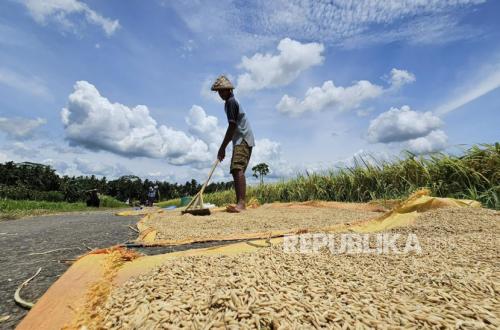
REPUBLIKA.CO.ID, JAKARTA – The threat of a global food crisis is once again haunting the world. The latest World Food Programme (WFP) report warns that the escalation of conflicts in the Middle East has the potential to drive a surge in the number of people worldwide experiencing acute hunger to record levels by 2026.
If the conflict persists and global energy prices remain high, nearly 45 million additional people are estimated to fall into conditions of acute food insecurity. This situation indicates that food resilience has now become a strategic global issue that determines the economic and social stability of a country.
In response to this condition, Agriculture Minister Andi Amran Sulaiman stressed that the world is indeed facing a serious food crisis threat, so every country must strengthen its food resilience and not depend on other countries.
“The world is facing a serious food crisis threat. Therefore, every country must strengthen its food resilience and must not depend on other countries,” said Minister Amran on Sunday (22/3/2026).
He explained that rising energy prices, disruptions to international shipping routes, and increasing logistics costs have the potential to trigger global food inflation, as occurred during the Russia-Ukraine war in 2022.
The impact of the conflict is not only felt in the war zones but also spreads worldwide through global supply chains. Countries that depend on food imports are the most vulnerable to price surges and supply shortages.
“If a global crisis occurs, especially geopolitical issues from Iran versus America and Israel, the safest are countries that can produce their own food. That’s why we must strengthen domestic production,” said Minister Amran.
Amid this global food crisis threat, Indonesia is instead seen to be on the right path towards food self-sufficiency.
The current government agricultural development programme not only focuses on increasing production but also builds a strong, modern, and sustainable agricultural system. The government targets food self-sufficiency while making Indonesia a world food granary.
“We must be optimistic. Indonesia has land, water, climate, and human resources. If all are maximised, self-sufficiency is not a dream, and becoming a world food granary is not impossible; it’s wrong if we let this strength go to waste,” he asserted.
The strategy to increase production through simultaneous intensification and extensification programmes has already shown results last year, where Indonesia successfully achieved food self-sufficiency.
Intensification is carried out through increasing land productivity with superior seeds, agricultural mechanisation, pump irrigation, and increasing the cropping index. Meanwhile, extensification is through land clearing for paddy fields and optimising swamp land as new production sources.
“Absolute independence, absolute self-sufficiency. We not only increase the productivity of existing land but also open new land through paddy field clearing and swamp land optimisation. We must optimise everything. Production must rise significantly,” he said.
According to Minister Amran, the main steps that become the pillars of sustainable food self-sufficiency are deregulation and the transformation of agriculture from traditional to modern. These two steps are the key to the sustainability of national agricultural production amid global challenges.
“Our steps are two to achieve sustainable self-sufficiency; to get out of geopolitical problems, we continue to improve regulations, deregulate, and massively transform agriculture from traditional to modern,” he asserted.
The self-sufficiency that has been achieved, he continued, is not mere fiction.
The government is carrying out major reforms in the agricultural sector by issuing 13 Presidential Regulations in agriculture — the most in history — and revoking around 500 internal regulations deemed to hinder the acceleration of the national agricultural programme.
This deregulation cuts bureaucratic chains, speeds up the distribution of production facilities, and lowers farmers’ production costs. “If there are too many regulations, the programme doesn’t run. That’s why we cut regulations that hinder so production can rise faster,” explained Amran.
The most significant reform occurred in fertiliser governance. Previously, fertiliser distribution involved hundreds of regulations and multi-layered approvals across regions; now it is streamlined into a direct line from the Ministry of Agriculture to Pupuk Indonesia and to farmers.
The impact is very significant: fertiliser costs have dropped by up to 20 per cent, and fertiliser volume has increased by 700,000 tonnes without additional state budget burden. “In the past, farmers were ready to plant, but fertiliser hadn’t arrived. Now distribution is direct, fast, and on target,” he said.
In addition to deregulation, agricultural modernisation transformation is also key to increasing national production.
Agricultural mechanisation enables workforce efficiency of up to 90 per cent, speeds up planting and harvesting processes, and encourages the cropping index from once to two or three times a year.
This efficiency reduces production costs by up to 50 per cent and directly impacts improving farmers’ welfare. “Agricultural modernisation reduces production costs, speeds up harvests, and makes farmers more prosperous. This is what we are promoting across Indonesia,” said Amran.
The improvement in farmers’ welfare is evident from the Farmers’ Exchange Rate (NTP), which now reaches 125, the highest in history.
This figure is supported by the Government Purchase Price (HPP) policy for unmilled rice at Rp 6,500 per kilogram, generating economic circulation of up to Rp 132 trillion at the farmer level. This policy is a form of government support for farmers to ensure they continue to profit from farming.
“If farmers profit, they will be enthusiastic to plant. If farmers are enthusiastic, production will definitely rise. That’s the key to self-sufficiency. For sustainability, we continue to boost production input sources,” he asserted.
National rice production is in surplus, reaching around 34.7 million tonnes, an increase of about 13 per cent.