
WFH for Civil Servants Viewed as Momentum for Improving Government Governance
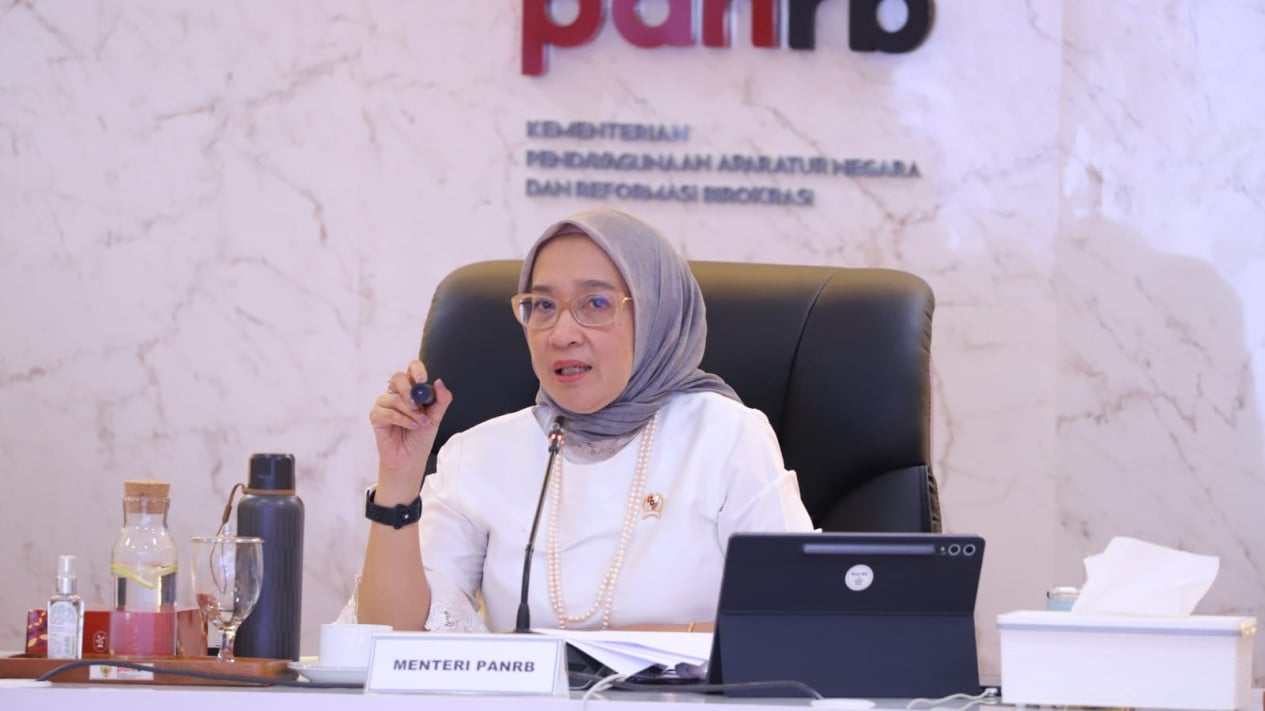
Jakarta – Minister for State Apparatus Utilization and Bureaucratic Reform Rini Widyantini stated that the work-from-home (WFH) policy represents a momentum for improving government governance digitally, not a reduction in civil servants’ working hours.
The statement was made by Rini in response to questions from members of Commission II of the Indonesian House of Representatives regarding the WFH policy for civil servants (ASN) to address geopolitical dynamics during a working meeting at the parliamentary complex in Senayan, Jakarta, on Tuesday, 31 March 2026.
“We indeed want to make improvements. It is not about reducing working hours, but how we improve to promote digital government and enhance government governance,” she said.
Rini explained that, broadly speaking, the mechanism for implementing WFH is regulated in Ministerial Regulation No. 4 of 2025 on the Flexible Implementation of Civil Servant Official Duties in Government Agencies.
According to her, with the application of flexible work schemes, including WFH, the government is shifting the paradigm from being oriented towards physical presence to being oriented towards results.
Rini added that government agencies are allowed to regulate further rules regarding flexible work schemes. However, WFH must not compromise the quality of essential public services.
“So, the approach is that for essential public services, WFH cannot be implemented. They must provide services directly, but for hybrid ones, we can implement flexible working arrangements like that,” she said.
After the meeting, Rini emphasised that WFH literally means working from home. She conveyed this when asked by reporters whether ASN are allowed to work from anywhere, including cafes.
“It’s work from home, that’s the name, right? The mechanism will be as per the Ministerial Regulation,” she said.
Previously, the government officially implemented the work-from-home policy or WFH for ASN every Friday. The government also issued recommendations for WFH in the private sector.
Coordinating Minister for Economic Affairs Airlangga Hartarto, in a press conference in Jakarta on Tuesday, stated that the policy applies starting 1 April 2026 and will be evaluated after two months of implementation.
Several sectors are exempt from this WFH policy, including public services (health, security, and cleanliness), as well as strategic sectors (industry, energy, water, basic commodities, food and beverages, trade, transportation, logistics, and finance).