
WFH for Civil Servants: Verbal Warning for Ignoring Calls Twice, Written Warning for Not Responding to Messages Within 5 Minutes!
JAKARTA, KOMPAS.com - Indonesia’s Minister of Home Affairs, Tito Karnavian, has outlined several consequences that can be imposed on Civil Servants (ASN) if they fail to take their work from home (WFH) seriously.
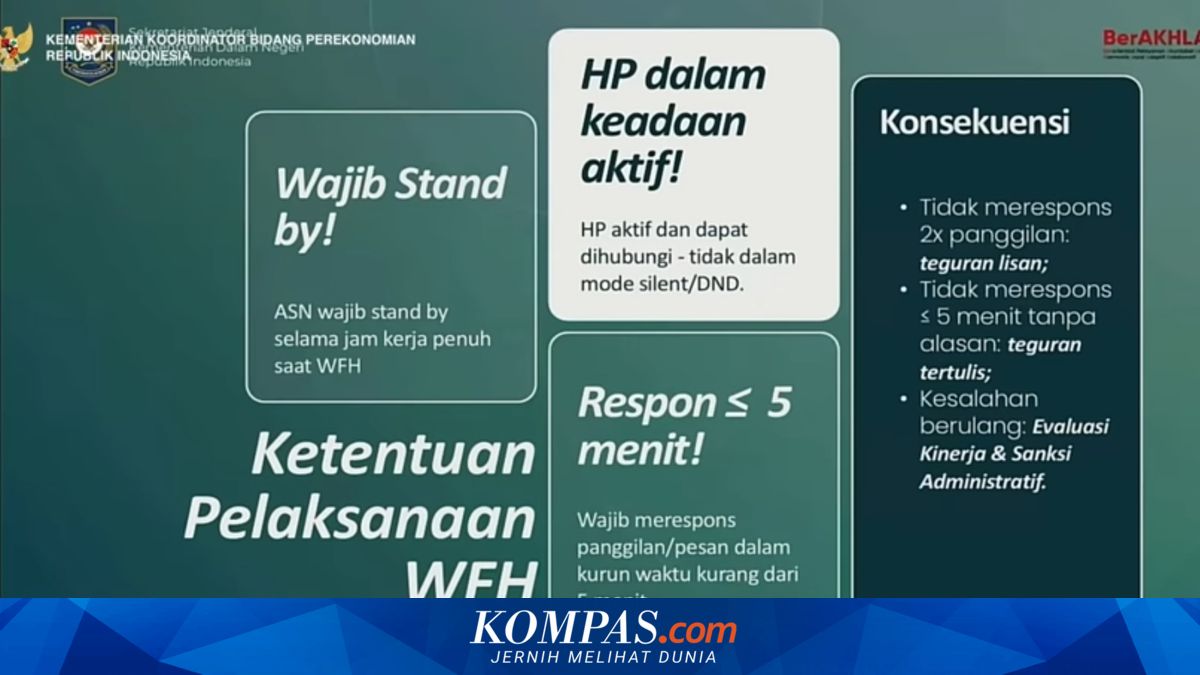
In a presentation slide shown during a press conference on the government’s policy response to the global geopolitical situation, broadcast on the Ministry of Economy’s YouTube channel, as quoted by Kompas.com on Friday (10/4/2026), there are several provisions for implementing WFH.
“Must be on standby! ASN must be on standby during full working hours while WFH,” states the presentation from the Human Resources Bureau of the General Secretariat of the Ministry of Home Affairs, dated 31 March 2026.
There is then a column emphasising that responses to messages must be within or less than five minutes.
“Must respond to calls/messages within a timeframe of less than five minutes,” it says.
The final column covers consequences, explaining that failing to respond to two calls will result in a verbal warning.
The next consequence, for not responding to messages or calls within or less than five minutes, will result in a written warning.
Minister of Home Affairs Tito Karnavian also emphasised that all agencies can ensure that ASN are truly carrying out their work from home.
“Their mobile phones are also required to be active so that their location can be tracked via geo-location,” he said.
WFH Now in Effect
For information, working from home (WFH) one day per week for civil servants (ASN) officially takes effect from Friday (10/4/2026).
The implementation of WFH for ASN every Friday is one of the government’s policies to save or achieve efficiency, particularly in energy, following the outbreak of conflict in the Middle East.
He stated that the four-day workweek policy has previously been implemented in several ministries/agencies during the Covid-19 pandemic.
Airlangga also emphasised that public services will continue to run despite the WFH policy every Friday.
“Public services will continue to operate, and productive activities including banking, capital markets, and others will continue to run. Institutions are permitted to manage this with specific applications,” said Airlangga.