
West Java Opens Path for 4,000 Workers to Germany
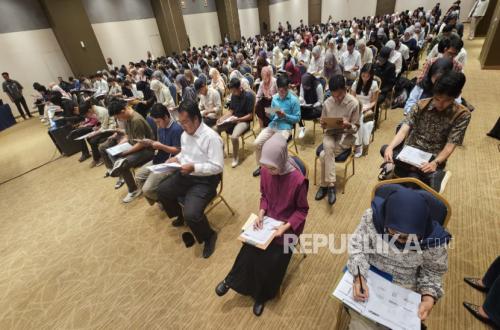
West Java provincial government continues to drive improvements in human resource quality to compete in the global employment market. One such effort is being undertaken through the organisation of A1-level German language examinations participated in by hundreds of candidates in Majalengka.
The Department of Labour and Transmigration (Disnakertrans) of West Java Province, in collaboration with LPK Instudia, organised offline German language examinations for 350 participants at Fitra Hotel, Majalengka, on 15 March 2026. This activity is reportedly the largest single-location offline German language examination in West Java.
The participants are part of an intensive training programme followed by 325 main participants who passed selection from over 7,300 applicants throughout West Java. A number of reserve participants were also involved to ensure programme continuity.
I Gusti Agung Kim Fajar Wiyati Oka, Head of Disnakertrans West Java, stated that German language training is one of West Java Provincial Government’s strategies in addressing global employment challenges whilst capitalising on employment market opportunities in Germany.
According to him, Germany is currently facing a substantial labour shortage. To maintain economic stability, the country requires approximately 400,000 foreign workers annually. “In 2024, approximately 439,000 job vacancies were recorded in Germany available for skilled workers and specialists. In February 2026, Indonesia also newly signed a memorandum of understanding to place approximately 4,000 workers across various strategic sectors,” Kim said.
He assessed the opportunity as wide open for West Java, which has Indonesia’s largest workforce population.
Kim explained that several sectors requiring urgent workers in Germany include the healthcare sector, particularly nursing, the hospitality and tourism sector, and the information technology sector such as IT specialists and software developers. Additionally, demand exists in industrial, logistics, and construction sectors.
To access these opportunities, prospective workers must fulfil three primary requirements: language ability, qualification recognition or degree equivalence, and residence permit or work visa.
Language ability is an important requirement for most professions. For healthcare workers, professionals, and vocational education or Ausbildung programmes, German language ability at minimum B1 to B2 level is generally required. Whilst A1 or A2 level can serve as an initial stage for certain types of technical work.
“Language is the key that opens the doors to the world. Through this training, we want to ensure young West Javans have relevant competencies so they are ready to compete at the global level,” Kim said.
LPK Instudia Director Aceng Imam explained that the German language training programme commenced on 11 February 2026 and was officially opened on 18 February 2026 by the Head of Disnakertrans West Java.
Training was conducted using hybrid learning methods, combining online and face-to-face learning integrated through a learning management system (LMS) to achieve German language competency levels A1 to A2.
In examination administration, participants took written examinations covering listening (Hören), reading (Lesen), and writing (Schreiben) abilities simultaneously in the Fitra Convention Hall, Hotel Fitra Majalengka. For oral examinations (Sprechen), the committee prepared 13 examiner teams working in parallel across 13 examination rooms so that each participant received objective assessment in accordance with international standards.
Aceng stated that this internal examination served as a means to measure participant ability before participating in the official German language certification examination recognised by the German government. According to him, over 20 years’ experience managing German language training demonstrated that internal examination results possessed high accuracy levels against official certification examination results.
The programme is expected to open the path for West Java’s younger generation to penetrate the German employment market, either through vocational education Ausbildung pathways or other professional sectors. Equipped with adequate language ability and skills, participants are assessed as increasingly positioned to achieve international-level careers.