
Weaving Dreams to the World Stage
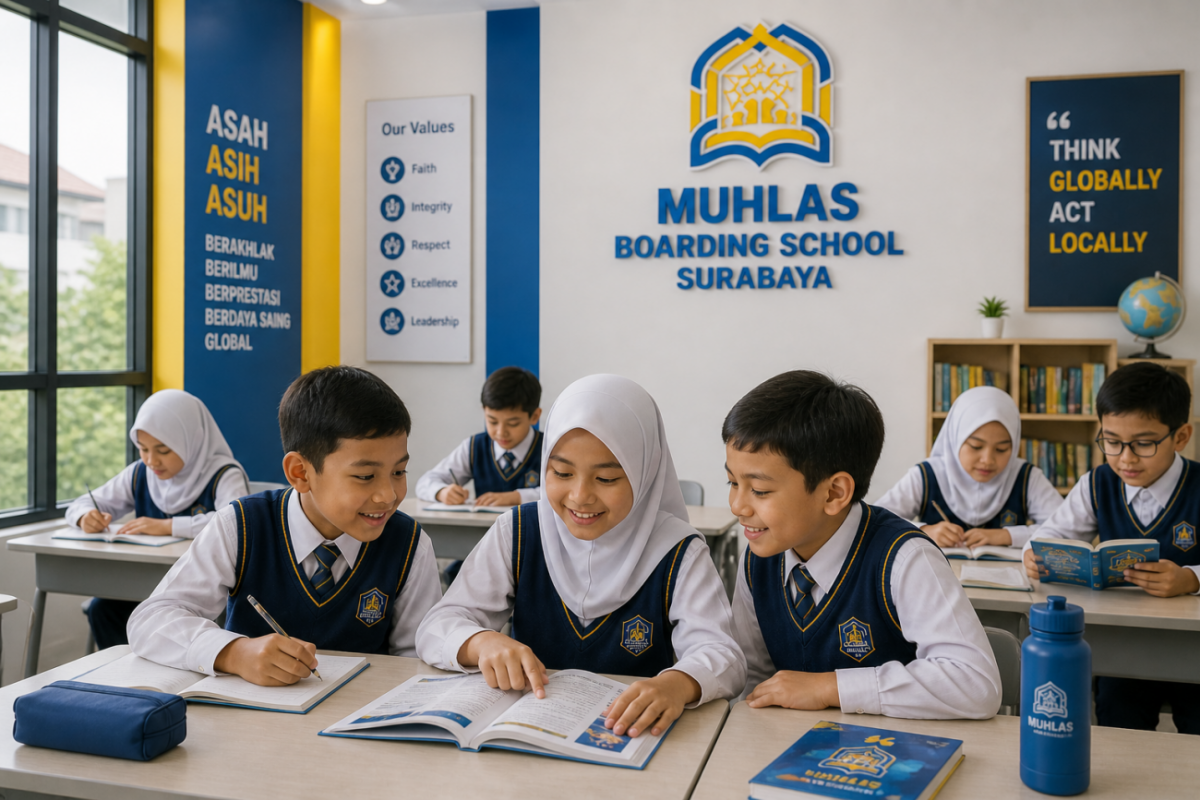
Surabaya’s step towards global education is a bold and strategic move. This is not merely a school construction project, but an effort to build civilisation.
Surabaya (ANTARA) - In a classroom, a child gazes at a world map hanging on the wall. His finger moves slowly, tracing the lines of countries whose names he has only heard before. He stops at a distant point, then turns to his teacher with a simple question: “Can I get there?”
That question may sound light, but it is where the direction of education is changing. Schools are no longer just places for memorisation, but spaces that open possibilities that distance is no longer a barrier, and dreams do not have to stop within the scope of the city where they were born.
In the new, neat classrooms, children begin to build dreams in a different way. They do not just learn to read and count, but are also invited to understand a wider world, a world that demands cross-border skills, global languages, and competitiveness that is no longer local.
It is here that the City of Surabaya, East Java, is beginning to take serious steps by making education a bridge to the global stage.
That step becomes more concrete with the inauguration of MuhlaS Boarding School in the Krembangan area, carried out by the Minister of Basic and Secondary Education of Indonesia, Abdul Mu’ti, together with the Mayor of Surabaya, Eri Cahyadi, recently. This dormitory-based school is not just an additional educational facility, but a marker of a change in perspective.
Education is no longer positioned as a formal routine, but as an ecosystem for forming character, leadership, and international competitiveness. In this context, Surabaya is not building an ordinary school, but designing the future.
Across Borders
The transformation of education in Surabaya did not emerge from a vacuum. It arises from the awareness that global competition now touches the most basic level, namely children’s education. The world of work is changing rapidly, technology is developing without pause, and national borders are becoming increasingly blurred in the exchange of knowledge. A city that wants to survive must prepare a generation capable of adapting.
The boarding school model championed by MuhlaS Boarding Class becomes one of the answers. The integration of academic education, character strengthening, and leadership becomes an important foundation. More than that, collaboration with international curricula such as Cambridge shows concrete efforts to align local standards with global standards.
However, this step also invites critical questions. Is the internationalisation of education just about curriculum and language of instruction? Or is it deeper than that, namely about ways of thinking, creativity, and problem-solving abilities?
Global experience shows that countries with advanced education systems do not only adopt international curricula, but also build strong learning cultures. Finland, for example, emphasises understanding-based learning, not memorisation. Singapore combines academic discipline with innovation. This means that the globalisation of education is not just a label, but a comprehensive transformation.
Surabaya appears to be heading in that direction. The deep learning approach, which is a national priority, becomes an important foundation. This approach emphasises understanding of concepts, not just achievement of grades. If implemented consistently, this could become the main differentiator.
The Pulse of the Ecosystem
What is interesting about this development is not only in the educational institutions, but also its impact on the social environment. Areas that previously had limitations are now turning into centres of learning. This change shows that education has real transformative power.
Community participation becomes a key factor. When residents are willing to endow their assets for education, it is not just material support, but a form of trust in the future. This is social capital that cannot be built instantly.
In terms of policy, this aligns with the spirit of Hardiknas 2026 which emphasises “universal participation”. Education cannot rely solely on the government. It requires collaboration between schools, communities, organisations, and other sectors.
However, the biggest challenge lies in equity. High-quality education models often emerge in certain points, while other areas are left behind. If not anticipated, this gap could widen.
National data shows that access to quality education is still not evenly distributed, especially in terms of facilities, teacher quality, and digital access. Although Surabaya is a city with relatively good educational infrastructure, internal challenges remain, particularly in ensuring that all layers of society feel the same benefits.
The digitalisation of learning becomes both an opportunity and a challenge. On one hand, technology opens wide access to global learning resources. On the other hand, gaps in internet access and digital literacy remain obstacles.
Roots of the World
Amid global ambitions, Surabaya does not seem to want to lose its roots. Emphasis on religious values, character, and local wisdom becomes an important part of the developed education model. This is a strategic step.
Globalisation without identity risks producing a generation that is uprooted from local values. Conversely, education that is too local without global insight could leave the generation behind. Balance between the two becomes the key.
The philosophy of education rooted in the values of nurturing, loving, and caring remains relevant. Knowledge must go hand in hand with empathy and guidance. This is not just a normative concept, but a foundation for forming complete human beings.
Within the policy framework, five national strategies from digitalisation, improving teacher quality, strengthening character, improving learning quality, to expanding access become a clear roadmap. The challenge is implementation in eight