
Weaving a Circular Coconut Economy for Coastal Villages
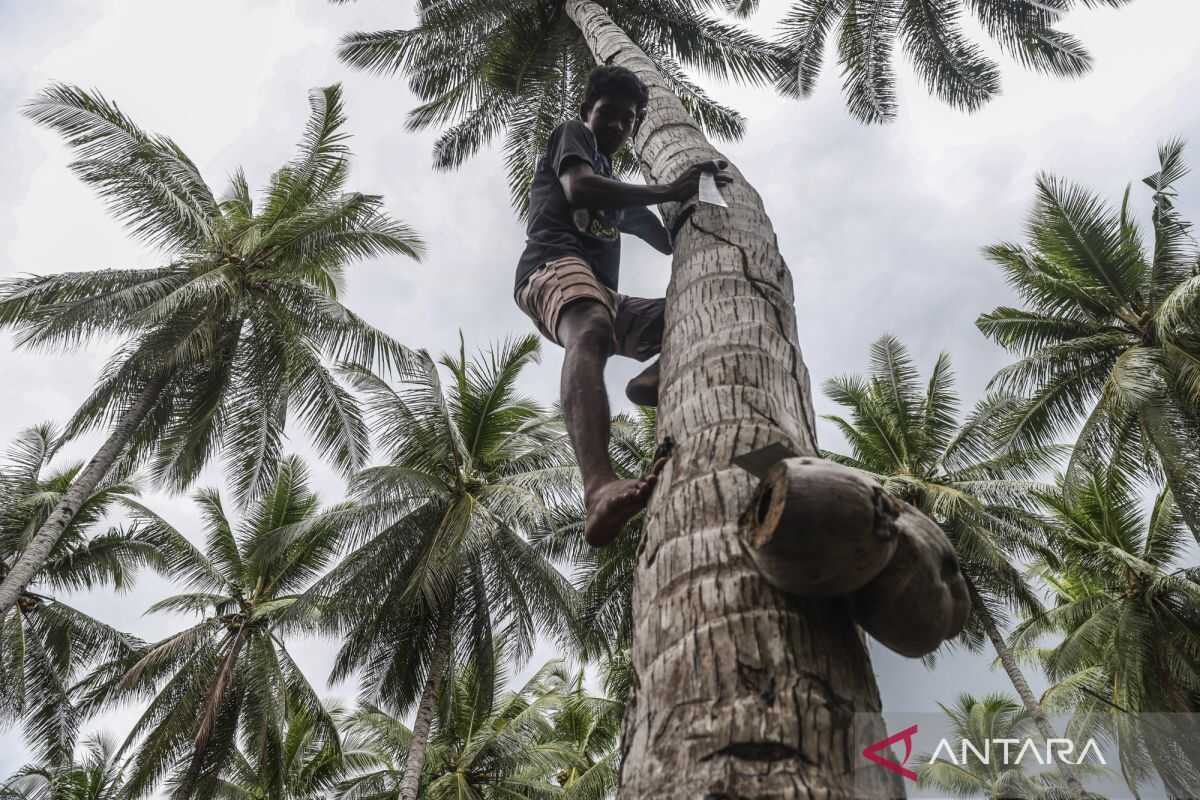
Jakarta (ANTARA) - From husk to shell, from coconut water to pulp, the coconut holds value that is often overlooked. In coastal villages, the circular economy opens up opportunities so that no part is wasted and added value does not stop at the farm.
Across many coastal villages, coconut has long been identified with copra. The flesh is dried, sold, and the economic cycle ends there. The husk piles up in gardens, the shells are burned haphazardly, and coconut water is often discarded.
Yet, from a single coconut, almost no part truly becomes waste. Indonesia is one of the world’s largest coconut producers. FAO data put national production at around 17 million tonnes per year, placing Indonesia alongside the Philippines and India among the top three global producers. Meanwhile the Coconut Outlook 2025, released by the Centre for Data and Agricultural Information, notes that the area of coconut plantations is about 3.31 million hectares, with more than 98 percent managed by smallholder plantations.
The dominance of smallholder farms shows that coconut is not just an export commodity but a livelihood for millions of rural households. Yet such large production is not always commensurate with welfare. The business model remains linear; harvest, sell whole coconuts or process into copra, leaving farmers heavily dependent on a single product and a single market price. When copra prices weaken, incomes come under pressure. On the other hand, the potential added value from other coconut components has not been fully exploited.
Value chain
The circular economy approach offers a different perspective. In this system, every part of the product is encouraged to re-enter the production cycle as new raw materials, energy, or value-added derivatives. Coconut is biologically highly compatible with this concept. The flesh can be processed into coconut oil, coconut milk, and virgin coconut oil (VCO). Its water can become nata de coco or fermented beverages. The husk can be processed into cocopeat and industrial fibre. The shells can be converted into charcoal and briquettes. Even the residue can be used as cattle feed or compost.
In other words, a single commodity can give rise to multiple lines of business, from food to renewable energy.
A number of regions are beginning to demonstrate these practices. In Banyuwangi, small-scale business groups convert husks into cocopeat used as a substrate for horticulture and urban farming. These products are in demand in export markets as they are considered more environmentally friendly than peat.
Meanwhile in Indragiri Hilir, Riau, one of the national coconut hubs, shells are no longer merely used as household fuel. They are processed into charcoal and briquettes with higher value and broader markets.
These examples show that coconut is not merely a single commodity but can form the basis of a village-scale industrial ecosystem.
Value addition and household resilience.