
Weakening in Line with Asian Markets, IHSG Opens Down More than 2%
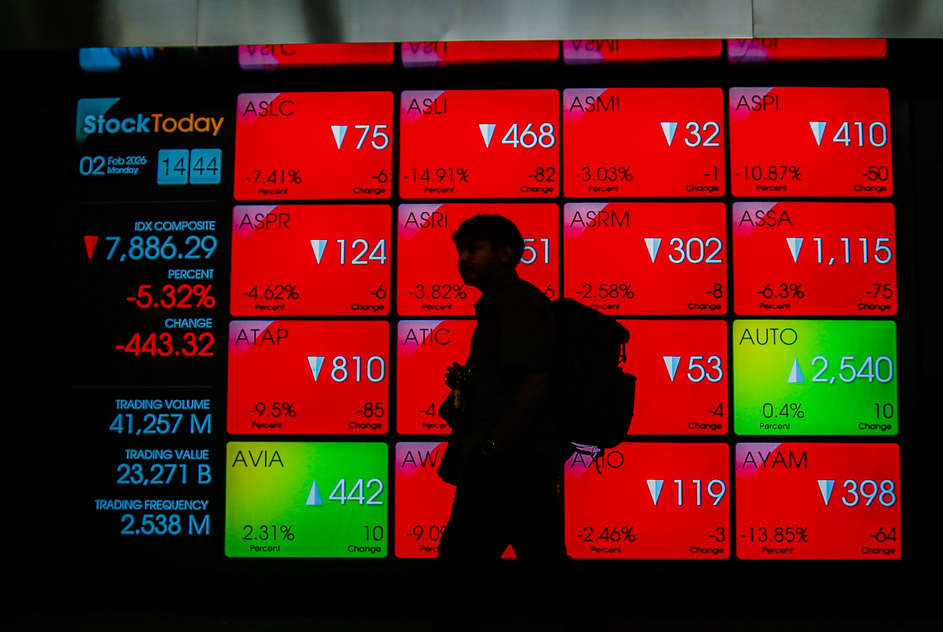
The composite stock index (IHSG) at Indonesia’s Stock Exchange (BEI) opened weaker during Monday’s trading session (9 March). The decline mirrors pressure across most Asian stock markets, triggered by surging global oil prices and escalating geopolitical tensions in the Middle East.
At the opening of the trading session, IHSG fell substantially. The IHSG opened weaker by 211.38 points or 2.79% to the level of 7,374.31. Meanwhile, the LQ45 index, which comprises 45 leading stocks, also corrected 22.31 points or 2.87% to 753.74.
Liza Camelia Suryanata, Head of Research at Kiwoom Securities Indonesia, advised market participants to monitor the still-elevated volatility.
“Kiwoom Research reminds investors that volatility will remain high this week, with continued consolidation risks towards 7,335. Adopt a wait-and-see stance whilst paying attention to global sentiment,” said Liza Camelia Suryanata during her analysis in Jakarta on Monday (9 March).
Pressure on global equity markets has been driven by the escalating conflict between the United States and Israel with Iran. Rising tensions have fuelled concerns about the stability of global energy supply.
Under such circumstances, investors tend to redirect funds to safer and more liquid assets. As a result, the US dollar strengthened whilst equities and other risky instruments faced pressure.
Geopolitical uncertainty has also increased following Iran’s appointment of Mojtaba Khamenei as the new Supreme Leader, replacing Ayatollah Ali Khamenei, who was previously reported to have died.
This move is perceived by markets as strengthening the perception that Iran is unlikely to soften its stance soon in the conflict with the US and Israel. This condition heightens the risk of escalating conflict in the Middle East region.
Conflict escalation and disruptions to maritime traffic in the Strait of Hormuz have also driven surging global oil prices.
At 07:50 WIB, crude oil WTI prices were recorded as rising 20.81% to US$109.82 per barrel. Meanwhile, Brent Oil increased 18.17% to US$109.53 per barrel.
This sharp rise in energy prices has the potential to trigger global inflationary pressure.
“The surge in energy prices increases the risk of global inflation and can dampen economic growth through rising fuel prices and production costs. Several Middle Eastern energy producers are beginning to reduce production due to supply chain disruptions,” said Liza.
Beyond geopolitical factors, market participants are also monitoring the dynamics of trade relations between the United States and China. The two countries are scheduled to hold high-level talks at the end of March 2026.
The meeting between US President Donald Trump and Chinese President Xi Jinping is expected to focus more on maintaining the stability of economic relations, rather than undertaking major overhauls in trade and investment cooperation.
The US is pushing China to continue fulfilling its commitments under the trade agreement, including purchases of US agricultural products, Boeing aircraft, and rare earth supplies.
One potential agenda item is China’s plan to purchase approximately 500 narrow-body Boeing aircraft.
According to Liza, global market movements this week will be heavily influenced by two main factors: developments in the Middle East conflict and the release of US inflation data.
Market participants are awaiting the publication of the US Consumer Price Index (CPI) for February 2026. If inflation is recorded higher than expected, the likelihood of an interest rate cut by the US Federal Reserve could be delayed.
Currently, the probability of a 25 basis point (bps) rate cut in June 2026 is estimated at around 45%.
Domestically, the government has begun calculating the potential impact of rising oil prices on the fiscal situation.
Finance Minister Purbaya Yudhi Sadewa stated that if average oil prices reach US$92 per barrel, the state budget deficit (APBN) could widen significantly.
The budget deficit is estimated to potentially increase to 3.6-3.7% of Gross Domestic Product (GDP) if there is no policy adjustment.
The government itself targets the deficit to remain below the 3% of GDP threshold in line with its fiscal discipline framework.
From a geopolitical perspective, President Prabowo Subianto stated that Indonesia could withdraw from the Board of Peace initiative proposed by US President Donald Trump if it does not provide benefits to Palestine or Indonesia’s national interests.
The government has also postponed further discussions on the formation of a UN-backed Gaza stabilisation force until the conflict situation in the region subsides.
Market pressure is not limited to Asia. European stock markets closed in negative territory on Friday’s trading (6 March).
The Euro Stoxx 50 index fell 1.09%, the UK FTSE 100 weakened 1.24%, the German DAX declined 0.94%, and the French CAC corrected 0.65%.
Similar developments occurred on Wall Street. The Dow Jones Industrial Average fell 0.95% to 47,501.55, the S&P 500 weakened 1.33% to 6,740.02, and the Nasdaq Composite declined 1.59% to 22,387.68.
In Asian trading this morning, substantial declines also occurred across several major indices. The Nikkei plummeted 4,185.60 points or 7.53% to 51,435.00. Meanwhile, the Shanghai index fell 57.98 points or 1.41% to 4,066.70, the Hang Seng weakened 797.78 points or 3.10% to 24,959.26, and the Strait Times corrected 148.93 points or 3.07% to 4,699.68.