
Water Hyacinth Explosion in Pluit Reservoir, Water Surface Turns Green in an Instant
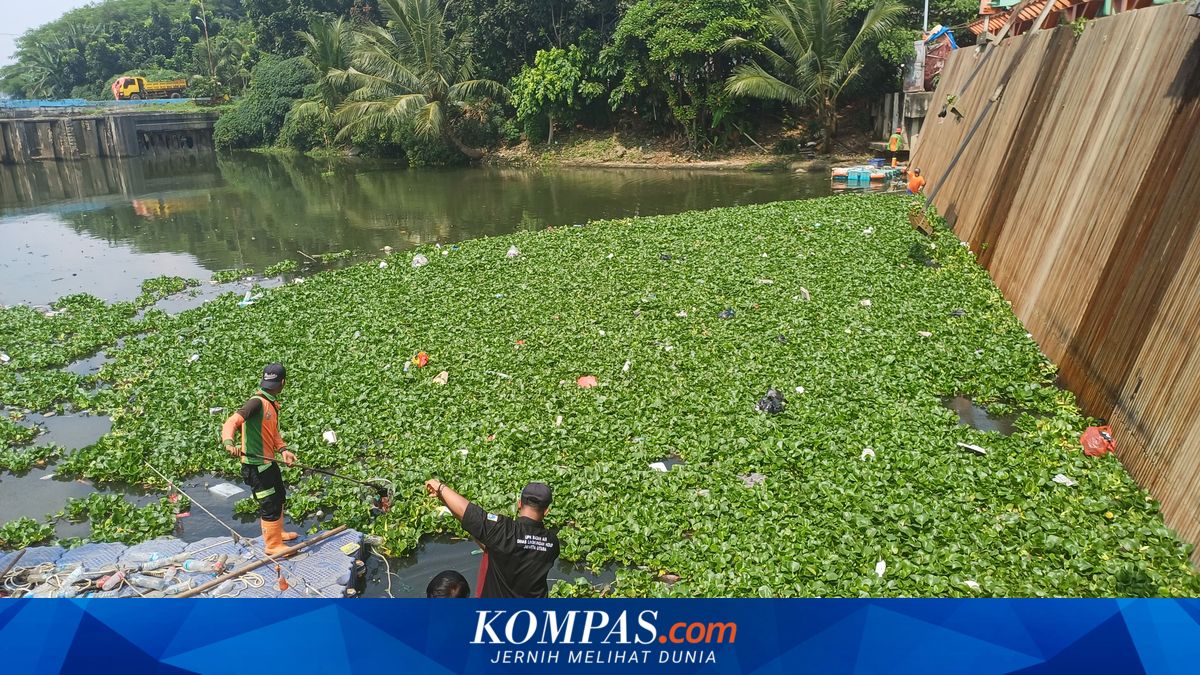
JAKARTA – The sudden greening of the Pluit Reservoir in North Jakarta, caused by it being covered in water hyacinth, has drawn public attention. This phenomenon has gone viral on social media, raising concerns about water quality and environmental management in the capital.
The spotlight emerged after a video of the current condition of Pluit Reservoir was uploaded by the Instagram account @ilhamapriyanto on Tuesday (31/3/2026). In the video, most of the reservoir’s surface appears covered by a blanket of water hyacinth.
Several personnel from the Water Body Waste Handling Unit (UPS Water Body) of the Jakarta Environment Agency (DLH) were seen busy carrying out the cleanup. They even stood on the blanket of aquatic plants covering the reservoir’s surface.
Additionally, the transportation process was assisted by waste filtering equipment that pulled the water hyacinth to the shore. After being lifted, the plants were moved using a conveyor machine into transport trucks.
The supervisor of the UPS Water Body Penjaringan waste filter, Abu Bakar, said the water hyacinth began growing significantly since Sunday (29/3/2026).
The transportation process has been carried out intensively since Tuesday (31/3/2026). In a single day, personnel work from morning until evening to clean the reservoir.
“Up until yesterday, we transported from morning until evening. Around 5:00 PM WIB, almost 6:00 PM, we finished. We transported that, finishing 12 trucks,” said Abu when interviewed at the location on Wednesday (1/4/2026).
He mentioned that on Tuesday alone, the volume of water hyacinth transported reached about 108 cubic metres. Meanwhile, until Wednesday afternoon, an additional amount successfully transported reached about 54 cubic metres.
“Scientifically, the explosion of water hyacinth is almost always an alarm for eutrophication, water that is too rich in nutrients, especially nitrogen and phosphorus,” he said when contacted on Thursday (2/4/2026).
According to Mahawan, the presence of water hyacinth does not always mean that water quality is in an extreme condition at the same time. However, ecologically, it indicates pollution pressure due to excessive nutrient loads.
He explained that the main sources of nutrients in Jakarta’s water bodies generally come from domestic waste.
“In the urban context like Jakarta, the more direct triggers are often domestic waste, detergents, organic rubbish, runoff from settlements, and pollutant loads from rivers entering the reservoir,” he stated.
These efforts aim only to restore the reservoir’s function as a flood controller. If not cleaned, water hyacinth can disrupt water flow, clog pump systems, and reduce the reservoir’s storage capacity.
However, as long as the nutrient content in the water is not controlled, water hyacinth growth will continue to recur even after being cleaned.
Therefore, strict supervision is needed, including utilising modern technologies such as drones, satellite imagery, and regular water quality testing to prevent the reservoir from being polluted again by domestic waste.