
Warteg Vendors Pressured by Plastic Prices, Sudden Emergence of 'Fancy' Warteg
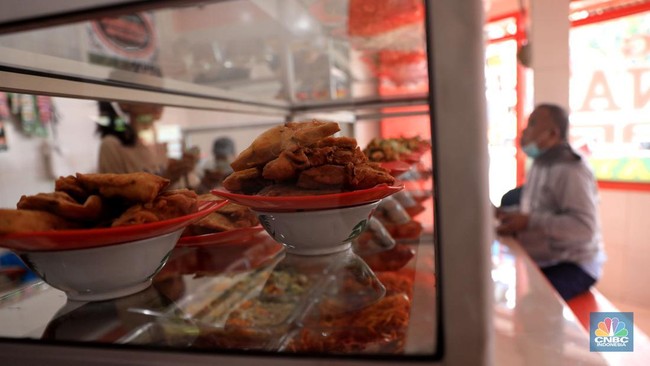
The trend of modern warteg with aesthetic concepts has been underway for several years. This includes chains like ‘Rumanasi’ with branches in Cikajang and Puri Indah, ‘Cahaya Selatan’ in Panglima Polim which focuses more on Chinese food flavours, and ‘Luwe’ in Cikajang with a glass display case concept like a warteg to showcase various dishes.
When entering the keyword “modern warteg Jakarta” on social media, a variety of viral content promoting modern-style wartegs immediately appears.
Most recently, a premium restaurant borrowing the warteg concept has emerged, namely ‘Salira’ in the Senopati area, South Jakarta. Its prices are much higher, with a customer demographic of middle-to-upper class.
Content related to this new restaurant opened by the F&B Union Group chain is starting to frequently appear on social media FYPs (For You Page). Some content labels it as a ‘fancy’ warteg.
Around 25,000 wartegs have closed down in the Jabodetabek area since the Covid-19 pandemic until mid-2025, according to data from the Warteg Nusantara Cooperative (Kowantara).
The economic conditions impacted by the war in the Middle East are also affecting the sustainability of traditional warteg businesses that prioritise food inclusivity for labourers and lower-middle class.
Dilemma of Traditional Warteg: Surge in Plastic Prices and ASN WFH
The surge in oil prices is also hitting derivative products that use oil as a raw material, including resin or plastic pellets.
Coordinator Chairman of the Warteg Nusantara Cooperative (Kowantara), Mukroni, said the price of 15cm packaging plastic has risen from Rp10,000 to Rp14,000. This poses a serious challenge to the conventional warteg business ecosystem, as their business model heavily relies on the take-away packaging culture.
“Conventional wartegs are known for their affordable prices. When variable costs like plastic bags, mica, and styrofoam rise, warteg owners are in a difficult position,” Mukroni told CNBC Indonesia on Thursday (9/4/2026).
On one hand, raising food prices risks making conventional warteg customers switch to other alternatives. However, if they have to absorb the plastic price increase themselves, their already thin profits will be further eroded.
Moreover, the government’s Work From Home (WFH) policy for Civil Servants (ASN) every Friday starting 1 April 2026. The implementation of WFH for ASN is again a response to global energy price volatility caused by the war in the Middle East.
For wartegs located in government office areas or city centres, daily customer volume and quick turnover are the mainstay. ASNs are one of the main market segments for wartegs. Reduced office activity could eliminate peak sales times for wartegs.
“Losing ‘Prime Time’, namely lunchtime, is the biggest source of income [for wartegs]. If offices are quiet for 3 days a week, daily revenue potential could drop 50%-70%,” he explained.
Fancy Warteg in the Eyes of Traditional Warteg Vendors
Regarding the emergence of modern-fancy wartegs, Mukroni said that for now, it has not had a serious impact on the survival of traditional wartegs. This is because modern-fancy wartegs and conventional ones are considered to have their own customer segments.
“For example, fancy wartegs’ customers are office workers [middle-to-upper class], while traditional wartegs target drivers, ojol (online motorcycle taxis), and street vendors,” said Mukroni.
Some modern wartegs are also members of Kowantara. Mukroni said that usually, modern warteg entrepreneurs ask for permission before building, so they are not close to existing traditional wartegs.
“Actually, for [modern and] fancy wartegs, Kowantara doesn’t mind as long as their location isn’t near existing conventional wartegs. If they suddenly are close and become competitors, that’s the problem,” Mukroni explained.
Based on Kowantara membership data in the Jakarta area, the majority of member wartegs are in South Jakarta (199), followed by East Jakarta (95), West Jakarta (54), North Jakarta (46), and the fewest in Central Jakarta (17).
Fancy Warteg Cannot Replace Traditional Warteg
Research Director at the Center for Study Indonesian Food Anthropology, Repa Kustipia, assesses that the impact of fancy wartegs on the existence of traditional wartegs and warteg franchises is not very surprising.
This is because the strength of wartegs and simple eateries like warkop, Padang rice stalls, and Sundanese stalls lies in customer loyalty. Repa does not deny there is a shock effect in the form of enthusiasm when these fancy wartegs first open.
“That’s normal in market competition. However, the consistency of ordinary wartegs is more afraid of simpler, cheaper, more numerous wartegs. That’s actually the psychology of wartegs,” Repa told CNBC Indonesia.
In the monograph ‘Warteg Phenomenon’ released by Repa, he writes that “wartegs grew in the capital because they are cheap, have a homely taste, are easy to manage, and are supported by the social network of Tegal migrants, making them a dining solution for low-income urban communities”.
In line with that, Popular Culture Researcher, Hikmat Darmawan, said it is impossible for traditional wartegs to be displaced by the emergence of fancy wartegs. This is because the lower-class economy always serves as a buffer during crises.
“It’s not just because [traditional wartegs] are cheap and easy to access, but whether in crisis or not, the circulation of the lower-class economy is very large,” he stated.
Hikmat said the lower-class economy always serves as a buffer and saviour when situations are not going well. A simple example is when someone is laid off, their lifestyle has to decrease. “That person still has to eat, and traditional wartegs become the support,” he said.