
Warning Issued as Rice Harvest Area Potential May Shrink in October 2026
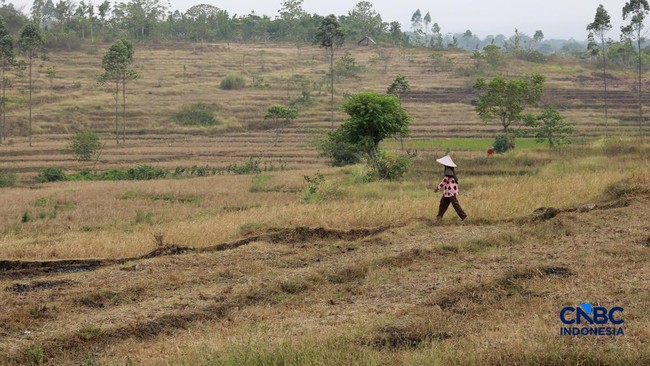
Jakarta, CNBC Indonesia - Statistics Indonesia (BPS) has revealed the reasons why the potential rice harvest area in October 2026 is estimated to decrease by 0.11% compared to October 2025. This decline is closely linked to rice planting conditions monitored through the Area Sampling Frame Survey (KSA) in July 2026.
BPS noted that the potential rice harvest area for October 2026 is estimated to reach 0.86 million hectares, a slight decrease from October 2025. This condition occurred after July 2026 saw a decrease in the proportion of land currently planted with rice (standing crop) and land under preparation, while the proportion of land at risk of crop failure actually increased.
Ateng Hartono, Deputy for Distribution and Services Statistics at BPS, stated that the change in land composition provides an important picture for assessing potential harvests in the following months.
“In July 2026, there was a decrease in the proportion of rice planting area or standing crop, a decrease in the proportion of land preparation, an increase in the proportion of fallow land, an increase in the proportion of land at risk of crop failure, and an increase in the proportion of land planted with crops other than rice, compared to the previous month (June 2026) as well as last year (July 2025),” Ateng said during a BPS press conference on Tuesday (1/9/2026).
Ateng explained that the planting conditions in July are crucial because the growth phase of the plants determines when the rice will be harvested.
BPS noted that in July 2026, 36.27% of agricultural land was in the standing crop phase, or currently being planted with rice. However, not all of these plants will be harvested in the same month.
Of the total standing crop, the largest portion is in the generative phase at 15.78%. Plants in this phase are generally harvested about one month later. Meanwhile, plants still in the late vegetative phase are expected to be harvested two months later, and early vegetative plants approximately three months later.
“From the standing crop area in July 2026, the majority is in the generative phase at 15.78%, which largely has the potential to be harvested in August 2026. As a note, rice plants in the generative phase are generally harvested within one month, the late vegetative phase within two months, and the early vegetative phase within three months,” he explained.
This means that the potential harvest for October is highly dependent on plants that were in earlier growth phases in July. When the proportion of standing crops and land preparation decreases, while land at risk of failure increases, the capacity for harvests in subsequent months is also pressured.
Potential Harvest for August-October Declines
BPS estimates that the potential rice harvest area for August-October 2026 will reach 3.07 million hectares, a decrease of 0.04 million hectares or 1.29% compared to the same period last year, which reached 3.11 million hectares.
Specifically, the potential harvest area for August is estimated at 1.11 million hectares, September at 1.10 million hectares, and October at 0.86 million hectares.
The October decline is also accompanied by a potential drop in rice production. Rice production for October 2026 is estimated at 2.73 million tons of dried milled grain (GKG), a 0.11% decrease compared to October 2025.
Weather as a Risk Factor
In addition to planting conditions, weather factors must also be considered as they can alter harvest realisations.
Based on BMKG analysis presented by BPS, rainfall in July 2026 was generally in the low category across most regions of Indonesia. Meanwhile, rainfall in August is predicted to be low, and for September-October, it is expected to be in the low to medium category.
“The high or low level of rainfall will certainly affect rice cultivation in every region of Indonesia,” he said.
BPS emphasised that the October projection remains a potential figure and is not yet final. The figures are subject to change if disruptions occur in the planting process, including pest attacks, floods, droughts, or changes in the timing of harvests by farmers.
“These potential figures are still subject to change, primarily depending on the planting conditions from August to October 2026, such as if there are attacks by pests or plant-disturbing organisms (OPT), floods, droughts, or if the timing of the harvest by farmers changes, and so on,” Ateng concluded.