
War in Server Room
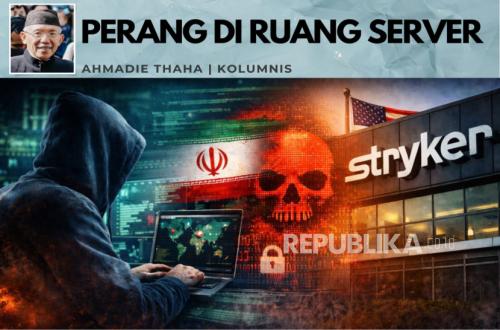
In the past, wars began with the rumble of cannons. Then humanity escalated the drama with tanks, aircraft carriers, and ballistic missiles capable of crossing continents. However, the 21st century appears to have its own sense of humour: war can now begin with the quiet sound of a keyboard—a click.
There is no smell of gunpowder. There are no air raid sirens. Only a login screen that suddenly changes face.
The latest chapter in the conflict between the United States and Israel against Iran has now entered a far quieter battlefield: server rooms. The terrain is not desert, not ocean, not sky. It is data centres, optical cables, and computers humming softly like giant refrigerators of digital civilisation.
On that battlefield, a name suddenly appeared that sounds like a comic book character: “Handala”.
This is not merely a hacker alias. It comes from a legendary cartoon character created by Naji al-Ali, a Palestinian artist who was assassinated in London in 1987. Handala is depicted as a ten-year-old boy always standing with his back to the world—a symbol of resistance against global injustice.
Now that cartoon character has reappeared. Not on newspaper pages. But on the login screens of American companies.
The target was not a small company with servers stored in an office cabinet. The attack was on Stryker, an American medical technology giant that manufactures surgical instruments, patient monitoring systems, defibrillators, and medical devices used by the United States military to treat wounded soldiers.
The company employs approximately 56,000 people and its products are used by more than 150 million patients each year. In other words, this is not a laptop repair shop. This is global health infrastructure.
The attack occurred in the early morning hours several days ago. Around three in the morning American time—the hour when the world is usually only filled with security guards, on-call doctors, and programmers who forgot to go home.
Suddenly the system stopped. Laptops could not log in. Servers were inaccessible. Administrator accounts changed. The Handala image appeared on the login screen.
The hackers claimed something that sounded like a cyberpunk film scene. They announced they had “deleted over 200,000 systems”—servers, laptops, and mobile devices belonging to the company—and stolen approximately 50 terabytes of data.
Fifty terabytes. If printed as documents, it might be enough to fill the bookshelves of an entire university library.
As a result, the company’s operations in 79 countries suddenly stopped. An employee wrote on a Reddit forum with a sentence that sounded like a report from a digital battlefield: “The entire company is at a complete stop.” The company came to a total halt.
However, the drama was not finished. Another forum user wrote something more terrifying: many employees’ personal mobile phones were also “completely deleted”. Devices that were previously connected to the company network—through applications like Intune, Company Portal, Teams, or VPN—suddenly lost all their data.
Even the two-factor authentication system was crippled. As a result, many employees could no longer access their own accounts. A worker claiming to be based in Australia wrote with a tone of resignation: “All personal data on my phone is gone. Now I can’t even access my email and Teams.”
At this point, cyber warfare became something very personal. Not only did the company’s servers die. Mobile phones in employees’ pockets became victims as well.
The attack method used is called a wiper attack, a type of malware that not only steals data but “deletes it permanently”. It is like a thief who not only takes the contents of your home but also burns the family archives.
This technique is not new in digital geopolitics. One of the most famous examples is the Shamoon attack against Saudi Aramco in 2012, which deleted data from more than 30,000 computers of the world’s largest oil company.
Russia subsequently used wiper malware extensively in its cyber war against Ukraine. This year, reports even emerged that attacks on Poland’s power grid network systems also used similar methods.
North Korea also used this technique in the Sony Pictures hack in 2014, which suddenly taught Hollywood that even comedy films could trigger digital wars between nations.
In other words, this is no longer the actions of a bored teenage hacker in a bedroom. This has become the military doctrine of the 21st century.