
Wamendag: Government to clamp down on MinyaKita sales above the price ceiling
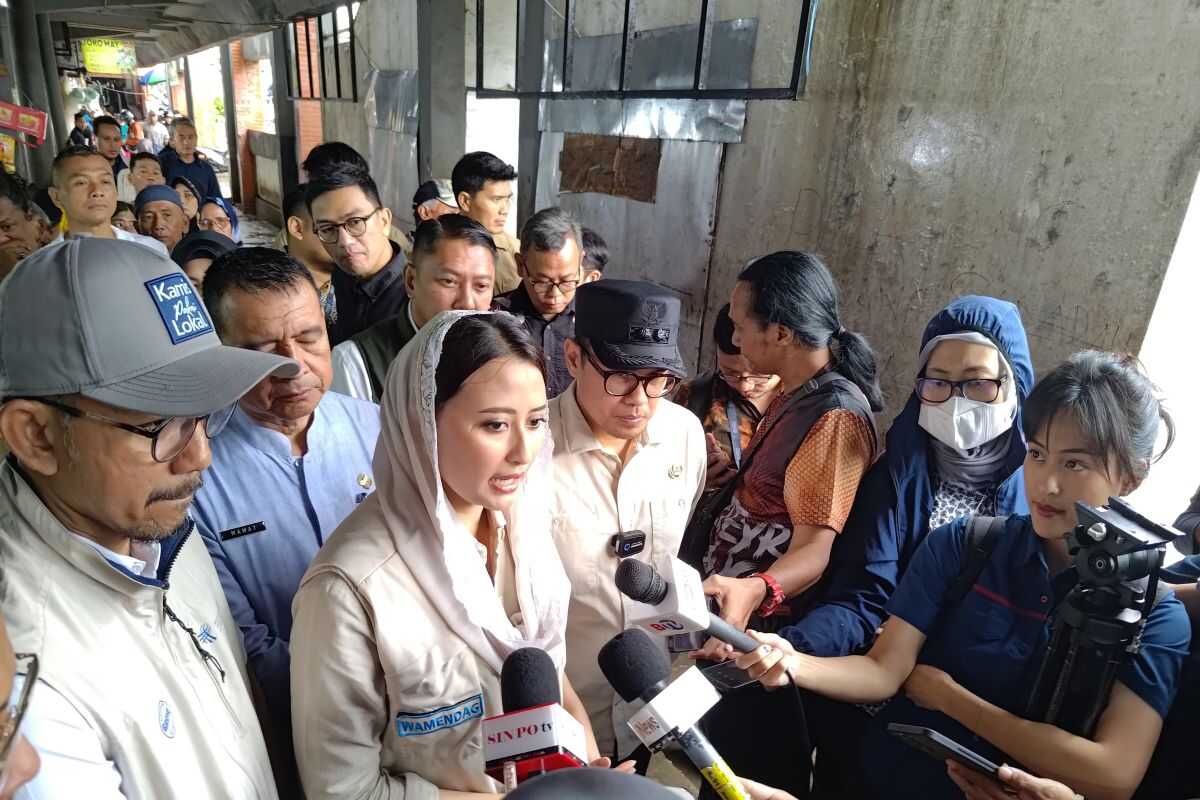
South Tangerang (ANTARA) – The Ministry of Trade (Kemendag) said it would tighten the sale of MinyaKita branded packaged cooking oil to ensure it does not exceed the highest retail price (HET) of Rp15,700 per litre.
Deputy Minister of Trade (Wamendag) Dyah Roro Esti Widya Putri emphasised that the government will continue to monitor the price of MinyaKita in traditional markets through a monitoring system that involves regional governments.
‘That (sales above the HET) is something we must tighten. From us, it is something we must curb,’ she said after inspecting staple food prices at Pasar Ciputat, South Tangerang, on Friday.
She explained that price monitoring can be carried out through the Market and Staple Needs Monitoring System (SP2KP), which involves around 514 districts and cities through local trade offices.
The system, she said, can be used to track price movements of staples while providing early warnings if price volatility occurs in the market.
Results of the monitoring are then conveyed to relevant stakeholders, including the National Food Agency (Bapanas), for follow-up if an abnormal price rise is found.
In addition to price monitoring, the government is strengthening the MinyaKita distribution system through Minister of Trade Regulation Number 43 of 2025, which requires at least 35 percent of the distribution of rakyat’s cooking oil to be channelled through state-owned food entities such as Perum Bulog and ID Food.
Based on observations at Pasar Ciputat, the price of MinyaKita at some stalls was seen to be in line with the HET of Rp15,700 per litre.
‘What I checked just now is in accordance with the HET. But if there is any rise, we will coordinate from there with Bulog and ID Food as I mentioned,’ she said.
The Ministry of Trade, continued Roro, will continue to coordinate with relevant parties such as city and regional governments, Bulog, and ID Food to maintain price stability and smooth distribution of cooking oil in the market.
Earlier, Bapanas’ Principal Secretary Sarwo Edhy said that the government would continue to strengthen its steps to stabilise prices for strategic staple foods in the lead-up to and during Ramadan until Eid al-Fitr 1447 Hijri.
These efforts are implemented through intensified supervision by the Task Force (Saber) for Clean Sweep Violations, Safety and Quality of Food in 2026, deployed nationwide.
According to Roro, the move is expected to improve the supply chain so that distribution of cooking oil to markets can be more closely monitored.
‘We channel the MinyaKita DMO through the Food State-Owned Enterprises. Because its system is better, we can monitor more efficiently and keep prices affordable and well managed,’ she said.