
WALHI Demands Evaluation of National Waste Management
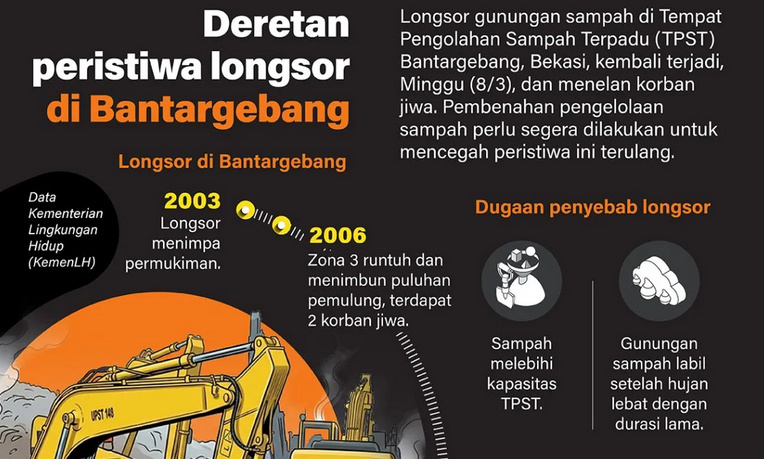
The Indonesian Environmental Forum (WALHI) has assessed that both the central and regional governments have failed to implement comprehensive waste management policies, resulting in repeated waste landslide disasters at Bantargebang.
WALHI’s Urban Justice campaigner, Wahyu Eka Setyawan, stated that the Bantargebang incident was not merely a workplace accident. According to him, the incident was a consequence of a waste management model still based on the collect, transport and dispose pattern, with large-scale waste accumulation at final disposal sites (TPA).
“This incident repeats an old wound that should have been an important lesson for the nation. We previously experienced a major waste landslide tragedy at the Leuwigaja landfill disaster, which killed hundreds of people. However, more than two decades later, the national waste management approach still relies on accumulation at TPA sites that continue to increase and become increasingly dangerous,” said Wahyu in a statement on Wednesday (11/3).
WALHI assessed that the Bantargebang situation reflects a broader waste management crisis across various cities in Indonesia. Many TPA sites are reported to have exceeded their carrying capacity, whilst waste production continues to increase without serious reduction strategies from the source.
WALHI noted that approximately 343 of Indonesia’s total 550 TPA sites remain classified as open dumping, potentially triggering a waste accumulation crisis in urban areas. Wahyu assessed that this condition indicates Indonesia is facing a waste mountain emergency.
“The Bantargebang crisis also demonstrates how waste problems are simply relocated from one area to another,” he said.
Consequently, WALHI has urged the government to immediately undertake a transformation of the waste management system by placing source reduction as the primary priority. The government is deemed to need strengthening waste reduction policies, implementing producer responsibility through Extended Producer Responsibility (EPR) schemes, and promoting industrial redesign to reduce waste production from the outset.
“The tragedy at Bantargebang must serve as a serious alarm for the government to implement waste governance transformation focused on source reduction in accordance with Law Number 18 of 2008 on Waste Management. Without fundamental change, cities across Indonesia will continue to face the risk of similar disasters with increasing casualties for people and the environment,” concluded Wahyu.