
Wake-Up Call from MSCI, OJK-BEI-DPR Prepare Measures to Reform the Stock Exchange
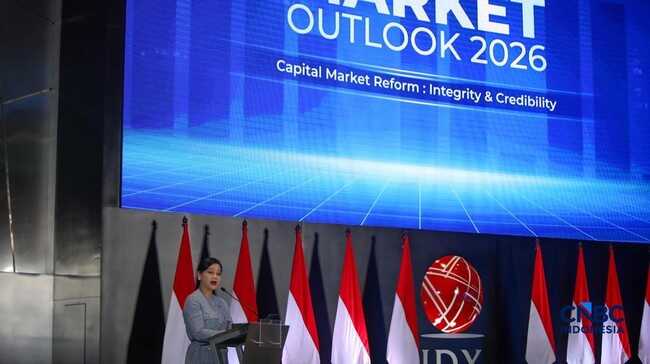
Jakarta, CNBC Indonesia - Indonesia’s capital market is at a crucial crossroads. On one hand, domestic macroeconomic fundamentals show very solid resilience. On the other, the national financial market is not immune to global volatility pressures. These pressures are triggered by escalations in geopolitics, intense cross-border liquidity competition, and rising expectations of higher integrity standards from global index providers.
The dynamics and urgency of reform have become a major focus in the CNBC Indonesia Market Outlook 2026 agenda, held at the Indonesia Stock Exchange (BEI) building in Jakarta on Tuesday (3/3/2026).
The strategic forum brought together policymakers from the Financial Services Authority (OJK), the XI Commission of the DPR RI, Self-Regulatory Organisations (SROs), and the leadership of the banking, asset management, and insurance sectors to formulate comprehensive mitigation steps.
External Threats and Contagion Effects from the Strait of Hormuz
Interim Chair of the OJK Board of Commissioners and Chief Executive for the Supervision of Business Actors in Financial Services, Hasanuddin (Friderica) Widyasari Dewi, opened the discussion by highlighting the escalation of conflict in the Middle East. This escalation is considered a near-term major risk for the domestic market.
Iran’s position, holding the world’s third-largest oil reserves and controlling strategic routes to the Strait of Hormuz, could disrupt 30 percent of the global oil and LNG supply chain. This condition risks triggering massive energy inflation.
The rise in inflation would, in turn, constrain global liquidity as central banks in developed countries are forced to maintain high policy rates. As a result, emerging markets, including Indonesia, experience capital outflow pressures.
Friderica noted that a sharp correction in the Jakarta Composite Index (IHSG) recently triggered outflows of up to Rp6.2 trillion in a single trading day following MSCI’s announcement of a potential downgrade of Indonesia to frontier market status.
This was evident in the performance of the MSCI Indonesia index, which had a worrying trajectory, even more so than the LQ45, which has historically shown less-than-optimal gains as the IHSG rose by 22.13%.
The Stock Market as the Face of the National Economy
Chairman of the DPR RI Commission XI, Mukhamad Misbakhun, offered a sharp macro perspective on this volatility. He stressed that the stock market is the direct representation or “face” of the economy, with movements monitored every second in numerical form.
The paradox today is that Indonesia’s fundamentals are extremely stable. Growth remains above 5%, reserves are robust, and the current account is positive. However, the financial markets remain highly vulnerable to sentiment, both global and domestic leadership transitions—such as cabinet or presidential changes.
“Imagine our economy’s fundamental strength still being influenced by sentiment. When the three pillars of Indonesia’s economic strength—the stock exchange, government bonds, and the Rupiah—are pressured by global sentiment, our brand is in crisis. We are risking Indonesia’s name,” Misbakhun asserted.
He also highlighted a public perception issue where the stock market is often associated with “hot stock” speculation. In reality, the market is a crucial instrument for corporate financing with cheaper funds, where the cost of funds is measured by dividend performance, far more efficient than bank credit burdened by administrative costs and high interest rates.
Responding to the Wake-Up Call and Strengthening the Early Warning System
Pressure on sentiment intensified as global index providers, such as MSCI and FTSE, issued notes specifically addressing liquidity and transparency in Indonesia’s capital market.
OJK’s Chief Executive for Market Surveillance, Hasan Fawzi, called this moment not just a rebuke but a wake-up call to which authorities have responded proactively.
During February 2026, OJK and SROs held no fewer than four intensive meetings with the index providers. From these constructive discussions, eight Action Plans for Accelerating Reform of Market Integrity were born.
Beyond transparency actions, OJK has tightened the Early Warning System from upstream to downstream. In supply, OJK embraces the principle of quality over quantity for companies seeking IPOs.
Fundamental business viability becomes the main consideration so investors are not harmed by manipulation. In trading, the Unusual Market Activity (UMA) status will be optimised to give investors a psychological pause to reconsider trading in shares with abnormal volatility.
Unraveling the Mystery of the Ultimate Beneficial Owner (UBO)
The technical implementation of market transparency is being carried out by PT Kustodian Sentral Efek Indonesia (KSEI). KSEI’s Chief Executive, Samsul Hidayat, explained that updating the investor data structure is the backbone of openness.
Relying on the Single Investor Identification (SID) infrastructure built since 2012, KSEI is now expanding the categories of investor identity from 9 to 28 entity types.
“This is not something made up. The diversity of data is a consensus in the financial sector. Today we have increased to 28 types and have achieved 97 percent completion. If we move faster, we expect to announce it by mid-March,” Samsul said. KSEI will also open investor ownership data above the 1% level, down from the previous threshold of 5%.
However, Samsul acknowledged technical challenges in tracing the Ultimate Beneficial Owner (UBO) below 10%, particularly for entities using omnibus or foreign nominee accounts. He cited the ownership chain of