
Wakapolri says terrorism is now moving through networks that are hard to detect
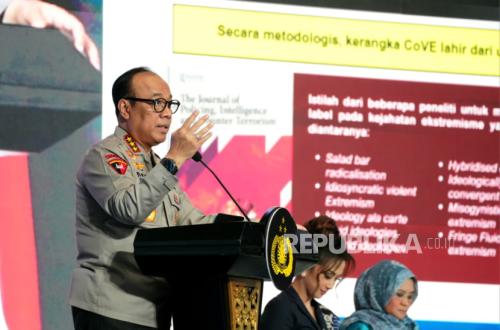
Deputy Chief of the Indonesian National Police (Wakapolri), Commissioner General Pol. Dedi Prasetyo, stressed that patterns of terrorism and extremism have undergone a fundamental change. The threat now moves from a structured model to a more fluid, adaptive digital network that is difficult to detect with conventional approaches.
The message was delivered by the Wakapolri at a forum discussing the direction of counter-terrorism and extremism, attended by the Head of the National Counter-Terrorism Agency (BNPT), Commissioner General Pol. (Ret.) Eddy Hartono, and Kadensus 88 AT Polri, Inspector General Sentot Prasetyo.
The forum was a moment to reinforce the policy direction of Indonesia’s counter-terrorism efforts, with increasing emphasis on early prevention, child protection, strengthening digital literacy, and a collaborative approach across sectors, as extremist patterns move faster than previous handling approaches.
Wakapolri asserted that all counter-terrorism strategies must be anchored in the Polri Grand Strategy 2025–2045 and aligned with Polri’s Strategic Plan 2025–2029, to ensure the effectiveness and sustainability of policies facing future dynamics.
“We are facing a major change. Terrorist patterns are no longer always present in the form of large organisations that are easy to map, but develop through digital spaces, loose sympathisers, and networks formed by algorithms. Therefore, our strategy must also change,” the Wakapolri said.
According to the Wakapolri, modern extremism is increasingly fragmented, moving through individuals or small groups without formal structures, yet consolidated through digital exposure and the social environment.
He explained that the perpetrators’ ideology is no longer always expressed as a single, coherent doctrine, but as fragments of ideology mixed according to the psychological and social needs of individuals. Therefore, the old approaches to understanding extremism need to be complemented with new perspectives such as Composite Violent Extremism (CoVE) to read ambiguous and convergent patterns.
In addition, the Wakapolri reminded that extremism today is ‘glocal’, as global information flows can rapidly influence local social dynamics through digital media.
“Extremism patterns can no longer be understood separately between global and local dimensions. The information flow moves quickly and can affect the social environment in a short time,” he said.
One of the main concerns raised by the Wakapolri is the increasing vulnerability of the younger generation to exposure to extremism and the normalisation of violence in the digital space.