
Wages, Productivity, and the Future of Indonesian Workers' Welfare
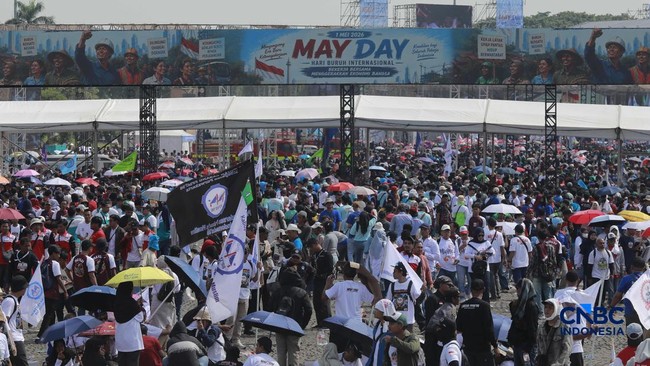
International Labour Day commemorations each year consistently raise the same demands: wage increases and improved welfare. However, behind these demands lies a more fundamental question: why does workers’ welfare still feel stagnant even as wages continue to rise? The answer is not singular.
It lies in the relationship that is not yet fully aligned between wages, productivity, and the dynamics of living costs faced by workers daily. Empirically, wage trends in Indonesia do show an increase.
The Central Statistics Agency (BPS) records that the average worker’s wage in November 2025 reached around Rp3.33 million per month. Over the past decade, the minimum wage has also continued to rise, with the national average UMP reaching around Rp3.11 million in 2024 and increasing by about 6.5% in 2025. Even in some regions like DKI Jakarta, the UMP has exceeded Rp5.3 million per month.
However, these figures do not automatically reflect an improvement in welfare. Data shows that more than half of workers—around 53%—still receive wages below the UMP standard. This indicates a gap between normative policies and field realities. In other words, the main issue is not just “how high the wage is set”, but also its distribution and implementation.
Further, from a real perspective, pressure on workers’ welfare also comes from inflation. In February 2026, annual inflation was recorded at 4.76%, with the main components coming from basic needs such as food and transportation.
In this condition, nominal wage increases are often eroded by rising living costs. As a result, workers’ purchasing power does not experience significant improvement. This is where it is important to distinguish between nominal wages and real wages.
Workers’ welfare is not determined by wage figures alone, but by the ability of those wages to meet living needs. When living costs rise faster than wages, real welfare actually declines. This explains why many workers still feel “not enough” even though wages statistically increase.
Regulatorily, Indonesia’s wage system has a fairly strong legal foundation. Law No. 13 of 2003 on Manpower affirms that workers are entitled to income that meets a decent livelihood. This principle is then strengthened in various derivative regulations, including changes in the framework of the Omnibus Law.
In the latest developments, the government regulates the formula for setting the minimum wage through regulations such as Government Regulation No. 36 of 2021, which was then updated through Government Regulation No. 51 of 2023 and the latest Government Regulation No. 49 of 2025. This formula generally includes inflation and economic growth components as the basis for calculation, aiming to maintain a balance between workers’ purchasing power and business sustainability.
This approach reflects a shift towards a more formula-based and technocratic system. However, on the other hand, this approach also has limitations. Economic growth as a proxy for productivity does not always reflect sectoral conditions or productivity distribution in the field. As a result, wage policies may not be fully responsive to the realities faced by workers.
The Needs for a Decent Living (KHL) component has so far been the normative basis for setting the minimum wage. Conceptually, KHL aims to determine the minimum needs standard for workers. However, in practice, KHL faces relevance challenges.
Society’s consumption structure has changed significantly. Needs such as internet, smartphones, and digital transportation have now become an integral part of workers’ economic activities, especially in urban areas. If the KHL components are not updated periodically, the standards used will lag behind reality.
In addition, there are significant differences between living costs in big cities and rural areas. Housing, transportation, and consumption costs in metropolitan areas are much higher than the national average. This causes uniform provincial minimum wage figures to often not sufficiently reflect actual living cost pressures.
The wage issue in Indonesia is essentially multidimensional and structural. One key factor is the low productivity in most economic sectors. Data shows that the national average wage is still around Rp3.3 million, with quite wide variations between sectors. High value-added sectors such as information and communication have average wages above Rp5 million, while informal and simple service sectors are much lower.
This condition shows that the main problem is not “the willingness to pay wages”, but the economic capacity of sectors to generate added value. As long as most of the workforce is still absorbed in low-productivity sectors, broad wage increases will be difficult to achieve sustainably.
In addition, the high level of informality is also a major obstacle. Informal workers are generally not protected by minimum wage regulations, so wage policies do not reach a large portion of the workforce. This explains why minimum wage increases do not always have a broad impact on workers’ welfare.
In economic theory, the relationship between wages and productivity is fundamental. Wages ideally reflect labour productivity. However, in practice in Indonesia, this relationship does not always run in tandem.
If wages rise faster than productivity, then labour costs per unit will increase, which could pressure competitiveness and employment absorption. Conversely, if productivity increases but is not followed by wage rises, then inequality