
Visiting Yogyakarta, British Ambassador Supports Transition to Low-Carbon Urban Mobility System
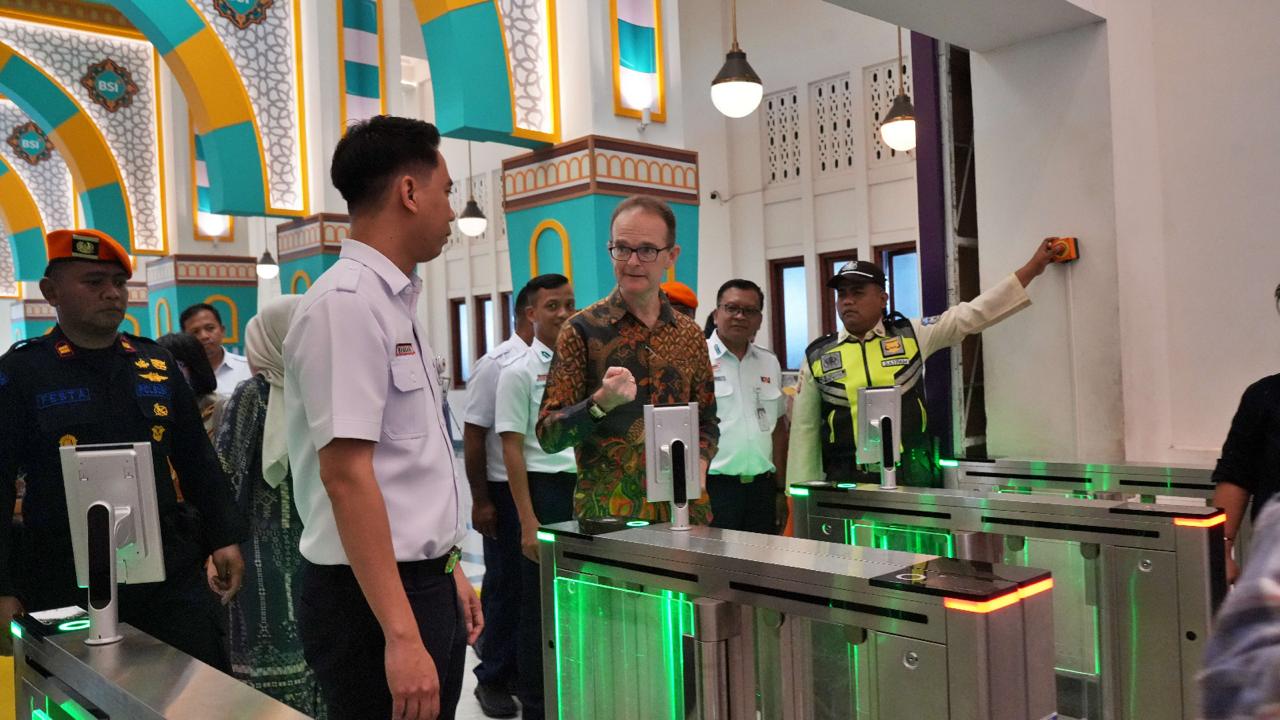
His Majesty’s Ambassador to Indonesia and Timor Leste, Dominic Jermey CVO OBE, visited Yogyakarta Station on Wednesday (8/4). Mr Jermey stated that the purpose of his visit was to strengthen collaboration between the UK and Yogyakarta.
“In Yogyakarta, the UK-Indonesia Strategic Partnership has shown tangible results. The UK-Indonesia Infrastructure Partnership supports the transition to a low-carbon and integrated urban mobility system,” he explained.
This support includes the development of implementation guidelines for Transit-Oriented Development (TOD) and Land Value Capture, as well as the technical assistance needed to lay the foundations for inclusive e-mobility planning.
“Beyond low-carbon mobility, we also support climate resilience efforts and community-based initiatives, from circular waste management in Bantul to social forestry and eco-tourism in Kulonprogo,” he added.
“Inclusivity is at the core of our approach, including through gender-responsive climate action and ensuring that transport systems serve all segments of society,” stated His Majesty’s Ambassador to Indonesia and Timor Leste, Dominic Jermey CVO OBE.
EVP of KAI Daop 6 Yogyakarta, Bambang Respationo, had the opportunity to accompany the British Ambassador in directly inspecting the service atmosphere and facilities at Yogyakarta Station, such as the face recognition system, passenger waiting rooms, passenger crossings, and departure platforms.
Bambang expressed appreciation for the attention given by the UK Government to the advancement of railway transport, which not only promotes intermodal integration but also inclusivity and environmental sustainability.
Bambang also conveyed that services embracing customer convenience, inclusivity, and environmental friendliness and sustainability are part of KAI’s spirit in carrying out various innovations and service improvements.
This also supports the government’s strategic programme targeting the achievement of Net Zero Emissions or clean net zero emissions by 2060 or earlier. Environmental sustainability will also become one of the important foundations in the future layout plan for Yogyakarta Station.
“The layout plan for Yogyakarta Station will not only increase capacity but also facilitate intermodal integration to enhance passenger safety and comfort,” he explained.
Passengers will be further facilitated in accessing onward transport from the station with various onward mode options according to their needs. This layout plan certainly also embraces the spirit of environmental sustainability and supports the preservation of Yogyakarta’s cultural values and local wisdom,” stated Bambang Respationo.
Manager of Public Relations for KAI Daop 6 Yogyakarta, Feni Novida Saragih, stated that various efforts to improve sustainable and environmentally friendly services have been carried out by KAI Daop 6 Yogyakarta in recent years.
The face recognition boarding system reduces paper usage, water station facilities providing free drinking water for customers also reduce the use of single-use plastic bottles, umbrella drying machines to reduce plastic usage, and various other environmentally friendly innovations.
“In addition, choosing to use rail transport has also become an active participation by the community in supporting environmental preservation,” she said.
Trains are a low-emission mode of transport. The Carbon Footprint feature in the KAI Access application allows passengers to view and calculate the estimated carbon emissions produced during rail journeys.
Various efforts to improve inclusive, integrated, environmentally friendly, and sustainable services will continue to be provided by KAI Daop 6 Yogyakarta, and this certainly requires support from all parties, including rail passengers.