
Visit to Central Java and East Java: Customs Director General Pushes for Revenue Performance and Integrity
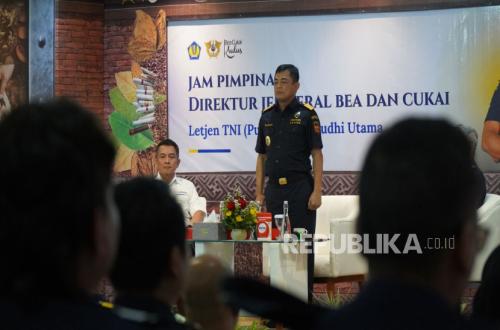
JAKARTA - The Director General of Customs, Lieutenant General TNI (Ret.) Djaka Budhi Utama, carried out a series of working visits to three regional offices, namely the Central Java and Yogyakarta Customs Regional Office, the East Java II Customs Regional Office, and the East Java I Customs Regional Office. This working visit aimed to ensure that state revenue performance remains optimal while strengthening employee integrity.
The activities were held centrally at the Kudus Customs Office, Kediri Customs Office, and Pasuruan Customs Office. Through this visit, all levels of employees in each region could receive direct and comprehensive strategic guidance from the leadership.
“In the current global conditions marked by conflicts, we must not lower the quality of services and supervision,” said Djaka.
The visit began at the Kudus Customs Office, which serves as the consolidation point for the Central Java and Yogyakarta Customs Regional Office. On this occasion, Djaka highlighted the changing characteristics of the Kudus Customs Office, which is no longer solely reliant on the excise sector but has also rapidly developed in bonded zones.
He emphasised the importance of focusing on these two core businesses and encouraged all ranks to remain optimistic in achieving the 2026 revenue targets. He also reminded the importance of maintaining integrity by implementing the zero fraud principle and avoiding practices that could damage public trust.
In addition, strengthening teamwork was a primary concern. Djaka stated that organisational performance cannot be achieved individually but through solid collaboration. In the context of global uncertainty, Customs is required to maintain a balance between optimising state revenue and providing facilities to business actors without sacrificing service quality or supervision.
The visit then continued to the Kediri Customs Office as the meeting point for the East Java II Customs Regional Office. In his directions, the Director General appreciated the revenue achievements of the Kediri Customs Office while still emphasising the need for continuous improvement, especially in increasing revenue performance.
He also highlighted the importance of maintaining integrity amid public complaints. According to him, sting operations (OTT) must serve as an early warning for all employees to continuously improve. On the other hand, limited human resources amid the increasing number of bonded zones in the East Java II Regional Office area demand innovation and the utilisation of technology to ensure services remain optimal.
Another strategic issue that received attention was the dependence of revenue on the tobacco industry. Djaka stressed the need to strengthen supervision to protect the legal industry from the circulation of illegal cigarettes.
“If we want to remain trusted, show our best performance,” he said, while reminding the importance of maintaining public trust in the institution.
The series of visits concluded at the Pasuruan Customs Office, which is the backbone of national excise revenue. The Director General affirmed the strategic role of that office in supporting state revenue.
“The Pasuruan Customs Office is the largest contributor to excise revenue in Indonesia; I am here to jointly ensure that revenue targets can be achieved,” he stated.
In his directions, the Director General once again emphasised the importance of teamwork and integrity as the main foundation of the organisation. He reminded that success is not only measured by numerical achievements but also by real contributions to maintaining state revenue stability and supporting the national economy. Supervision of potential violations in customs and excise matters, including various new modus operandi, must also be continuously strengthened.
Not only serving as an internal evaluation medium, the Director General of Customs’ visits to these three service offices also provide direct benefits to the public. With strengthened integrity and improved revenue performance, Customs is committed to delivering faster, more transparent, and accountable services to business actors. On the other hand, more effective supervision will protect domestic industries from illegal practices, thereby creating a healthy and fair business climate.
Through this series of visits, Customs reaffirms its commitment to continuously improve and strengthen its role as a professional and trusted institution, while ensuring that every policy and step taken has a real impact on society and national development.