
Viral Seawall Cliff Collapse at Uluwatu Battered by Waves; Badung PUPR Responds
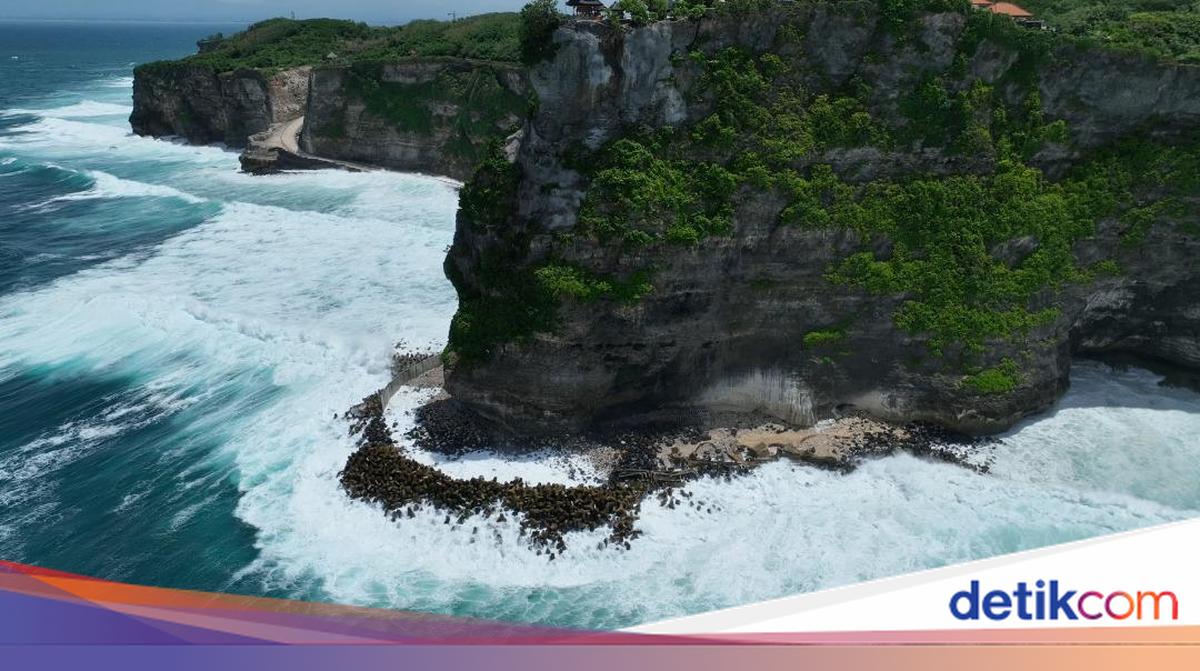
A seawall construction project at Pura Luhur Uluwatu, Pecatu Village, South Kuta, Badung, Bali, has drawn public scrutiny. Based on narratives that went viral on social media, the construction of the cliff stabilisation project appeared damaged and deteriorated from wave impact.
Acting Head of Badung’s Department of Public Works and Spatial Planning (PUPR), Anak Agung Rama Putra, responded to the situation. According to him, the seawall construction project is currently in the first of three planned phases.
“Our activity is actually in phase one. Phase one is intended to establish an inspection road and to dampen and reduce wave impact,” said Rama Putra on Thursday (12 March 2026).
Rama Putra explained that the first phase of the Uluwatu cliff stabilisation project focused on opening an inspection road whilst dampening wave impact. He noted that the maximum wave height that the currently installed breakwater structure can withstand is approximately 4–6 metres.
“This is a design and build project, so the movement is parallel between the planner and the implementer,” he added.
Rama explained that the scattered rocks visible and circulating on social media are part of the base layer of the inspection road used for mobilising materials and heavy equipment. He affirmed there was no damage to the revetment and that the Uluwatu cliff stabilisation project would continue.
“The scattered rocks you see are actually for the inspection road, so the rocks must be placed down to the bottom,” said Rama.
Meanwhile, Arisandi Putra, consultant planner for the Uluwatu temple cliff stabilisation project, explained that technically, the scattered rocks in the project area were placed irregularly. According to him, this was to achieve a stable position against wave impact.
“It may appear as if the rocks are scattered from this view. The rocks are indeed made to appear scattered; when scattered, once they are hit by waves they demonstrate a stable position. A stable position means that changes in the structure are no longer significant,” said Arisandi.
After the first phase, Arisandi stated, the second phase of the cliff stabilisation project is targeted to commence in April and be completed by 2028. According to him, the primary focus of the Badung Regency Government is currently to reduce wave impact so that the Uluwatu cliff is truly safe.