
Viral but Neutral
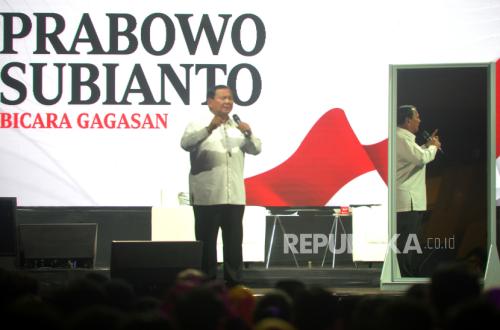
In his briefing to ministers and BUMN leaders in Jakarta on 8 April 2026, President Prabowo Subianto claimed that his government has worked effectively and reliably over the past one and a half years. The President appeared confident that his popularity remains very high.
That confidence is indeed warranted. The latest Indikator Politik Indonesia survey, released in February 2026, states that public satisfaction with President Prabowo Subianto’s performance stands at 79.9%. Not only that, Praxa Institute’s research on media coverage and social media posts about the President’s meeting with journalists and observers in Hambalang on 19 March 2026 also reveals a unique communication paradox.
This meeting was a clever effort to orchestrate narratives. The President opened space for his harshest critics at the same table. A series of sharp questions were posed to the President that were difficult to answer straightforwardly. It is no wonder that suspicions arose that the meeting would diminish the President’s popularity.
In reality, over the 11 days following the meeting until the end of March 2026, public conversation about it exploded to more than 41,000 mentions. The conversation was dominated by snippets of heated debates between the President and Najwa Shihab. However, the sentiment detected was overwhelmingly neutral.
Mainstream media recorded neutrality rates up to 99.1%. In the digital space, despite extraordinarily high noise levels, the public’s stance did not immediately crystallise, let alone judge.
Negative narratives emerged in limited fashion, mainly related to concerns over civil liberties, while positive tones highlighted firmness in law enforcement. A similar pattern was observed in the digital space: conversations were lively, even intense, but did not crystallise into a firm collective stance. Platform X became the most active arena for amplification and criticism, while Facebook and YouTube developed as spaces for deeper discourse.
The emerging topics were not singular. Geopolitical issues and international relations dominated conversations, followed by debates between the President and Najwa Shihab, fiscal policy, and civil liberties issues. This fragmentation of issues shows that the public absorbs multiple pieces of information at once but has not yet crystallised them into a single coherent assessment. Thus, that paradox emerges: noisy conversation without clear judgement.
Finance Minister Purbaya Yudhi Sadewa may claim that the minimal negative tone towards the President results from successful APBN policies that have kept energy prices affordable. But this phenomenon cannot be read so simplistically. The Minister’s claim remains vulnerable because it is not built on fundamental economic transformation or improvements in public welfare.
It is more reasonable to understand this neutral phenomenon as a transitional phase in public opinion formation—a condition in communication studies known as the pre-consensus stage, when attention has consolidated but meaning has not yet formed. There is a kind of collective wait-and-see attitude from the middle class. They are watching very closely but are not yet confident enough to take a firm position. They prefer to hold back—observing, comparing, and waiting before deciding on a stance.
Within the framework of agenda-setting theory (McCombs & Shaw), the media may not yet have determined how the public should think, but it has successfully determined what should be thought about. Key issues—geopolitics, fiscal policy, to civil liberties—have entered the public agenda. However, interpretations of these issues remain fluid and open.
This phenomenon also reflects a classic shift in the two-step flow of communication (Katz & Lazarsfeld). The media is no longer the sole actor in opinion formation. The public now awaits articulation from opinion leaders—analysts, academics, to public figures—to help crystallise meaning. The absence of dominant framing in the media indicates that this process is still ongoing.