
Viewing the Total Lunar Eclipse with ITB's Bosscha Observatory
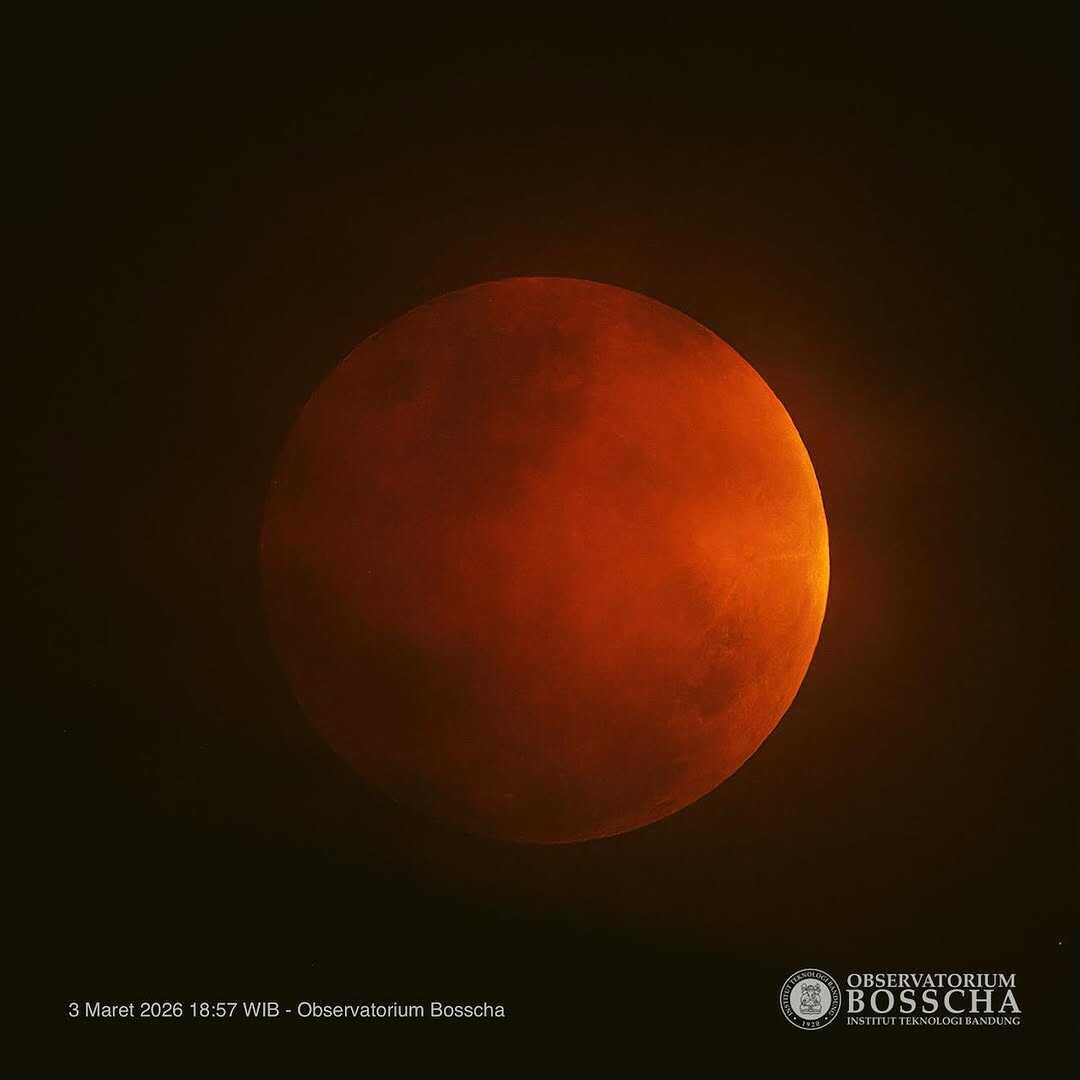
During Ramadan, ITB’s Observatorium Bosscha organised a virtual sky-watching event titled ‘Virtual Night Sky Observation (PVLM): Total Lunar Eclipse’, broadcast live on the observatory’s YouTube channel. The programme was hosted by education staff Dimas Gilang Ramadan and Fatimah Zahra, and despite cloudy conditions in Lembang, the team captured crucial moments as the Moon entered Earth’s shadow. In the educational segment, Dimas explained that a Total Lunar Eclipse occurs when the Sun, Earth and Moon align, causing the Moon to pass into Earth’s umbra. The spectacle’s red hue, often referred to as the Blood Moon, results from Earth’s atmosphere scattering blue light. The brightness of the red colour is measured using the Danjon Scale, with atmospheric conditions such as pollution or volcanic dust influencing how dark or bright the hue appears. As the oldest scientific institution in Indonesia, Bosscha relies on modern equipment to present the best possible images to the public. The observation employed a Refractor Telescope with a 6.15 cm diameter lens, a DSLR camera, and a panorama camera to monitor weather conditions on the eastern horizon. Image data from Bosscha is also transmitted to the Slooh Observatory network as part of an international astronomical collaboration. Beyond the science, PVLM also explored humanities through folklore, including the Batarakala myth in Java and Bali, which is believed to ‘consume’ the Moon, and Africa’s Batamariba tradition, which views eclipses as a moment for reconciliation of conflicts. The event was timely given Ramadan and other religious holidays in Indonesia, ending with a message of tolerance and unity under the same sky. For those who missed the event, observers were reminded that this Total Lunar Eclipse is the only one observable in Indonesia in 2026, with a similar phenomenon not due to occur again until 31 December 2028. ITB remains committed to delivering inclusive science to the public. For information on other celestial phenomena, the public can access the Astronomy Calendar 2026 via bosscha.itb.ac.id.