
Vietnam's top leader To Lam arrives in China for first state visit
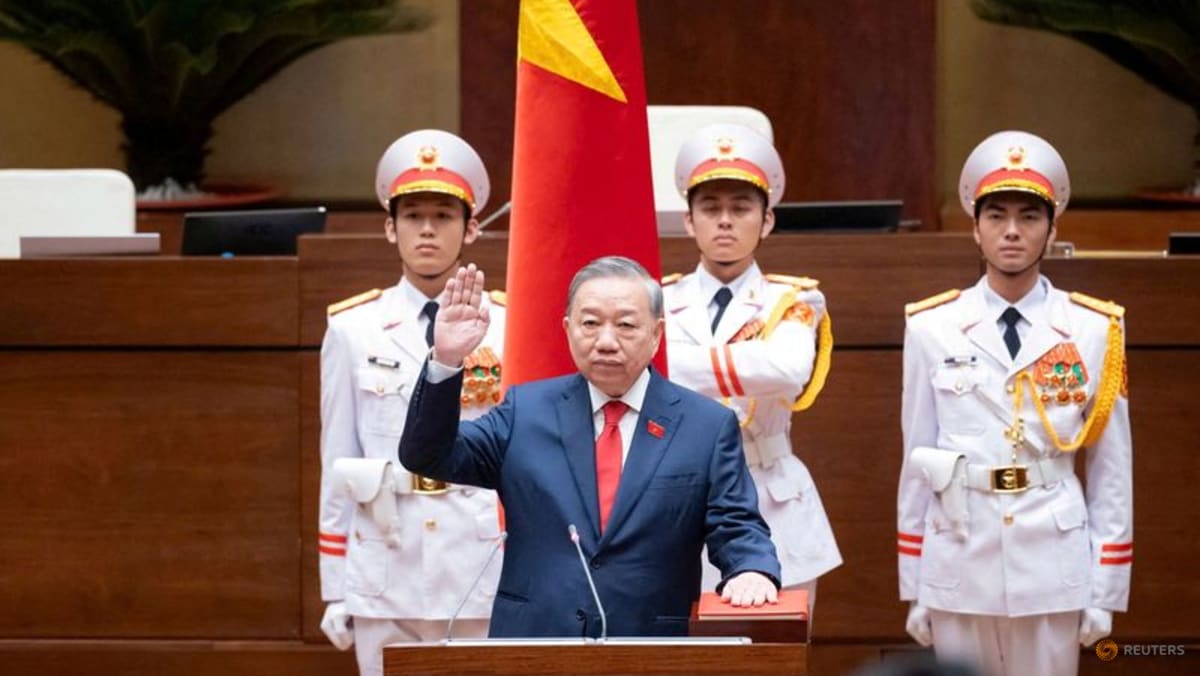
Vietnam’s top leader To Lam arrives in China for first state visit
The 68-year-old assumed the presidency while retaining his role as Communist Party chief – a dual mandate analysts say could bolster Vietnam’s global ambitions.
HANOI: Vietnam’s newly appointed President To Lam arrived in China on Tuesday (Apr 14) for his first overseas visit as head of state, signalling Hanoi’s foreign policy priorities under his leadership.
The 68-year-old, unanimously elected by lawmakers to a five-year term, assumed the presidency while retaining his role as Communist Party General Secretary – a dual mandate analysts say could bolster Vietnam’s global ambitions.
The visit comes as Vietnam seeks to play a bigger role in geopolitics.
This reflects a broader shift formalised at the party’s five-yearly congress in January, where foreign affairs was elevated to one of the country’s core pillars for the first time.
In his first speech as president last Tuesday, Lam – a former head of public security – underscored Vietnam’s commitment to contributing to global peace and development, a theme he has consistently highlighted.
GROWING DIPLOMATIC FOOTPRINT
Vietnam has increasingly positioned itself as an active player on the international stage.
In 2024, it launched the ASEAN (Association of Southeast Asian Nations) Future Forum as an annual platform, drawing global leaders including Malaysia’s Prime Minister Anwar Ibrahim, Timor-Leste President Jose Ramos-Horta and New Zealand Prime Minister Christopher Luxon.
Last month, Hanoi hosted the inaugural Vietnam-China ministerial-level “3+3” strategic dialogue, covering areas such as public security, defence and foreign affairs.
The country is also preparing to host the Asia-Pacific Economic Cooperation (APEC) forum next year and is set to assume the ASEAN chairmanship in the coming years – further signs of its growing diplomatic footprint.
Observers note that Vietnam’s geopolitical role has traditionally been reactive, but this is beginning to change.
Hanoi is now pursuing two key objectives of sustaining economic growth and strengthening its ability to defend itself proactively, including beyond its borders.
Le Hong Hiep, senior fellow and coordinator of the Vietnam studies programme at the ISEAS-Yusof Ishak Institute, said the shift comes amid rising uncertainties.
“In the current context where there have been a lot of geopolitical changes that tend to undermine peace and stability in the region, the task of defending the country from afar and early has become more prominent from the party’s perspective,” he noted.
“I think that’s why the party has advanced the role of foreign affairs to one of constant and prominent significance.”
Lye Liang Fook, associate senior fellow at the institute, said Vietnam’s timing in seeking a bigger role is understandable.
“It is not surprising that Vietnam is seeking to play a bigger role in geopolitics given its relatively big population in Southeast Asia, as well as the dynamism of its economy with the target of growing 10 per cent over the next few years,” said Lye, who was previously from the Vietnam studies programme but is now focusing his research area on China.
“More importantly, given the global headwinds caused to a large extent by America’s policies and actions, Vietnam as well as other countries will need to play a more active role to diversify risks, search for new market opportunities and work with key partners to continue to grow and remain stable,” he added.
CONTRIBUTING TO GLOBAL PEACE
Lam’s trip to China is likely to be the first of many overseas visits as head of state.
With his consolidated leadership as both party chief and president, analysts believe Lam is well-positioned to leverage foreign partnerships to advance the country’s interests.
At the same time, deeper engagement brings challenges, they warn.
In particular, Vietnam will need to carefully navigate intensifying rivalry between major powers.
Experts believe it is in the country’s interest to balance relations with both China and the United States, a strategy expected to remain in place for years to come.
Meanwhile, Vietnam’s expanding global engagement could bolster its image as a rising middle power ready to contribute more actively to international peace efforts.
One example is its participation in United Nations peacekeeping missions in Africa over the past decade – a move analysts say signals Hanoi’s willingness to take on greater global responsibilities.
ISEAS-Yusof Ishak Institute’s Hiep said: “Vietnam can play a more active role going forward if (it) can sustain its economic development and get more resources for its international contributions and commitments.”