
Vidi Aldiano's Final Question to Husein Ja'far and the Two Best Gifts for the Late
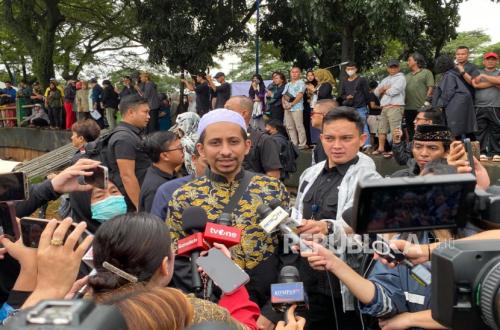
REPUBLIKA.CO.ID, JAKARTA — Rain fell as they carried the coffin. Not rain forcing people to seek shelter, but a gentle rain, as if whispering. At Tanah Kusir Public Cemetery in South Jakarta, that Sunday morning, the sky seemed to share the grief with hundreds of people standing in silence, shedding tears, or simply gazing at the red earth slowly covering a name.
Vidi Aldiano. Oxavia Aldiano. Aged 35. He passed away on Saturday (7 March) at 16:33 WIB, after seven years contending with kidney cancer, not with bitterness, but in a way that left many wondering: from where did he draw such strength?
The funeral service lasted about two hours. The faces familiar from screens and stages appeared that day without costumes, without roles, only as people who have lost someone. Afgan, Bunga Citra Lestari, Vincent Rompies, Enzy Storia, Nadin Amizah, Fadil Jaidi, Anya Geraldine, and Deddy Corbuzier who came with his two children, Azka and Nada, looked to support one another in a mood that required no words.
Sheila Dara Aisha, his wife, attended with close family guarding her. The lead actor from the film Sore looked deeply devastated. Around 10:00 WIB, she left the cemetery, bearing a grief that would not be resolved in a single day.
In addition to family and colleagues from the entertainment industry, local residents also crowded the area in front of the cemetery gates. Vidi was not only the stage’s; he belonged to many people who may never have shaken his hand, but who felt close through his songs.
Outside the cemetery gates, Habib Jaar, the preacher who has long been a confidant for Vidi on religious matters, stood before the media with eyes that held sadness as well as peace.
He said that although they had not met directly for a long time, they still communicated frequently via WhatsApp. And their conversations, Habib Ja’far said, were never about trivial matters.
“All his communications were about how he could better himself, deepen his worship. That is what he always asked about,” he said.
The last question Vidi asked, according to Habib Ja’far, was how to perform wudu and salat in light of his increasingly limited physical condition. A question small in words, but large in meaning, a man whose body was surrendering, yet whose heart did not want to stop reaching toward God.
Habib Ja’far then cited something that made the atmosphere fall silent for a moment: Vidi did not pass away on an ordinary day. He died in the month of Ramadan, precisely on the night believed to be the night the Qur’an was revealed, 17 Ramadan, the night of Nuzulul Quran.
“Insha Allah, our friend, our family, Vidi Aldiano, is in the best possible state, because on the best day and the best month—the holy month of Ramadan—and the night of the Qur’an’s revelation, i.e., Nuzulul Quran,” he said.
In Islam, the testimony of people about the goodness of someone who has died is a prayer. And that day, the testimonies flowed from everywhere. Habib Ja’far reminded that the seven-year illness Vidi endured, faced without much complaint, could be a means of cleansing sins, a theological consolation that feels profoundly humane amid the grief.