
Video: BI and Ministry of Finance "Key" to Strengthening the Economy Against Rupiah Volatility
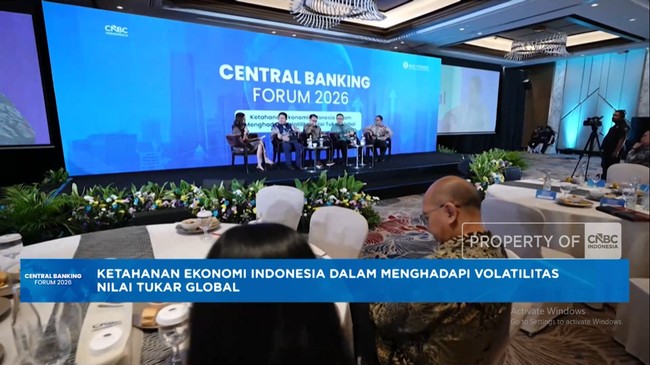
Jakarta, CNBC Indonesia - CNBC Indonesia, in collaboration with Bank Indonesia, presents the Central Banking Forum 2026 with the theme “Indonesia’s Economic Resilience in Facing Global Exchange Rate Volatility”. The forum thoroughly examines Indonesia’s responses and those of monetary authorities to global challenges, while strengthening national economic resilience and maintaining market confidence and positive perspectives.
Head of the Monetary and Securities Asset Management Department at Bank Indonesia, Erwin Gunawan Hutapea, reaffirmed the Rupiah exchange rate’s good condition. From the inflation perspective, it is maintained at 3.8% with a still strong trade balance and foreign exchange reserves that are sufficient.
Meanwhile, Director of Strategic Economic Stability at the Directorate General of Fiscal Economic Strategy, Ministry of Finance of the Republic of Indonesia, Noor Faisal Achmad, assured that the state budget is healthy to support Indonesia’s economic growth, supported by 10.5% tax revenue growth at the beginning of the year despite a surge in Q1-2026 spending.
The Ministry of Finance also ensures that the state budget is still capable of funding the energy sector amid global energy price spikes. Meanwhile, in managing state debt amid rising government bond yields, the Ministry of Finance has prudent and efficient strategies.
On the other hand, BCA’s Chief Economist, David Sumual, stated that the weakening of the exchange rate experienced by the majority of currencies, including the Rupiah, is due to the market’s short-term focus primarily on oil prices. This has led foreign investors to engage in capital outflows in equities and government bonds, although in the SRBI it recorded capital inflows, which could serve as a buffer for foreign reserves and the Rupiah.
Additionally, long-term improvement measures are needed, such as those carried out by China in developing renewable energy sources to reduce fossil fuels.
Meanwhile, Executive Director of the Center of Reform on Economics (CORE), Mohammad Faisal, provided views on the economic indicators that the government and monetary authorities must pay attention to amid pressure on the Rupiah exchange rate and global economic turbulence in 2026, related to real sector conditions up to fiscal and financial conditions.
Compared to the 1998 crisis or Covid-19, one real sector condition amid the US vs Iran war in 2026 that must be maintained is the purchasing power of the middle class, which has experienced pressure. In addition, fiscal governance must also be considered to maintain investor confidence in Indonesia.
For more details, watch the dialogue by Syarifah Rahma with the Head of the Monetary and Securities Asset Management Department at Bank Indonesia, Erwin Gunawan Hutapea, along with the Director of Strategic Economic Stability at the Directorate General of Fiscal Economic Strategy, Ministry of Finance of the Republic of Indonesia, Noor Faisal Achmad, and BCA’s Chief Economist, David Sumual, as well as the Executive Director of the Center of Reform on Economics (CORE), Mohammad Faisal, in the Central Banking Forum 2026, CNBC Indonesia (Tuesday, 14/04/2026).