
Vice President Ma'ruf Urges Government to Anticipate Impact of Indonesia-US Trade Deal on Halal Products
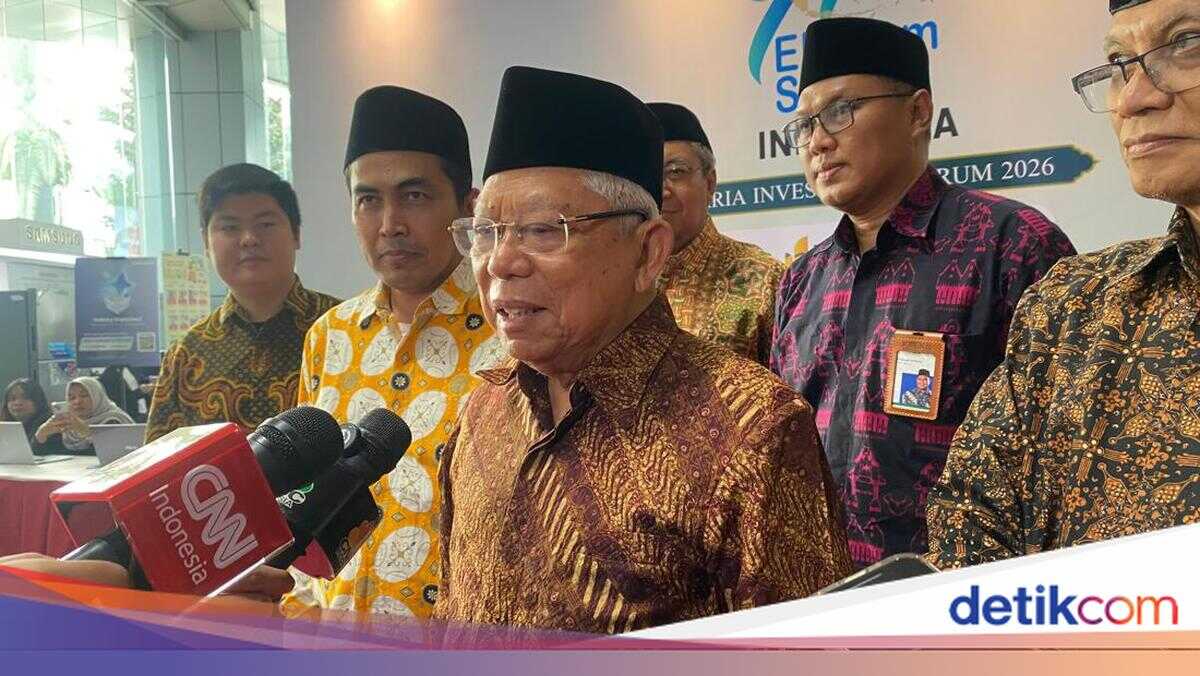
Indonesia’s 13th Vice President, Ma’ruf Amin, has responded to the reciprocal tariff agreement between Indonesia and the United States, which impacts regulations concerning halal products. Ma’ruf Amin has urged the government to anticipate the impact on domestic halal products to prevent them from being overshadowed by imported goods.
“Yes, I believe that, as this is a government policy, we must anticipate it, particularly for our halal products. And we shouldn’t focus solely on one country,” said Ma’ruf Amin after attending the ‘99 Indonesian Islamic Economists Forum’ at Menara Mega, South Jakarta, on Tuesday (24 February 2026).
Ma’ruf Amin hopes that Indonesia’s export cooperation will not be limited to a single country. This way, unilateral policies from other countries will not have a significant impact on Indonesia, as it will have other target markets.
“Yes, we must expand our exports to other countries, especially Muslim countries or countries with a significant Muslim population, even if they are not Muslim countries,” said Ma’ruf Amin.
“And I believe that market is quite large. So, we shouldn’t rely on traditional markets. We must build new markets around the world so that, if this policy has an impact, we can offset it by opening up new markets,” he added.
He also commented on the halal product labelling in the US, which could be recognised as valid in Indonesia. According to Ma’ruf, this is already being implemented, citing the Islamic Food and Nutrition Council of America (IFANCA) as an example of an internationally recognised halal certification body, including by BPJH Indonesia.
“There are halal certification bodies in the US that we endorse; previously, it was done by the Indonesian Council of Islamic Scholars (MUI). There are several, about five, and IFANCA is one of them,” said Ma’ruf.
“As long as the halal certificate is issued by a body that we endorse, there is no problem,” he added.
BPJH Emphasises that US Products Must be Halal Certified
The Halal Product Guarantee Organising Agency (BPJPH) has affirmed that the reciprocal cooperation agreement between Indonesia and the United States does not eliminate the obligation for halal certification and labelling for products entering and circulating in Indonesia. BPJPH has stressed that US products entering the country must meet the requirements.
“All products that fall under the mandatory halal category and enter, circulate, and are traded in Indonesia, including imported products from the United States and other countries, must still comply with halal certification requirements and the inclusion of halal labels in accordance with regulations,” said Head of BPJPH, Ahmad Haikal Hasan, in Jakarta on Monday (23 February 2026).
He emphasised that it is not true that US products can enter Indonesia without halal certification. The obligation for halal certification in Indonesia remains in accordance with the mandate of Law Number 33 of 2014 concerning Halal Product Guarantee and its implementing regulations.
Non-halal products are exempt from the obligation to be halal certified and must include a statement indicating that they are not halal, in accordance with applicable laws and regulations.
Currently, there are five halal certification bodies (LHLN) in the US that have cooperated with BPJPH, namely the Islamic Food and Nutrition Council of America (IFANCA), the American Halal Foundation (AHF), Islamic Services of America (ISA), Halal Transactions, Inc/Halal Transactions of Omaha (HTO), and the Islamic Society of Washington Area through the Halal Certification Department (ISWA).
These five bodies have undergone an assessment and evaluation process in accordance with BPJPH regulations before receiving recognition for the equivalence of their halal guarantee systems.
“Reciprocal cooperation is not the elimination of the halal obligation. Every product that is required to be halal and enters Indonesia must still be halal certified and include a halal label in accordance with applicable laws and regulations. The state is present to ensure that the protection of Muslim consumers remains intact,” Haikal Hasan continued.
See also Video: Indonesia Faces Turmoil Over US Trade Tariff Policy.