
Vehicle Volume Increases, MBZ Toll Road Temporarily Closed
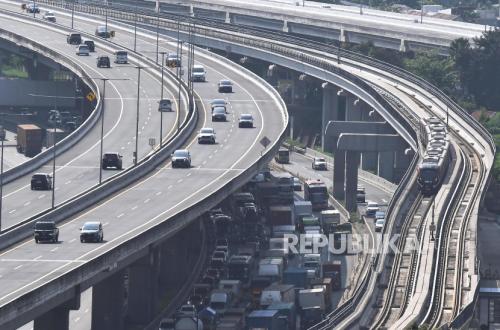
REPUBLIKA.CO.ID, JAKARTA – The Indonesian National Police Traffic Corps (Korlantas Polri) temporarily closed the Mohamed Bin Zayed or MBZ toll road section on Thursday afternoon (19/3/2026). The closure was carried out due to an increase in vehicle volume causing traffic congestion.
“This year is somewhat different because we had to temporarily close MBZ earlier. We have implemented the national one-way system, but the peak flow is still high,” said the Head of the Traffic Corps (Kakorlantas) Inspector General of Police Agus Suryonugroho at the Command Centre Post KM 29 of the Cikampek Toll Road in West Java.
He stated that based on data, the total vehicle volume up to Thursday morning reached 270,000 vehicles. This number, he said, is an increase compared to the 221,000 vehicles on Tuesday (17/3/2026).
Therefore, various traffic engineering measures were applied, including the temporary closure of the MBZ toll road. Mudik travellers had to use the Jakarta-Cikampek toll road below it.
After being closed for about 1.5 hours, he said that the MBZ toll road can now be used again. “We closed MBZ for almost 1.5 hours earlier. Because the contraflow measures have been completed, we have reopened it, and alhamdulillah, it is now smooth,” he said.
The surge in mudik traffic occurred throughout Wednesday (18/3/2026) and accumulated until Thursday morning (19/3/2026). The high mobility prompted the implementation of more dynamic traffic engineering on the Trans-Java Toll Road sections. This increase in volume affects the character of traffic flow this year. A traffic peak occurred on Thursday from 10:00 to 11:00 WIB, although overall conditions remained under control.
Korlantas is still implementing the national one-way system to maintain smooth vehicle flow. The impact of these engineering measures is also monitored up to arterial routes. To alleviate congestion, officers applied contraflow gradually from kilometre 36 to 70. The scheme started with one lane, then two lanes, up to three lanes, following the dynamics of the traffic peak in the field.
“From kilometre 36, we have implemented one-lane contraflow up to 47. After there was still a peak, from 47 we extended it to 48, then we implemented three-lane contraflow up to 70,” Agus explained.
He said that the flow towards Trans-Java is monitored as smooth after the national one-way scheme was applied. Congestion instead occurred in Central Java, particularly at the Krapyak exit due to high vehicle flow from the west.
Local police implemented local one-way systems to reduce that congestion. Similar engineering was applied at several other points according to field conditions. Traffic management is not only focused on toll roads. Arterial routes are also a concern, especially in urban areas like Brebes and Pemalang which have the potential for vehicle build-up.
Field officers prepared diversions to ring roads or alternative routes to reduce the traffic burden in city centres. This step is considered effective in maintaining smooth vehicle flow.
In Operation Ketupat, Polri prioritises security in five main clusters, including toll roads, arterial routes, crossings, transportation hubs, as well as places of worship and tourist areas. Security also covers the takbiran series up to the Id prayer implementation.