
Vanita Naraya Research: Women Now Trusted to Lead in Crisis Situations
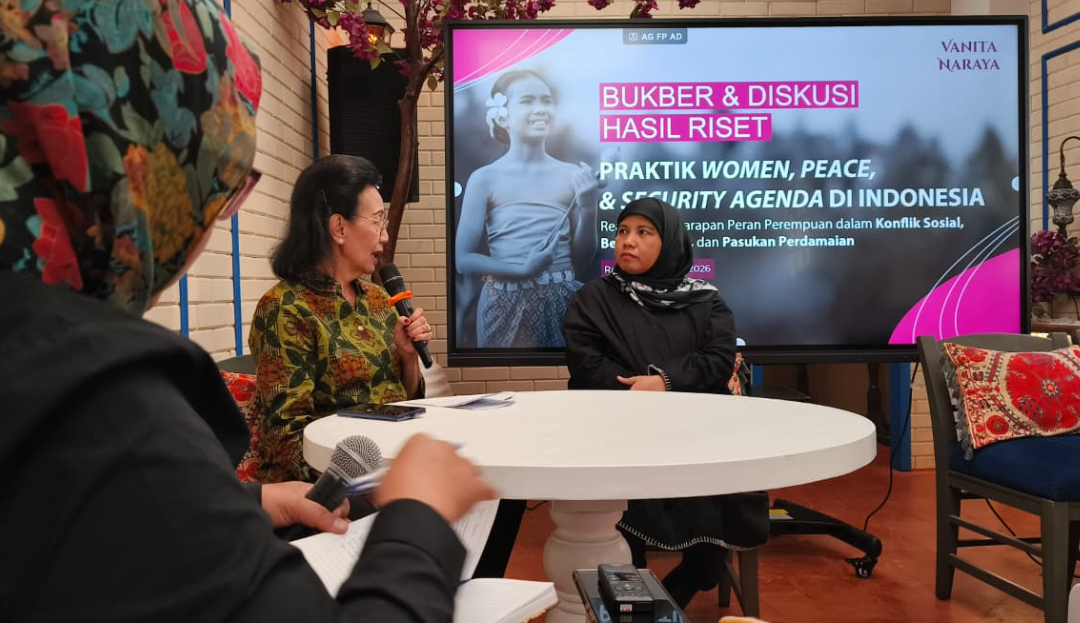
In every conflict and disaster situation, women are now increasingly perceived as dominant figures in driving justice and defending human rights in Indonesia. This is reflected in the results of research conducted by the Vanita Naraya organization on the Women, Peace, and Security (WPS) agenda.
The research reveals a significant shift in how the Indonesian public views the role of women in conflict and disaster situations. Vanita Naraya researcher, Kunto Adi Wibowo, stated that the public strongly rejects the narrative of women as passive victims in social conflicts.
Instead, Kunto said, the research found strong public support for women to take on strategic roles as peace activists.
“The public gives a strong mandate for women to take on strategic roles as activists who promote justice and defend Human Rights,” he said in Jakarta on Wednesday (February 25).
However, public trust in women’s leadership is not uniform in all types of crises. In the context of natural disasters, women actually receive the highest legitimacy as social leaders.
“In natural disaster situations, women receive the highest legitimacy as social leaders, with a figure of 21.5 percent,” he added.
Conversely, this legitimacy declines sharply in social conflicts with political undertones, when women are still directed towards preventive roles such as educators and peacekeepers. In the research, Kunto highlighted that the conflict arena has shifted to the digital space. Women are seen as playing a crucial role as a cultural early warning system.
In addition, the public views women’s literacy skills, persuasive communication, and family education as key to reducing the flow of misinformation and hate speech.
Kunto concluded that the biggest challenge in implementing the WPS agenda in Indonesia is no longer about normative recognition, but about the courage to transform policies.
“The public no longer wants women to be protected passively, the public wants women to be able to actively fight for human rights,” he added.
Meanwhile, the Vanita Naraya Advisory Board, Gusti Kanjeng Ratu Hemas, emphasized that women’s perspectives have a unique strength in conflict resolution, with a dialogical approach and a focus on sustainable peace.
Based on her experience during the Maluku conflict, women played a key role as peace creators through simple activities in public spaces.
“These barters were carried out by women as peace creators at that time,” she added.
In the context of disasters, GKR Hemas rejects the view that only places women as a vulnerable group. In fact, women have a dual role, ranging from organizing assistance to providing psychological recovery for women and children.
“Women are not just a vulnerable group that needs to be protected, but also have a dual role in organizing assistance and managing public facilities,” she said.
The Chairperson of Vanita Naraya, Diah Pitaloka, stated that the role of women in conflict and crisis situations has often been marginalized, even though in reality they are very central at the community level.
Diah explained that a qualitative-based study forum was held to highlight this reality. According to her, women play an important role in maintaining the survival of residents during a crisis.
“For example, managing women’s logistics, for example. Maintaining access to life-sustaining resources such as water and food supplies, and also maintaining the stamina of residents,” she said.
Women, she added, are often able to be decision-makers on the ground because they directly understand the conditions of their community. However, this contribution has not been accompanied by equal recognition of leadership.
“We actually want there to be recognition of women’s leadership, which is sometimes not seen,” she said.
On the other hand, she believes that women are not enough to be given a workspace without access to decision-making, even though they have practical knowledge and skills related to the needs of residents. In addition to structural recognition, she also highlighted the importance of increasing women’s capacity through training.
“The importance of various training materials, including digitalization and digital literacy for women, as well as leadership or management materials in the midst of a crisis,” she concluded.