
US Supreme Court's Trump Tariff Reversal Creates New Trading Risks, Warns Indonesian Economist
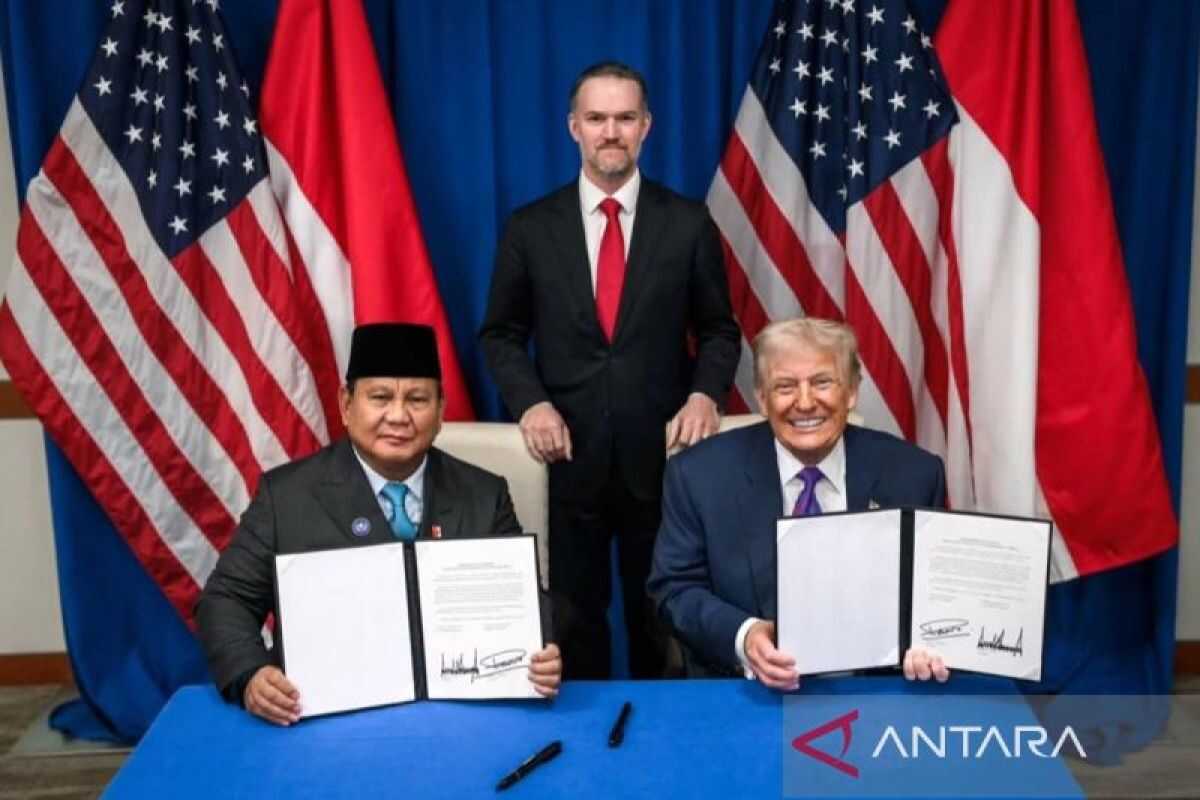
Agreement could be signed today, but the legal basis could change within months
Jakarta (ANTARA) - The Chief Economist of Trimegah Sekuritas Indonesia, Fakhrul Fulvian, has said that the decision by the Supreme Court of the United States to overturn Trump’s reciprocal tariffs has created new risks in the global trading system.
According to him, this legal dynamic within the US adds a new layer of uncertainty, not only for the US domestic economy, but also for partner countries, including Indonesia.
“We no longer live in an era where trade policies move in a linear fashion. We are entering what I call the age of policy reversibility. An agreement could be signed today, but the legal basis could change within months,” said Fakhrul in Jakarta on Wednesday.
He explained that tariff policies are no longer just a matter of geopolitics, but also a constitutional and legal issue.
The Executive Order, which forms the basis for the implementation of tariffs, can be challenged and even overturned through judicial mechanisms. This creates a new form of uncertainty in the architecture of global trade.
“Supply chains are designed for five to ten years. Factories are built with a long-term horizon. However, tariff policies can now change in 120 days. There is a mismatch between the policy horizon and the investment horizon,” he said.
On the other hand, Fakhrul highlighted the Agreement on Reciprocal Trade (ART) between Indonesia and the US, which he believes has provided a differentiated tariff structure. In this scheme, there are 1,819 products that receive a 0 percent tariff, as well as additional restrictions on other categories.
“The narrative of 19 percent is too simplistic. The tariff structure is layered, and Indonesia has succeeded in obtaining differentiation. There are clauses ‘in accordance with national interest’ and ‘shall communicate’ which provide legal flexibility for Indonesia. This is not insignificant. However, he reminded that legally, the ART has not yet come into effect because it still requires the domestic process of each country,” explained Fakhrul.
“We must not read the agreement as the final result before the legal architecture is fully completed,” he added.
Furthermore, Fakhrul said that in classical theory, trade risks are usually limited to fluctuations in exchange rates, tariffs, and global demand. Now, a new dimension has emerged in the form of policy reversal risk.
Policy reversibility is not just a change in policy direction, but a situation where policies that are already in place can be challenged, revised, or overturned. This means that trade risks are no longer purely economic, but also institutional.
He believes that the US Supreme Court’s decision to test the legality of unilateral tariff policies is an important precedent.
“When tariffs become judicially testable, the credibility of aggressive escalation will be more limited. In the long run, this could reduce the risk of extreme trade wars and global inflationary pressures,” he said.
However, on the other hand, the differentiation premium obtained by Indonesia through the ART could narrow if the global baseline tariff also changes.
“Absolute risk may decrease. But relative advantage also decreases. That is the paradox,” said Fakhrul.
In an increasingly fragmented global context, he stressed that Indonesia must not only react to external changes. Trade agreements, according to him, are only tactical instruments.
“The foundation of development must still be based on structural competitiveness, market diversification, and domestic resilience,” he emphasised.
He also mentioned five policy agendas that need to be strengthened by the government, namely long-term market diversification, increasing value-added and global standard-based industries, strengthening trade defence and monitoring instruments, consistent regulations based on strong domestic law, and adaptive trade strategies to global legal risks.
“A strong country is not the one that responds most aggressively to change, but the one that has a consistent direction,” he said.
According to Fakhrul, economic sovereignty does not mean protectionism, but the capacity to determine its own development direction without losing international credibility.
“In the end, trade is not just about tariffs. It is about the direction of development. And in a reversible world, a clear direction is the highest form of sovereignty,” he added.