
US Supreme Court Overturns Trump's Tariffs, Japan and EU to Re-evaluate Agreements
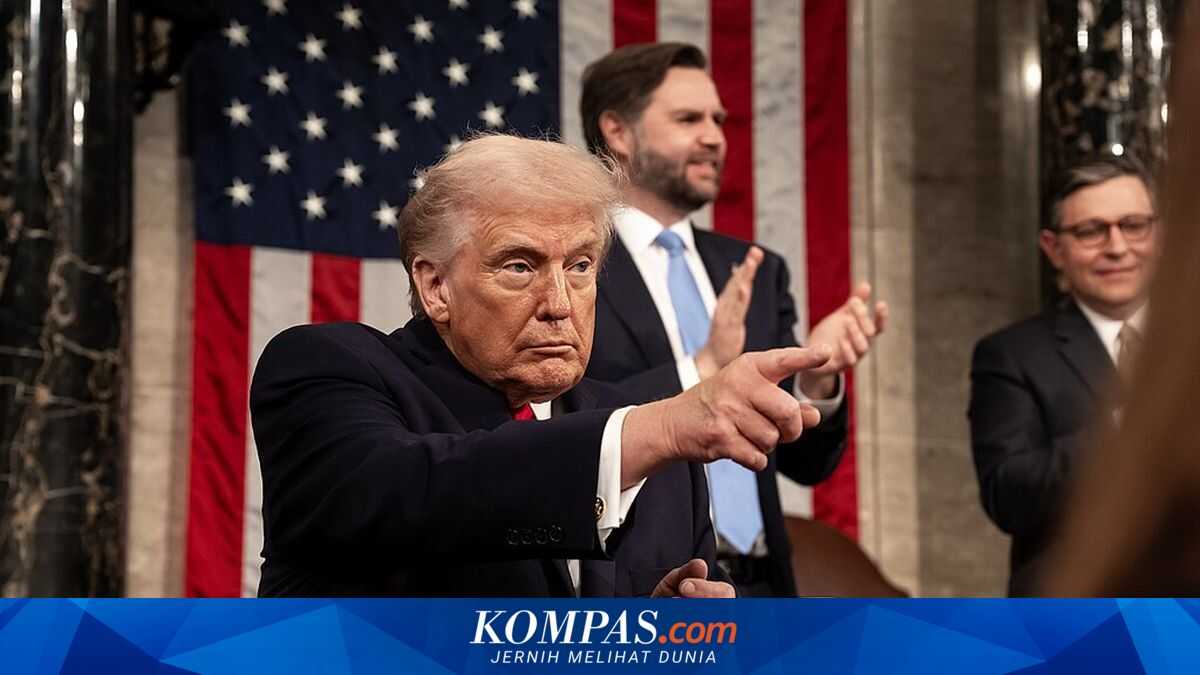
WASHINGTON, KOMPAS.com - The policies of US President Donald Trump regarding tariffs have once again come under scrutiny after the US Supreme Court overturned tariffs imposed under the International Emergency Economic Powers Act (IEEPA).
This decision has created new uncertainty regarding various bilateral trade agreements previously negotiated by Washington with global partners.
In his State of the Union address on Tuesday (24/2/2026), Trump defended his tariff agenda.
The ruling effectively revokes the legal basis for emergency tariffs that underpinned a number of bilateral trade agreements.
However, almost immediately after the ruling, Trump replaced them with a 10 percent tariff under Section 122 of the 1974 Trade Act, which took effect on Tuesday.
He also threatened to raise the tariff to 15 percent under the same section, although it is unclear when this policy will be implemented.
“(Trading partners) made concessions in exchange for special tariff treatment based on IEEPA. That legal basis is no longer there,” said Johannes Fritz, CEO of St. Gallen Endowment for Prosperity through Trade, as quoted by CNBC on Thursday (26/2/2026).
“Whether the government can reconstruct these agreements under Section 301 or other authorities remains to be seen, but it will take time and a new legal process,” he added.
Section 301 of the 1974 Trade Act requires the US Trade Representative to conduct a formal investigation into trade practices deemed unfair before imposing tariffs.
This situation creates legal uncertainty for trading partners who have agreed to various concessions in exchange for tariff reductions or exemptions.
Several analysts believe the Supreme Court’s ruling has the potential to change the dynamics of global trade negotiations.
“Countries that made agreements with the United States after last year’s Liberation Day tariffs have been left to bear the consequences,” said Sarang Shidore, director of the Global South Program at the Quincy Institute, to CNBC.
Read also: Restructuring Investment Strategies Amidst the Turmoil of Trump’s Tariff Rules