
US Signals of Surrender
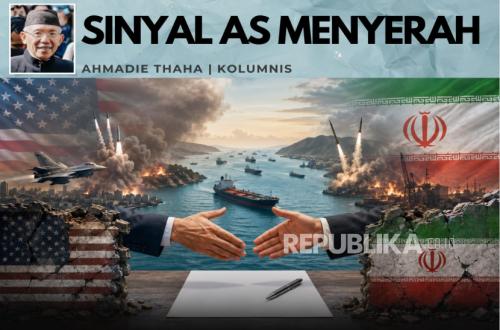
Finally, after missiles flew like New Year’s fireworks bought by a prestige-drunk conglomerate heir, US President Donald Trump has begun signalling surrender. The US-Israel war against Iran appears to have reached its final breath. This was not announced through a heroic speech in the style of a Hollywood film. No. This time, it emerged in a simpler and more realistic form: a one-page peace proposal. One page. Imagine that. After thousands of lives lost, oil prices dancing like a possessed demon in the global market, and merchant ships trapped in the Strait of Hormuz, it all ends with a single sheet of paper. Imagine further: the world economy is already gasping like an old rickshaw forced to climb Puncak hill while carrying gas cylinders and water gallons, and Trump arrives with a one-page proposal as if this war were merely a misunderstanding between neighbours quarrelling over a fence. The modern world is indeed amusing. Sometimes wars are started by a three-minute speech and ended by a one-page memo. According to various diplomatic leaks, the proposal contains a cessation of hostilities and the opening of a 30-day negotiation period. A sort of “cooling down” before the world truly catches fire on a broader scale. But as usual, the real devil is in the details. You know what Trump is demanding. America wants Iran to stop uranium enrichment in the long term, even for more than ten years. Previously, Washington demanded twenty years; now the tone is softening. Like a debt collector who initially storms the gate, then suddenly speaks softly upon realising the house isn’t a student’s late-rent boarding room, but the headquarters of a fully armed warrior with a front yard full of landmines. According to CNN leaks, the latest proposal also demands that Iran send all its high-enriched uranium stockpile abroad. Russian President Vladimir Putin has already stated his readiness to receive Iran’s uranium stockpile. But Trump, in an interview with PBS News, openly stated that Tehran is asked to send that material to the United States while promising not to operate its underground facilities any longer. At this point, the war is changing faces. It is no longer just about explosions and missiles, but about who gets to possess the future of nuclear technology. America wants Iran to remain in the position of a “monitored state,” while Iran wants to be recognised as an equal regional power with the right to statehood like America too. So don’t imagine the negotiating table as a forum of wise sages seeking peace. No. It is more like a bargaining table between two bloodied boxers who are still holding folding chairs, quietly looking for a bottle to throw if the negotiations fail. The problem is, Iran is not Gaddafi-era Libya that can be easily stripped and left naked. Iran has had its fill of learning from history. They have seen how countries that surrender all their defence cards end up like a motherless chick lost in the global market. Therefore, the demand to halt uranium enrichment for over a decade is viewed in Tehran not merely as a technical nuclear issue, but as a matter of geopolitical rights and dignity. In simple terms: America is asking Iran to disable part of its strategic muscle while hoping Tehran simply trusts Western diplomatic promises. And the history of the Middle East has never been too kind to such promises. In that region, the lifespan of signed agreements is sometimes shorter than a twin-date discount in an online shop. Then, the world arrives at the real nerve of this war, which is also Trump’s demand in the proposal: the Strait of Hormuz. You know, that strait is just a narrow sea passage whose width is far inferior to the egos of world leaders, yet it can make the planet’s economy feverish. That is where Iran plays its most frightening card. They don’t need to sink the American fleet to make Washington panic. Just making merchant ships afraid to pass through is enough to send global energy prices skyrocketing like chillies before sudden Eid shortages. According to CNN, positive feedback from Pakistani mediators once made Trump halt US military operations previously used to escort trapped ships in the strait. But the US blockade of Iranian ports continues. On the other hand, Washington is pressing Iran to reopen freedom of navigation and stop levying “security guarantees” on passing ships. How ironic. Countries that have talked about free markets and global trade routes for decades now suddenly realise that one small strait in the Middle East can make Wall Street break out in cold sweats. It turns out global capitalism is only brave when tanker ships pass peacefully. And this is where Trump is truly cornered. Because every day the Strait of Hormuz is disrupted, every day oil prices bite into the American economy from within. People may not know where Hormuz is on the map, but they know the numbers at the petrol pump. That is why the Trump administration now appears very eager to find a “diplomatic offramp,” an elegant term for the urgent need to exit the war before everything turns into a domestic political disaster. Because in modern democracy, the voice of voters is far more terrifying than the sound of missile sirens. Not to mention economic sanctions, which Trump also included in that one-page proposal. This is the most sensitive, slipperiest part, and the one that makes Israel most anxious.