
US Missile Defences Leave South Korea as Kim Jong Un Tests Strategic Capabilities
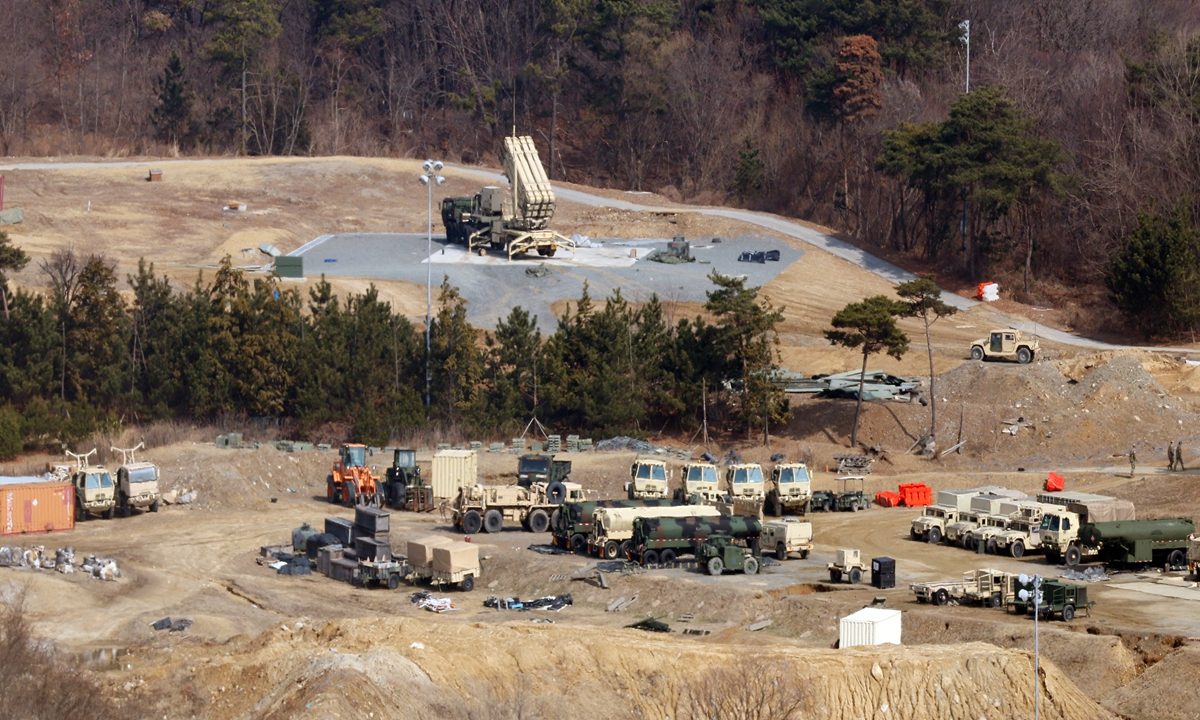
As the US-Iran War pulls THAAD and Patriot systems away, South Korea’s sky grows dangerously thin
When the United States and Israel launched strikes against Iran on February 28, 2026, the shockwaves did not stay in the Middle East. Thousands of miles away, on the Korean Peninsula, a quiet but alarming shift began — missile defense shields started disappearing from South Korea’s sky, heading westward to a war that has no clear end in sight. And as America’s attention turned toward Iran, Kim Jong Un made sure no one would miss his own message.
The United States launched Operation Epic Fury against Iran on February 28, 2026, alongside Israel — marking the formal start of a war that would expose just how dangerously thin America’s global missile defense stockpile truly is. Within days of combat, the US and its allies had already fired more than 800 Patriot interceptors worth an estimated USD 2.4 billion — exceeding every Patriot round fired throughout the entire Russia-Ukraine War, according to a New York Times report citing the Centre for Strategic and International Studies (CSIS). With Iran targeting multiple THAAD batteries in the Middle East — including a confirmed radar strike at Muwaffak Salti Air Base in Jordan on March 2 — the Pentagon urgently needed replacements. It found them in an unexpected place: South Korea.
The Quiet Pullout That Seoul Couldn’t Stop
On March 10, the Washington Post broke a story that sent tremors through East Asia: the Pentagon was moving parts of its THAAD system from Seongju, South Korea, to the Middle East — citing two US officials directly. Flight-tracking data confirmed the unusual activity, with two C-5 Galaxy strategic airlifters and at least eleven C-17 Globemaster III cargo aircraft departing Osan Air Base south of Seoul in the days since the Iran war began. South Korean broadcaster SBS also cited CCTV footage near the Seongju base showing THAAD launchers being dismantled and loaded for transport. The scale of the airlift pointed to something far larger than a routine rotation.
South Korean President Lee Jae Myung was forced into a corner. During a cabinet meeting on March 10, he confirmed what Seoul had long feared but hoped would never arrive. “Although we express our opposition to the removal of some air defense weapons by US Forces Korea based on their own military needs, it is also a reality that we cannot fully enforce our position,” Lee said, in one of the most candid public admissions yet that Washington’s defense decisions fall outside Seoul’s authority to override. His words were equal parts resignation and reassurance — telling the South Korean public that deterrence against North Korea remained intact, while quietly conceding the painful truth that key assets were already gone.
A Gap That Cannot Be Patched Overnight
The departure of Patriot batteries is serious, but manageable. South Korea has the domestically developed Cheongung-II system, which can handle low- and medium-altitude interceptions. THAAD is a completely different matter. Designed to intercept ballistic missiles at altitudes between 40 and 150 kilometers, THAAD has no South Korean equivalent in active service. The country’s homegrown high-altitude interceptor, the L-SAM, is scheduled to enter service only next year — leaving a window of potential vulnerability that experts say should not be taken lightly.
Yang Uk, a researcher at the Asan Institute for Policy Studies, noted that removing the entire THAAD radar would render the entire battery useless, suggesting only launchers and interceptors were likely shifted — a small comfort. “Once the entire battery and radar are pulled out, it becomes a major risk to bring them back, both physically and politically,” Yang warned. Andrew Yeo, a senior fellow at the Brookings Institution, added a sharper caution: removing more Patriots or THAAD batteries “could create vulnerabilities against a missile attack from North Korea.”
Kim Jong Un Seizes the Moment
North Korea moved with choreographed precision. On March 10, 2026 — the same day Seoul admitted the THAAD departure — Kim Jong Un personally oversaw a test-firing of strategic cruise missiles from the Choe Hyon, a 5,000-ton destroyer that is the centerpiece of Kim’s naval nuclear armament program. His daughter, Ju Ae, sat by his side as he watched via a video command center. It was the second such test in a single week, following a March 4 launch also from the Choe Hyon during its final operational trials. The missiles flew a complex orbit over the Yellow Sea for over 10,100 seconds — nearly three hours — before striking designated island targets. Pyongyang’s foreign ministry had already issued a statement supporting Iran, slamming the US-Israel strikes as an “unlawful military attack” and accusing Washington and Tel Aviv of “destroying the regional peace and security foundations.” The timing of the missile tests was unmistakably deliberate.
Choi Gi-il, a military studies professor at Sangji University, said the danger now is miscalculation. “There is a risk that North Korea could miscalculate the relocation of some of these weapons as a pretext for low-level provocations to test the allies’ defense posture,” he said. The tests also came as US and South Korean forces were midway through Freedom Shield — their annual joint military exercises that began March 9 and run through March 19. Pyongyang has historically used these drills as cover for escalating its own weapons demonstrations. This year, the combination of the exercises and a visibly thinned defense shield offered a provocation too tempting to ignore.
One War, Three Crises, One Arsenal
The deeper problem is now undeniable: the United States is fighting — or supporting — multiple simultaneous conflicts with a single, finite pool of advanced missiles. According to the Eurasian Times, the US produced an average of only 270 advanced Patriot missiles annually from 2015 to 2024. Lockheed Martin did deliver 620 PAC-3 MSE interceptors