
US Military "Attacks" Itself: Internal War Rocks the Pentagon
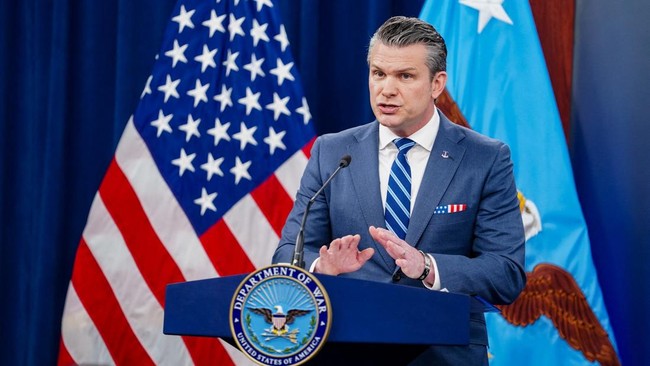
The United States military appears highly dominant in the war against Iran. Over 38 days of airstrikes, US fighter jets conducted more than 13,000 combat sorties, destroying Iranian military capabilities from industrial facilities to nuclear sites.
However, behind the success of that operation, the Pentagon is being shaken by internal conflict.
This is occurring amid the largest US war in several decades. Instead of focusing on the conflict, US Secretary of War Pete Hegseth has carried out a series of dismissals of military leaders, sparking concerns about politicisation, internal military culture, and the future of professionalism in the US armed forces.
Pentagon Rocked by Internal Purge
On 2 April 2026, Pete Hegseth dismissed General Randy George, the highest-ranking officer in the US Army, and sidelined two other senior leaders.
According to former US military officials, such actions are almost unprecedented, especially during a major war when ground forces are also moving towards the Gulf region.
Hegseth did not explain the reasons for the sudden dismissals. However, many parties view them as the latest victims of a wave of purges targeting US military leadership.
Several former high-ranking military officials interviewed by The Economist described the Pentagon as now filled with resentment, politicisation, and Hegseth’s obsession with instilling a masculine, anti-woke warrior spirit. According to them, this attitude could even extend to disdain for international law.
During a Pentagon press conference on Operation Epic Fury, Hegseth, a former Fox News host, is sometimes seen as more preoccupied with culture wars than the actual war unfolding in Iran. One former military official even mocked him as like a 12-year-old playing war with toy soldiers.
Since taking office last year, Hegseth is said to have removed at least 21 generals. Many of them are suspected of being dismissed without clear reasons, aside from possible factors like race, gender, or differing political views.
Kori Schake from the American Enterprise Institute said this has never happened before. According to her, dismissing 21 senior leaders without clear reasons is highly unusual and has squandered talent built over centuries.
Randy George himself reportedly once opposed Hegseth’s decision to strike four officers from the promotion list last March.
Those four officers consisted of two Black men and two women. Such situations have led some officers to opt for early retirement or withdraw their names from the promotion process. This was stated by Nancy Lacore, an admiral forced to retire last year and now running as a congressional candidate in South Carolina.
Replacements Deemed Competent, But Still Raise Questions
Most of the appointed replacements are indeed considered to have good qualifications and no apparent strong political biases. However, some decisions still raise questions.
One of them is the appointment of General Christopher LaNeve as Randy George’s replacement. LaNeve, previously Hegseth’s military aide, is seen as having thin experience for the Army Chief of Staff position. That role is crucial as it oversees soldier recruitment, training, and equipping.
Nevertheless, LaNeve is known to have called the president just hours after the inauguration to welcome his return to the White House. The president reportedly responded with an admiring comment about the individual.
Concerns are not only coming from combat ranks but also from military legal circles. A recently retired former high-ranking official from the US Army’s legal corps admitted worry that the new generation of military lawyers might seek legal justifications for whatever the government desires.
Another senior military official described Hegseth’s mindset as victory at any cost. According to him, there is now a clear clash against the core values long believed in and upheld by the US military.
Several former military officials suspect Hegseth is trying to fix things that once angered him when he was a lieutenant and captain in the National Guard. Hegseth himself once said the Army discarded him after colleagues flagged him as an internal threat due to the Deus Vult tattoo on his arm.
That symbol is known to be frequently used by white nationalist groups. People inside the Pentagon also say Hegseth sometimes appears confused during briefings. One former senior military leader even assessed that Hegseth might feel like an outsider when discussing complex strategic issues.
Despite all the turmoil, the US military remains effective in the war against Iran. This is seen as strong proof of the robustness of the US armed forces institution.
That success is primarily supported by technological superiority, decades of combat experience, and the nonpartisan culture that has long been a key foundation of the US military. However, it is precisely that culture which is now seen as threatened by Hegseth.
Many parties worry that the impact of the internal damage under his leadership could last far longer than the US conflict with Iran itself.