
US Media Reports Saudi Arabia Quietly Lobbied Trump to Attack Iran
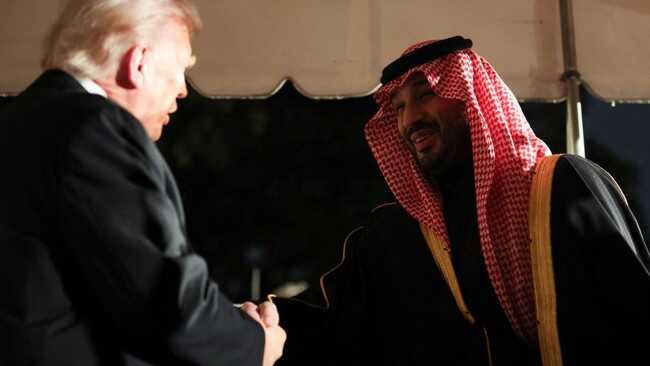
US media reports that the large-scale American air strikes against Iran on Saturday, 1 March 2026, in the “Epic Fury” operation ordered by President Donald Trump to target Tehran’s leadership and military installations, were reportedly driven by intense pressure from two Washington allies in the Middle East: Israel and Saudi Arabia.
According to four sources with knowledge of internal discussions, as reported by The Washington Post, Israeli Prime Minister Benjamin Netanyahu and Saudi Crown Prince Mohammed bin Salman both urged Trump to take military action against Iran.
The initial strikes were reported to have killed Iran’s Supreme Leader Ali Khamenei and several other senior officials in a joint Israeli-US operation aimed at ending nearly four decades of his rule.
Saudi Arabia’s Quiet Lobbying and Israel’s Public Campaign
The four sources stated that Crown Prince MBS conducted several personal telephone calls with Trump over the past month to advocate for US strikes, despite publicly declaring support for a diplomatic solution.
Meanwhile, Netanyahu continued his long-standing public campaign to press for US military action against Iran, which he views as an existential threat to Israel.
Their combined efforts reportedly helped convince Trump to order the massive air campaign against Iran’s leadership and military. This decision was made despite previous US intelligence assessments that Iranian forces were unlikely to pose a direct threat to the US mainland over the coming decade.
The strikes marked a major departure from decades of Washington policy of restraint in attempting to fully overthrow the government of a nation of over 90 million people. The action also contrasted sharply with Trump’s previous, far more limited military operations.
“No president has been willing to do what I am willing to do tonight,” Trump said in a video address to the Iranian people as American bombs struck various targets throughout Iran.
“Now you have a president who gives you what you want, so let us see how you respond.”
Failed Diplomacy
Saudi pressure for US strikes occurred whilst presidential envoy Steve Witkoff and Trump’s son-in-law Jared Kushner were conducting negotiations with Iranian officials regarding the country’s nuclear and missile programmes.
During this process, Riyadh issued a statement, following a telephone conversation between MBS and Iranian President Masoud Pezeshkian, that Saudi Arabia would not permit its airspace or territory to be used for strikes against Iran.
However, in closed discussions with US officials, the Saudi leader warned that Iran would emerge stronger and more dangerous if the US did not attack now, after deploying the largest military presence in the Middle East since the 2003 invasion of Iraq, according to the sources.
This position was reinforced by his brother, Saudi Defence Minister Khalid bin Salman, who held a closed meeting with US officials in Washington in January and warned of the risks if the strikes did not occur.
Saudi Arabia’s seemingly complex position likely reflected its desire to avoid Iranian retaliation against vulnerable Saudi oil infrastructure, whilst viewing Tehran as the primary regional threat. The long-standing rivalry between Shia-dominated Iran and Sunni-led Saudi Arabia has triggered various proxy wars throughout the Middle East.
Following the initial US strikes on Saturday, Iran indeed retaliated by attacking Saudi Arabia. Riyadh responded with a harsh statement condemning the attacks and calling on the international community to “take all necessary and decisive measures” against Iran.
A Saudi official stated that Riyadh had “been consistent in supporting diplomatic efforts to reach a credible agreement with Iran. Throughout our communications with the Trump administration, we never lobbied the president to adopt a different policy.”
Trump’s Frustration and Rapid Escalation
The final contact between Witkoff and Kushner with Iranian officials occurred in Geneva on Thursday, the third high-level meeting since early February. A senior Trump administration official stated they left the discussions with the conviction that Tehran was playing games regarding nuclear enrichment requirements.
“It is very clear that their objective is to maintain their uranium enrichment capability so that, over time, they can use it to develop nuclear weapons,” the official said.
On Friday afternoon, as he arrived in Corpus Christi, Texas, for a campaign event ahead of the primary elections, Trump’s rhetoric intensified. He repeatedly stated he was “unhappy” with the Iranian negotiators.
“Right now I am busy with many things,” he told his supporters. “We must make big decisions, you know that. It is not easy, not easy. We must make very big decisions.”
He subsequently flew to Palm Beach and attended an event at the Mar-a-Lago resort before recording the announcement speech for the strikes.
Although the large deployment of US forces over the past two months had signalled the possibility of military action, Trump’s previous track record did not suggest he would choose an optional war in the Middle East aimed at regime change.
In explaining his decision, Trump referred back to Iran’s 1979 revolution. He described the US strikes as retaliation for decades of conflict, including the 1979 hostage-taking of 52 Americans, the deaths of 241 US servicemen in the 1983 Beirut barracks bombing carried out by Hezbollah with Iranian support, and the 2000 attack on the USS Cole which he claimed Iran was “likely” involved in, despite the US long attributing it to al-Qaeda.
Trump also cited an “imminent threat from the Iranian regime” and accused Tehran of supporting terrorist organisations, though the article text appears incomplete at this point.