
US–Israel–Iran War Triggers Panic as People Panic-Buy Fuel
South Korea
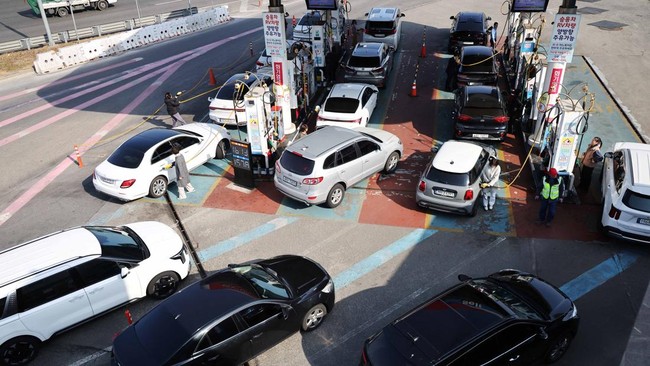
Panic buying was evident in South Korea, with queues snaking at petrol stations in Seoul on Wednesday as global oil prices spiked and markets were rattled by Middle East tensions. Many motorists chose to top up their tanks amid fears fuel prices would continue to rise. Station operators reported longer-than-usual queues. ‘I’m filling up now because I’m afraid it will be more expensive tomorrow,’ one Seoul driver told local media. Yonhap News Agency said public anxiety was also weighed down by heavy pressures on South Korea’s economy. At the same time, petrol prices in the country have surpassed 1,800 won per litre, about Rp21,000. This exacerbates concerns about living costs. South Korea is highly vulnerable to energy supply disruptions due to reliance on imports for more than 90% of its energy needs. About 70.7% of crude oil imports and 20.4% of LNG imports pass through the Strait of Hormuz. The situation intensified after reports that Iran attacked and burnt ten oil tankers in the area. Around 26 tankers registered as South Korean-flagged were reportedly stuck near the strait. While the government has oil reserves covering around six months, analysts warned that prolonged disruption along the maritime route could trigger an economic emergency.
Australia
Similar scenes in Australia. In Perth, Western Australia, thousands of drivers queued at petrol stations on Tuesday night to refuel. Western Australia Premier Roger Cook sought to reassure the public and urged people not to panic buy. ‘Don’t raise prices simply because people are worried about the future,’ he said. ‘You currently have a sustainable fuel supply,’ he added. In Queensland, the state’s automotive body even planned to report several major fuel retailers to the Australian Competition and Consumer Commission (ACCC) over alleged price gouging after the Middle East conflict. In the last 24 hours, more than 210 service stations in Southeast Queensland raised prices to 219.9 cents per litre, the highest in weeks, including in Brisbane. In Sydney and Melbourne, oil companies were accused of exploiting the conflict to push prices higher. However, the Australasian Oil and Household Gas Marketers Association said supply remained secure: ‘Most of Australia’s oil comes from Singapore, not the Middle East, so even if market prices rise, there should be no supply issues.’ Rowan Lee, a representative of the association, added that the impact of any disruption would only become apparent after several weeks. ‘(Also) a lag of up to two weeks… it is still too early to determine how this will unfold.’
Energy Minister Chris Bowen said Australia is prepared for potential supply instability resulting from the Middle East conflict. Bowen noted he had spoken with the chief executives of Australia’s refineries and that the country currently holds fuel stocks above the minimum requirement. ‘Companies have told us they are confident of fuel supply through to May,’ he said.
United Kingdom
Across the United Kingdom, fears of possible fuel shortages have also prompted long queues at several petrol stations. NDTV reported drivers in London, Manchester and Liverpool waiting more than an hour to refuel. The government and local energy authorities urged the public not to panic buy, even as petrol prices could rise. ‘Prices at the pumps are rising, wholesale costs have increased even before the weekend attack on Iran,’ one official said. ‘However, average pump prices today remain below last year’s level.’ ‘Fuel trading has reported increased demand, which was expected, but drivers generally have followed the advice to continue with their usual refuelling routines.’ ‘There is little point in wasting time, fuel and money queuing when there is no need to.’
Bangladesh
The impact of the Middle East conflict is also being felt in Bangladesh. In major cities such as Dhaka and Chattogram, queues at petrol stations have formed as motorists rush to buy fuel amid fears of supply disruptions. The Daily Star notes that Bangladesh relies heavily on energy imports, particularly fuel and liquefied natural gas from the Middle East. According to the Bangladesh Petroleum Corporation (BPC), the country currently has petrol and diesel stocks for around two weeks, and octane stocks for almost four weeks. Although supply remains available, fears of stockpiling are driving demand; diesel sales, typically around 12,000–13,000 tonnes per day, reportedly surged to more than 20,000 tonnes.