
US–Israel–Iran War: Here Are the 11 Most Formidable Nuclear-Powered Aircraft Carriers in the World
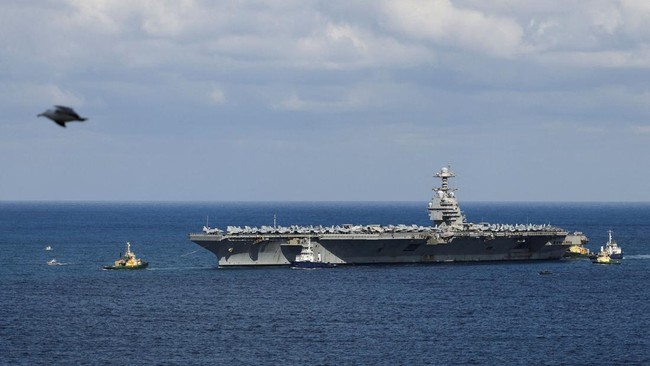
The Middle East conflict has intensified after a US-led operation with Israel against Iran, prompting discussion not only of missiles but also of naval power, notably aircraft carriers. Carriers are ships that host large air wings and serve as the backbone of military projection at sea. The United States still dominates globally with 11 nuclear-powered aircraft carriers, ten of the Nimitz class and one Ford class, which form the backbone of its power projection across the oceans. This fleet is a defining symbol of American military strength and plays a vital role in global security strategy.
Technically, the Nimitz class comprises 10 ships with a length of 1,092 ft (333 m), a deck width of 252 ft (77 m), and a waterline beam of 134 ft (41 m). With a displacement of around 97,000–103,300 tonnes, these vessels are powered by two A4W nuclear reactors driving four shafts and capable of speeds in excess of 30 knots and operation for up to 20 years without refuelling.
Each accommodates 75–90 aircraft and a crew total of more than 5,500 personnel, complete with defence systems such as Sea Sparrow, Rolling Airframe Missile (RAM), and CIWS.
The United States Navy notes that the Gerald R. Ford class (USS Gerald R. Ford CVN‑78) employs cutting-edge technology: two A1B reactors, a flight deck width of 256 ft (78 m), and a full-load displacement of around 100,000 tonnes. Although it carries slightly fewer crew (about 4,550), this class can launch an average of 160 sorties per day — 25–33% more than the Nimitz class thanks to EMALS and dual‑band radar (SPY‑3/4). The Ford’s edge lies not only in sortie rates but in higher power generation, up to 250%, enabling support for future systems such as directed‑energy weapons. However, the integration of cutting-edge technologies such as EMALS and the Electro‑Weapons Elevator (AWE) continues to face production challenges, with some delays on the CVN‑79 John F. Kennedy.
Here are the 11 U.S. aircraft carriers
USS Dwight D. Eisenhower
USS George Washington
USS Theodore Roosevelt
USS Ronald Reagan
USS Harry S. Truman
USS Carl Vinson
USS Abraham Lincoln
USS George H.W. Bush
USS John C. Stennis
USS Nimitz
USS Gerald R. Ford
Operationally, the presence of 11 nuclear-powered carriers enables the United States to respond rapidly to crises around the world, such as when the carrier groups including USS Gerald R. Ford, USS Carl Vinson, and USS Nimitz operated off the Mediterranean and Persian Gulf in response to Iran–Israel tensions. The fleet is equipped with F‑35C stealth fighters and F/A‑18 Super Hornets, supporting versatility from military intervention to maritime diplomacy.
However, the emergence of anti-ship missiles (such as China’s Dong Feng‑21D) has forced carriers to operate further from enemy shores to preserve strike capability in high-tension scenarios in East Asia, Time notes. With technological advantages and global flexibility, the nuclear‑powered carrier fleet is expected to remain a pillar of maritime power for the coming decade—and a barometer of power in 21st‑century great‑power competition.