
US-Iran War Update: Ceasefire Collapses, Strait of Hormuz Blockaded
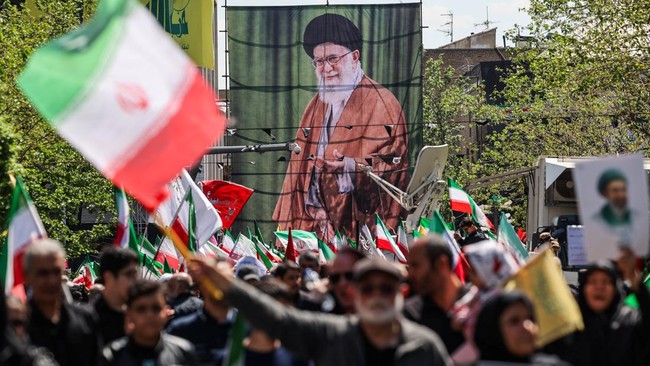
Tensions in the US-Iran conflict have reignited after attempts at a ceasefire and peace negotiations completely failed, triggering blockade threats and exacerbating the crisis in the Strait of Hormuz, a vital global energy route.
Washington is even preparing to blockade Iranian ports, while Tehran has warned of serious consequences should there be any military intervention in the region. This situation has immediately shaken the global oil market and intensified pressure on shipping traffic in Hormuz.
Here is the latest update on the situation in Iran, as compiled by CNBC Indonesia on Monday (13/4/2026).
- Trump Claims Effective Blockade of Iranian Ports
US President Donald Trump has affirmed that plans to blockade Iranian ports will be a strategic move to pressure Tehran’s economy, particularly its energy sector. The statement was made to the media before he departed for Washington, DC.
Trump stated that the operation would be supported by several other countries, though he did not specify the parties involved. He claimed that this international coordination aims to halt Iran’s oil sales to the global market.
“This blockade will be very effective,” Trump said, as quoted by Al Jazeera. He also emphasised that the measure is a response to the latest diplomatic failure between the two countries, which had previously been hoped to ease tensions.
- Oil Prices Surge After Blockade Announcement
The blockade announcement immediately rocked the global energy market. Crude oil prices surged sharply at the start of trading, reflecting investor concerns over supply disruptions from the Middle East region.
US crude oil rose 8% to US$104.24 per barrel, or approximately Rp1.7 million. Meanwhile, Brent crude, the global benchmark, climbed 7% to US$102.29 per barrel.
This spike extends the price volatility since the conflict intensified. Before the joint US-Israel attack on 28 February, Brent prices were around US$70 (Rp1.19 million) per barrel. However, after the conflict escalated, prices once surged above US$119 (Rp2 million) before correcting.
Last Friday, ahead of negotiation efforts in Pakistan, Brent prices fell 0.8% to US$95.20 (Rp1.6 million) per barrel. However, market sentiment has sharply reversed following the blockade announcement, underscoring the market’s sensitivity to geopolitical developments.
- Gulf States Seek Alternatives, Hormuz Remains Closed
The situation in the Strait of Hormuz has grown increasingly tense after Iran confirmed that no US military vessels have successfully passed through. Tehran has also threatened action against any attempts to violate the strategic route.
For Gulf Cooperation Council (GCC) countries, this is a major concern. The Strait of Hormuz is their primary route for distributing oil to global markets, so even minor disruptions can have significant economic impacts on the region.
The latest data shows a drastic drop in shipping traffic. In the last 24 hours, only three vessels managed to pass through: two flying the Chinese flag and one from Liberia, each with a capacity of around 2 million barrels. This is far below normal conditions, which see about 100 ships per day.
Additionally, two vessels attempted to pass but ultimately turned back. The exact reason is unknown, but security conditions are suspected to be the main factor.
As a mitigation step, Gulf states are beginning to seek alternative routes. Qatar has announced the easing of maritime restrictions, while Saudi Arabia has upgraded its East-West pipeline, which can now transport up to 7 million barrels per day without passing through the Strait of Hormuz. Furthermore, Saudi Arabia is preparing the Manifa oil field, which can add up to 300,000 barrels per day to supply.
- Nuclear Negotiations Not Expected Soon
Diplomatic efforts between the US and Iran are not anticipated to yield an agreement in the near term. Federica Mogherini, former EU foreign policy chief and JCPOA negotiator, has cautioned that such negotiation processes require a long time and complex technical work.
“It took 12 years and a huge amount of technical work to reach the previous agreement. Does anyone really think a deal can be reached in 21 hours?” she wrote on platform X.
The JCPOA agreement itself was the result of lengthy negotiations between Iran and world powers, including the US, China, Russia, the UK, France, and Germany. The deal allowed for the lifting of sanctions on Iran in exchange for restrictions on its nuclear programme.
However, the US unilaterally withdrew from the agreement in 2018 during the Trump administration, which became one of the triggers for ongoing tensions.
- Iran Prepares for Prolonged War, Global Impacts Loom
From Iran’s side, strong signals continue to be sent. Zohreh Kharazmi, an academic at the University of Tehran, has emphasised that her country is prepared to face a prolonged conflict to defend its sovereignty, particularly in the Strait of Hormuz.
“The United States is not in a position to dictate how the Iranian people should act, or which ships are allowed to pass,” she said.
She also noted that Iran has demonstrated a selective approach to foreign vessels, where countries cooperating with Tehran receive better treatment.
Furthermore, Kharazmi warned of the global impacts from a potential blockade. According to her, the Strait of Hormuz is not only crucial for oil distribution but also for other strategic commodities such as fertiliser and helium.
“A blockade in this area could cripple global industry,” she said. She added that Iran is “prepared for a prolonged war”.
- Trump’s Statements vs US Military Create Confusion
Amid the escalation, confusion has arisen regarding the blockade’s implementation. Trump’s statements are seen as not fully aligned with official explanations from the US Central Command (CENTCOM).