
US-Iran War Begins to Plague the World, IMF Issues This Terrifying Warning
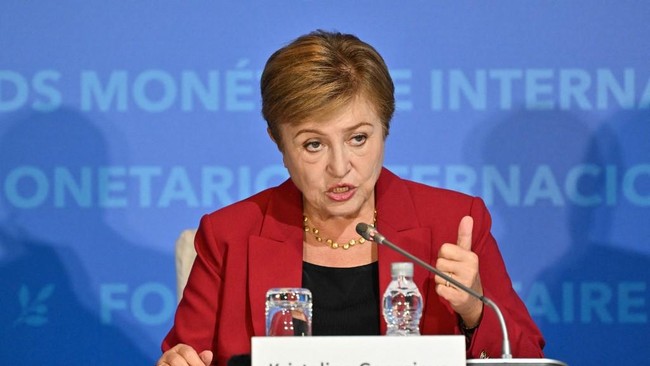
The International Monetary Fund (IMF) has officially announced it will cut its global economic growth projection due to the destructive impacts of the war in the Middle East. This bad news was delivered directly by the IMF chief on Thursday, warning of “deep wounds” to the world economy even as a fragile ceasefire begins to take hold.
The global economy is predicted not to return to normal levels as before the conflict erupted, even as security conditions start to ease. The damage to global market structures is deemed too massive to repair in the short term.
“Even in the best-case scenario, there will be no neat and clean return to the status quo ante,” stated IMF Managing Director Kristalina Georgieva on Friday (10/4/2026).
Georgieva explained that in the IMF’s most optimistic scenario, surges in energy costs, infrastructure damage, supply chain disruptions, and loss of market confidence will still result in much lower economic growth than anticipated. The IMF is now preparing to provide up to US$50 billion (Rp855.75 trillion) in emergency financial assistance to affected countries, given that a food crisis now threatens at least 45 million people.
“Given the spillover effects from the war, we estimate that short-term demand for IMF balance of payments support will increase between US$20 billion (Rp342.3 trillion) and US$50 billion (Rp855.75 trillion), with the lower bound applying if the ceasefire holds,” said Georgieva.
Similar warnings have come from the World Bank, which is also bracing for potential bankruptcies in developing countries. The crisis triggered by the conflict between the United States, Israel, and Iran since 28 February has paralysed major trade routes and driven crude oil prices sky-high after Tehran blocked the Strait of Hormuz.
World Bank President Ajay Banga expressed readiness for his institution to inject large-scale aid funds into countries on the brink of collapse. Aid priorities will focus on short-term fiscal stability.
“Our institution can disburse up to US$25 billion (Rp427.87 trillion) in financing very quickly to developing countries affected by the war. Up to US$60 billion (Rp1,026.9 trillion) may be available in the long term if countries need it,” said Ajay Banga on Thursday (09/04/2026).
This conflict has created uneven effects, with low-income countries that import energy suffering the most. Kristalina Georgieva highlighted the plight of small countries at the end of long logistics chains that now risk losing energy access entirely.
“Think of Pacific island nations at the end of long supply chains, wondering if fuel can still reach them after such severe disruptions,” stated Georgieva.
According to World Bank data, economic growth in the Middle East region excluding Iran is projected to slow sharply to just 1.8% in 2026. This figure reflects a drastic decline of 2.4 percentage points compared to pre-war projections.
Extreme rises in oil, gas, and fertiliser prices are now spilling over into the food sector, potentially triggering a global humanitarian crisis. The situation is worsened by swelling government debts in various countries due to efforts to cushion successive economic shocks.
“Sharp increases in oil, gas, and fertiliser prices, combined with transportation barriers, will inevitably lead to rising food prices and threatened food security,” reads a joint statement from the heads of the IMF, World Bank, and World Food Programme (WFP).