
US Forces Deny Trump's Threat, Will Not Fully Blockade Strait of Hormuz
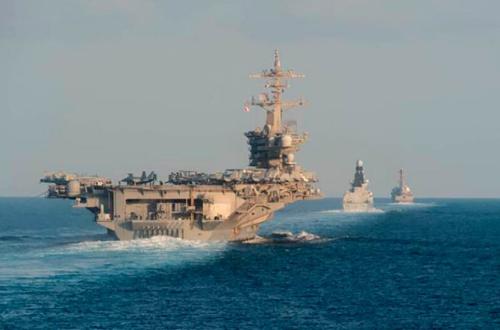
REPUBLIKA.CO.ID, TEHRAN – The US military has stated that it will not close the Strait of Hormuz completely as threatened by Trump. They have indicated that ships will only be prohibited from entering and exiting Iranian ports.
Iran’s Revolutionary Guard Corps (IRGC) has affirmed that it will thwart the blockade plan. The US Central Command (CENTCOM) stated in a release that it will begin implementing a blockade on “all maritime traffic entering and exiting Iranian ports” on 13 April, starting at 10:00 Eastern US time or 21:00 WIB. “This is in accordance with the President’s statement.”
Trump had previously said that the US would blockade the Strait of Hormuz after negotiations between the US and Iran in Islamabad failed to yield results.
“The blockade will be applied impartially to ships from all countries entering or leaving Iranian ports and coastal waters, including all Iranian ports in the Arabian Gulf and Gulf of Oman,” said CENTCOM.
“CENTCOM forces will not impede freedom of navigation for ships transiting the Strait of Hormuz to and from non-Iranian ports,” the statement added.
Several senior Iranian officials have dismissed the US threat to impose a naval blockade in the Strait of Hormuz, according to reports in Iranian media. “Trump’s threat is ridiculous,” said Navy Commander Admiral Shahram Irani, adding that Iranian forces have already been tracking all US military movements in the area.
Quds Force Commander General Esmail Qaani said that the US and Israel would be expelled from the region “without any results” just as they were expelled from the Red Sea and Bab al-Mandeb Strait by Yemen. Mohsen Rezaei, former IRGC commander and secretary of Tehran’s Expediency Council, stated that Iran “is not a place that can be blockaded with tweets and fanciful plans.” He emphasised that the US “is destined to fail.”
The negotiations in Islamabad on Saturday and Sunday last week ended without agreement, and Iran’s chief negotiator, Mohammad Bagher Ghalibaf, blamed the US for the failure. He said his delegation had proposed a “forward-looking” initiative during the talks, but the US failed to gain the trust of the Iranian delegation.
US Vice President JD Vance, who led the US delegation, had previously said that the negotiations ended without agreement.
“The bad news is that we haven’t reached an agreement, and I think that’s worse news for Iran than it is bad news for the United States,” he said.
This first direct engagement between the two countries at this level since the 1979 Iranian Revolution has revealed deep divisions on core issues, including Iran’s nuclear programme and the Strait of Hormuz, which has actually been under Tehran’s control since the war began on 28 February.
Several hours after the US-Iran negotiations in Islamabad failed, US President Donald Trump warned that American forces would soon “begin the process of BLOCKADING every and all ships attempting to enter or leave the Strait of Hormuz.”
“At some point, we will reach the bottom of ‘ALL ARE ALLOWED IN, ALL ARE ALLOWED OUT’, but Iran is not letting that happen,” Trump wrote on his Truth Social platform.
“I have also instructed our Navy to search and stop every ship in International Waters that has paid tariffs to Iran,” he continued. “No one who pays illegal tolls will get a safe passage in the high seas.”