
US Eagle Eye Shot Down by Iran
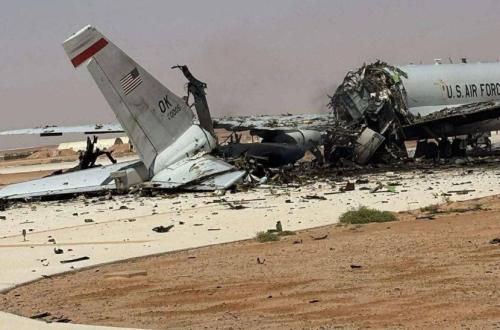
In the skies of modern warfare, there is one creature that is unarmed yet feared. This aircraft does not shoot, drop bombs, or chase anyone. Its eyes are like an eagle in the air, but it never attacks. It only observes. And it is precisely for this reason that everyone trembles. Its name is as long as a foreign professor’s title: E-3 Sentry AWACS. AWACS itself is an abbreviation for Airborne Warning and Control System. This aircraft resembles a Boeing 707, with a “flying saucer” (radar dome) on top of its body. One of them has just been hit by an Iranian missile until it shattered into pieces. From circulating photos, originating from Prince Sultan Air Base in Saudi Arabia, this “sky creature” appears lying like a giant beached whale in the desert. The front of its body is torn open like a sardine can opened with a screwdriver. Its metal frame protrudes, like bones not yet hidden. Its wings are still half majestic, but its body is like one that has lost its soul. The tail marked “U.S. Air Force” stands silently like a nameplate on a technological grave. You already know what U.S. Air Force means, even from the flag in the image. Around it, metal shards are scattered, and some personnel in white protective clothing walk slowly, as if performing an autopsy on a creature once considered “untouchable” because it likes to fly up to 10,000 metres in the sky. Let us simplify it. AWACS is not just an aircraft. It is the most prized and relied-upon “flying command tower” of the United States military forces since the 1970s decade. Imagine a complete war control room — radar, computers, operators, analysts, global communications — installed inside a Boeing aircraft body, then flown as high as 9–10 kilometres. Up there, it sees hundreds of kilometres in all directions. Fighter jets, missiles, drones, even small air movements, all enter the AWACS radar. In more honest terms, it is the “eyes, ears, and brain” that directs the war from the sky. If fighter jets are like soldiers, then AWACS is the general. It does not fight, but all wars depend on it. The so-called “command centre” inside the AWACS is not a metaphor. Inside it, there are dozens of operators monitoring radar screens, identifying threats, directing fighter jets, organising formations, even coordinating cross-air-sea-land attacks. Fighter jet pilots often cannot see their enemies. They “see” through AWACS. So when people say “without AWACS, fighter jets are blind”, that is not dramatisation. It is operational reality, just like an online taxi driver without GPS. But the difference is, this giant aircraft does not get lost in a narrow alley, but in the battlefield. Like all technology, AWACS has a history. This is not yesterday’s new technology. It was born from Cold War paranoia, when the world was divided like toast contested by two armed nuclear children. The E-3 Sentry version slashed by Iran was developed by Boeing in the 1970s and began to be used at the end of that decade. Since then, AWACS has been present in almost all major US wars. It appeared majestically in the 1991 Gulf War, was present in the 2003 Iraq invasion, NATO operations in the Balkans, to the war in Afghanistan. It became a kind of “little god in the sky” that is not worshipped, but obeyed. All air movements submit to its whispers. It is not only America that has it. NATO, Saudi Arabia, Britain, France — all have AWACS versions. The E-3 Sentry version that was shattered into pieces belongs to the US itself. Even now, there is a new generation like the AWACS E-7 Wedgetail, which is more modern, more digital, more advanced, like an upgrade from a home phone to a smartphone, but for war coordination matters.