
US Dollar Plummets Across Asia as Won and Yuan Surge
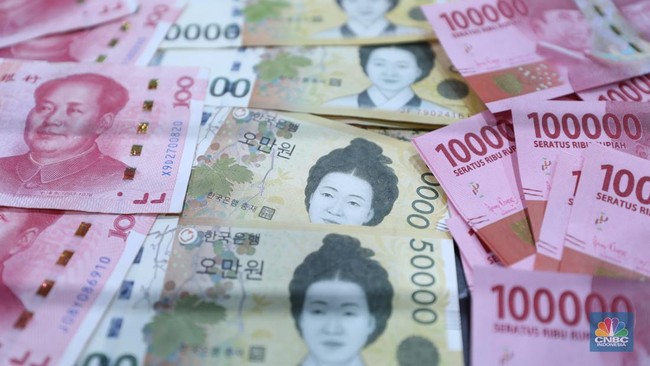
Jakarta, CNBC Indonesia – Asian currencies mostly strengthened amid a weaker US dollar index. According to Refinitiv, as of 12:19 WIB on Wednesday, 27 May 2026, the won led gains with a 0.6% appreciation against the US dollar, while the rupee weakened 0.09%. Indonesia and Malaysia’s financial markets were closed today due to Eid al-Adha celebrations.
The US dollar index, which measures the greenback against six major currencies, stood at 99.07, the lowest since 15 May 2026. China’s yuan rose close to a three-year high against the US dollar, supported by robust macroeconomic data. Recent figures showed industrial profits in China surged 24.7% in April compared to the previous year, the fastest pace since November 2023. However, this added to signals of uneven economic recovery, with some indicators suggesting the economy is losing momentum early in the second quarter despite strong exports.
“The yuan is likely to strengthen in the short term, but further gains may be limited,” said analysts from Huatai Futures Research Institute, cited by Refinitiv. They forecast the yuan to trade between 6.76 and 6.82 against the US dollar, considering dollar strength and the People’s Bank of China’s focus on exchange rate stability.
Before markets opened, the People’s Bank of China set the yuan’s central parity rate at 6.8291 per US dollar, 408 pips weaker than Reuters’ estimate. The spot yuan is allowed to fluctuate 2% above or below this rate daily.
Global market sentiment remained cautious after Iran accused the US of breaching the ceasefire by attacking targets near the Strait of Hormuz, complicating efforts to end the conflict. Meanwhile, the Indian rupee weakened by 8 paise to 95.78 per US dollar in early Wednesday trading due to rising oil prices after fresh US strikes on Iran dampened hopes of a swift peace deal between Washington and Tehran.
Amit Pabari, Managing Director of CR Forex Advisors, said the rupee came under pressure as oil prices rebounded following fading hopes of a rapid US-Iran peace deal. Market attention now turns to the Reserve Bank of India’s (RBI) monetary policy meeting on 3-5 June.
“The market is split between a potential rate hike or a hold, with the key question being whether the RBI will prioritise currency stability alongside inflation control,” Pabari said.