
US Dollar Nears Rp17,000, Business Owners Vent Frustrations and Point to Domestic Weaknesses
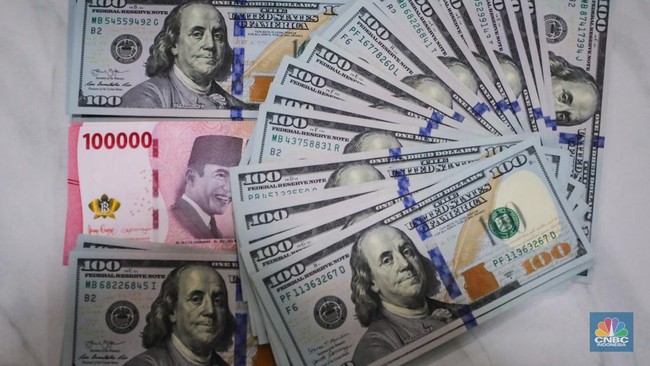
The weakening of the rupiah exchange rate approaching Rp17,000 per US dollar is viewed not merely as short-term volatility but as a serious signal regarding the resilience of the national industrial structure.
According to Refinitiv data, the rupiah opened trading this morning, Monday (30/3/2026), at Rp16,970/US, weakeningby0.06 on Friday (27/3/2026).
Still citing Refinitiv, the rupiah’s position at 12:18 WIB today (Monday, 30/3/2026) further weakened to Rp16,990/US$.
The General Chairman of the Indonesian Furniture and Handicraft Industries Association (HIMKI), Abdul Sobur, stated that the pressure on the rupiah in recent years reflects fundamental issues in the industrial sector that remain unresolved. Over the past five years, the rupiah has moved from around Rp14,000 to now approaching Rp17,000 per US dollar, amid rising global interest rates, geopolitical conflicts, and the strengthening of the US dollar as a safe-haven asset.
However, according to him, external factors cannot be the sole cause. He emphasised that the national industrial structure is still not strong from upstream to downstream, making it vulnerable to repeated global pressures.
“In the furniture and handicraft sector, which absorbs more than two million workers, Indonesia actually has advantages in terms of raw material availability, workforce skills, and a strategic position in the global supply chain. Nevertheless, the downstream industry often faces shortages of raw materials due to ongoing supply leakages abroad,” he told CNBC Indonesia on Monday (30/3/2026).
On the other hand, high logistics costs and suboptimal access to financing also burden business actors. These conditions make the rupiah’s weakening present double pressures. Production and logistics costs rise, while competitiveness cannot be fully leveraged.
“Moreover, the domestic market also faces challenges from the influx of cheap imported products. These products are often deemed not to meet quality standards or fair business competition principles, thus pressuring domestic industries that comply with regulations and absorb labour,” Sobur said.
This situation has the potential to cause double losses, namely the loss of added value in export markets as well as the erosion of the domestic market, which should be the main pillar of the national economy.
He views the current rupiah weakening as a momentum for reforming industrial policy direction. Dependence on raw material exports needs to be reduced and replaced with strengthening value-added industries domestically.
The government needs to take firm steps to ensure raw material availability for the national industry, including controlling leakages of strategic commodities such as wood and rattan. Additionally, strengthening the domestic market is considered important through selective import control policies for finished goods, especially for products that can already be produced domestically.
From a policy perspective, industry players also push for concrete support in the form of competitive financing access, logistics cost efficiency, and regulatory certainty so that business actors can be more responsive to global dynamics.
“Not only that, trade diplomacy is also seen as needing to be strengthened to open broader market access and create fairer competition in international markets,” Sobur stated.
Based on data compiled by HIMKI, the global furniture market reaches more than US$200 billion, while Indonesia’s exports are still around US$2.4 billion. These figures show the vast untapped opportunities.
The rupiah’s weakening should not be seen only as a crisis but as a warning to carry out comprehensive industrial transformation. According to him, Indonesia has great potential to become a global production base, provided it can strengthen the industrial foundation and be consistent in policy direction.
“If not, the pressure on the rupiah is feared to continue and have broader impacts on the future of the national industry,” he said.