
US Dollar Kicked Everywhere: Won, Yen - Rupiah Triumphs
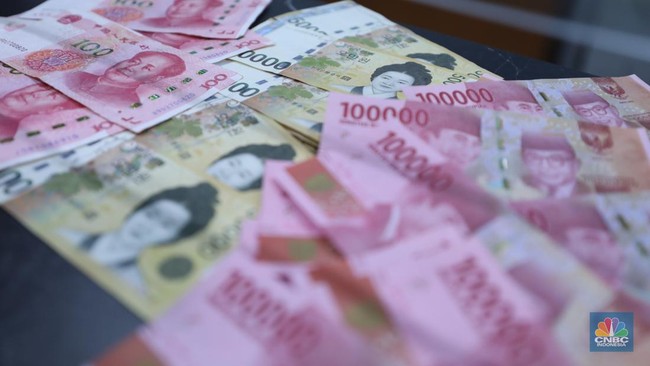
Jakarta, CNBC Indonesia - Nearly all Asian currencies moved stronger against the US dollar on Wednesday morning’s trading (8/4/2026). This comes alongside the weakening of the US dollar index (DXY) amid news of easing tensions in the Middle East war.
According to Refinitiv data, as of 09:15 WIB, out of eleven monitored Asian currencies, ten strengthened and only one weakened against the greenback.
The largest gain was led by the South Korean won, which rose 1.22% to KRW 1,478.4/US.TheThaibahtfollowed, strengthening1.2, while the Philippine peso gained 1.14% to PHP 59.51/US$.
Strengthening was also seen in the Malaysian ringgit, which rose 0.97% to MYR 3.98/US.TheJapaneseyenstrengthened0.79, followed by the Singapore dollar, which rose 0.57% to SGD 1.27/US$.
No less impressively, the rupiah was observed to strengthen by up to 0.56% to Rp16,995/US, orbackbelowitspsychologicallevelofRp17, 000/US. This condition is expected to hold until the close of trading today.
Next, the Indian rupee strengthened 0.48% to INR 92.39/US, theChineseyuanrose0.36, and the Taiwanese dollar strengthened 0.33% to TWD 31.78/US$.
Meanwhile, the only currency still in the red zone is the Vietnamese dong, which failed to move positively, weakening 0.1% to VND26,331/US$.
This directional movement aligns with the weakening of the US dollar index (DXY), which at the same time fell 0.95% to 98.914. The dollar’s weakness also pushed the DXY to its lowest level in the past two weeks, in line with improving global risk sentiment.
From an external perspective, the US dollar came under pressure after US President Donald Trump delayed his threat to attack Iran’s civilian infrastructure for two weeks. Trump described the move as a “double-sided ceasefire”, on the condition that Iran reopens the Strait of Hormuz. Trump also stated that the US has received a 10-point proposal from Iran, which he assessed could serve as a basis for negotiations.
In other developments, Iran is reported to have agreed to reopen the strategic route for two weeks provided all attacks are halted. Israel is also said to have approved the ceasefire. This combination of news has eased market concerns over the risk of global energy supply disruptions.
Ultimately, the easing of geopolitical tensions has reduced demand for the US dollar as a safe-haven asset, thereby opening room for the majority of Asian currencies to strengthen in this morning’s trading.